 Ferndale Siding
 Why Birch Bay Siding Wears Differently Than Inland Ferndale
Birch Bay sits right on the water, and that changes what siding has to survive. Homes a few miles inland in Ferndale deal with Whatcom County's wet winters and shoulder-season moss, but Birch Bay adds a layer most inland properties never see: salt-laden air blowing straight off the bay, driving rain pushed sideways by wind off the water, and long stretches of shaded, damp siding that never fully dries between storms. We've replaced siding on enough Birch Bay homes to know the failure patterns are consistent — and they're not the same failures we see on a Ferndale property set back from the water.
Salt air is corrosive to exposed metal fasteners and trim, and it accelerates the breakdown of finishes that aren't built to handle it. Combined with near-constant coastal humidity, siding in Birch Bay is under more sustained stress than siding almost anywhere else in Whatcom County. That's the starting point for any honest conversation about replacing it.
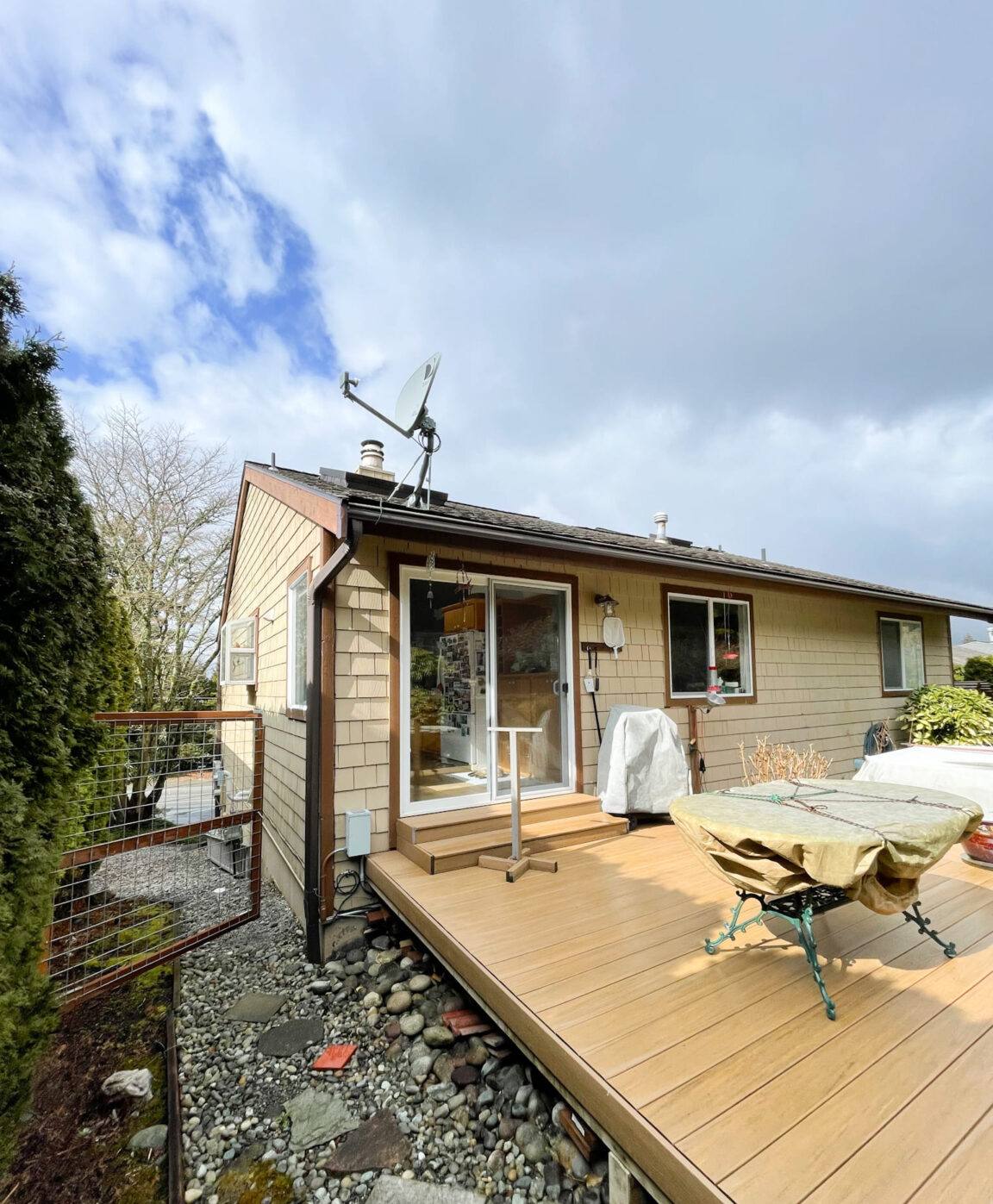
What Salt Air, Driving Rain, and Moss Actually Do to Siding
Salt Air
Airborne salt settles on siding surfaces and works into seams, fastener heads, and any spot where a finish has started to thin. Over years, it contributes to premature paint failure, corrosion at exposed nail heads, and a chalky, degraded look on lower-grade materials. Products that rely on a field-applied paint job are especially vulnerable — salt exposure shortens repaint cycles compared to the same product installed a few miles inland.
Driving Rain and Wind-Driven Moisture
Birch Bay's exposure to open water means wind-driven rain hits siding at an angle, not just straight down. That pushes water into laps, seams, and butt joints that would stay dry in a more sheltered location. Any siding system with weak water management at the seams — or installed without correct flashing and clearances — is going to show it first in a home this exposed.
The Long Moss Season
Shaded, north-facing, and tree-adjacent walls in this part of Whatcom County stay damp for months at a stretch. Moss and algae need sustained moisture to take hold, and Birch Bay's combination of marine humidity and tree cover gives them exactly that. Once organic growth establishes on a porous or textured surface, it holds even more moisture against the wall — which speeds up whatever degradation is already happening underneath.
What a Correct Siding Job in Birch Bay Actually Involves
Replacing siding here isn't just swapping old boards for new ones. Given the exposure, a few things matter more in Birch Bay than they would on a sheltered inland lot:
- Weather-resistive barrier and flashing details done right — every window, door, and penetration needs correct flashing and a properly lapped water-resistive barrier behind the siding, because wind-driven rain will find any gap.
- Rainscreen or proper drainage clearance — a small air gap behind the siding lets bulk water drain and the wall assembly dry, instead of trapping moisture against the sheathing.
- Correct fastening for coastal exposure — fastener choice and placement matter more here; corrosion-resistant fasteners installed to manufacturer spec reduce the corrosion and staining that salt air accelerates.
- Factory-cured finish, not field paint — a finish baked on at the factory holds up to salt and UV exposure far better than a field-applied coat, and it doesn't leave a fresh, unweathered surface waiting to be primed and painted on-site.
- Proper clearance from grade, decks, and roof lines — siding installed too close to grade, a deck surface, or a roofline stays damp longer and is the first place moss and rot show up.
Why We Install Only James Hardie Fiber Cement in Birch Bay
We've stood in front of enough failed siding jobs on this stretch of coastline to be blunt about it: this environment punishes products that can't handle sustained moisture and salt exposure. That's why we install James Hardie fiber cement exclusively — not vinyl, not LP SmartSide, not primed wood, not cedar.
Fiber cement is non-combustible and dimensionally stable, meaning it doesn't expand, contract, warp, or cup the way wood-based products can when they're cycling through wet and dry conditions constantly. James Hardie's ColorPlus factory finish is baked on and warrantied against fading and peeling — a real advantage in a location where a field-applied paint job is going to take more abuse than almost anywhere else in the county. And Hardie's HZ5 product line is specifically engineered for cold, wet climate zones like ours, with formulations built to resist moisture-related damage over the long term.
We're not saying every alternative product is bad everywhere. LP SmartSide, vinyl, and wood siding all have their place, and homeowners considering them for a sheltered inland property have real reasons to weigh in their favor. But on a home a short walk from saltwater, with wind-driven rain and a moss season that runs most of the year, we've made the call: we only put our name behind a product engineered to take that punishment and still look right ten and twenty years out.
Comparing Common Siding Choices for a Coastal Whatcom County Home
| Factor | James Hardie Fiber Cement | Vinyl | Wood / Primed Spruce / Cedar |
|---|---|---|---|
| Salt air resistance | Engineered coastal-grade lines (HZ5), factory finish resists salt-driven fade | Can become brittle and discolored with prolonged UV and salt exposure | Finish breaks down faster near saltwater, needs more frequent repainting |
| Moisture / rot behavior | Non-combustible, doesn't rot; engineered for wet climates | Doesn't rot itself, but traps moisture behind it if installed poorly | Prone to rot and moss growth without diligent, ongoing maintenance |
| Finish durability | Factory-applied ColorPlus finish, long warranty on color | Color is molded in, can fade and chalk over time | Field-applied paint, shortest repaint cycle in this environment |
| Fire resistance | Non-combustible | Combustible, can melt or deform near heat sources | Combustible |
| Long-term maintenance | Occasional wash, no repainting for the life of the finish warranty | Low maintenance but can crack and is hard to color-match if damaged | Regular repainting, caulking, and moisture monitoring required |
How Our Process Works
Every Birch Bay project starts with a walk of the exterior, checking for the specific things this location tends to expose: soft spots near grade, moss buildup on shaded walls, corrosion at fasteners and trim, and any sign that water has been getting behind the existing siding. From there:
- Assessment — we identify problem areas, check the condition of the sheathing and water-resistive barrier where accessible, and note anything specific to your home's exposure to wind and water.
- Removal and inspection — old siding comes off and we inspect what's underneath before anything new goes up. This is where hidden moisture damage from a previous installation usually shows up.
- Weather barrier and flashing — a correctly lapped water-resistive barrier and proper flashing at every window, door, and penetration, sized for the wind-driven rain this location sees.
- Hardie installation to spec — installed per James Hardie's fastening, clearance, and coastal exposure guidelines, not shortcuts that might pass in a more sheltered location.
- Final detailing — trim, caulking, and touch-up finish work checked against manufacturer standards before we call the job done.
Why Hiring a Crew That Already Works Birch Bay Matters
A siding installer who mostly works sheltered, inland neighborhoods can do a technically fine job and still miss the details that matter here. Fastener spacing that's adequate inland can be marginal on a wall taking direct wind off the water. Clearance details that are fine on a dry, sunny lot can leave a shaded, damp Birch Bay wall staying wet too long. A crew that already knows this stretch of coastline knows where moss tends to establish first, which walls take the worst of the wind-driven rain, and what clearance and flashing details actually hold up here — because they've gone back and looked at their own work years later.
That local track record is worth more than a lower bid from a crew unfamiliar with coastal exposure. Siding is a decade-plus investment; getting the install details right the first time matters more here than almost anywhere else in Whatcom County.
Signs Your Birch Bay Home's Siding Needs Attention
- Moss or algae established on shaded or north-facing walls, especially if it keeps coming back after cleaning
- Paint or finish that's chalking, peeling, or fading faster than you'd expect for its age
- Soft or spongy spots when you press on the siding, particularly near the ground, decks, or roof lines
- Rust streaks or corrosion around fastener heads and trim
- Visible warping, cupping, or gaps opening up at seams and joints
- A musty smell or moisture inside near an exterior wall, which can point to water getting behind the siding
Any one of these on its own might just need monitoring. Several together, especially on a wall exposed to the water, usually means it's worth having someone look at the whole system rather than patching one spot.
What Replacement Involves — Setting Realistic Expectations
Full siding replacement is a bigger project than a repair, and in Birch Bay it often turns up more than what's visible from the outside — trapped moisture, damaged sheathing, or flashing that was never installed correctly the first time. Costs vary based on the size of the home, how much of the substrate needs repair before new siding goes on, trim and detail work, and the specific Hardie products and finish chosen. We won't give you a number without seeing the house, but we'll walk you through exactly what we find and why each piece of the scope is necessary — no guessing, no padding.
If your Birch Bay home's siding is showing its age, or you just want an honest read on where it stands, we're happy to come take a look. Reach out for a free, no-pressure estimate — the form below gets you started.