 Ferndale Siding
 Siding in Nooksack: Built for Whatcom County Weather
Nooksack sits inland from the coast but still lives inside the same weather system that soaks all of Whatcom County — long wet winters, a marine layer that pushes moisture and salt air in from the Strait of Georgia, and a stretch of shoulder-season months where everything outdoors stays damp for weeks at a time. Homes here take that punishment on every exposed wall, year after year. Siding is the first thing standing between that climate and the framing underneath it, and around Nooksack and Ferndale, the siding that gets chosen matters more than it does in drier parts of the state.
We're a Ferndale-based exterior contractor working siding, roofing, windows, and decks throughout this part of Whatcom County, including Nooksack and the surrounding rural and residential properties. This page walks through what local homes are actually up against, how we approach a siding replacement here, and why we've standardized on one product — James Hardie fiber cement — instead of offering the full menu of options most siding companies sell.
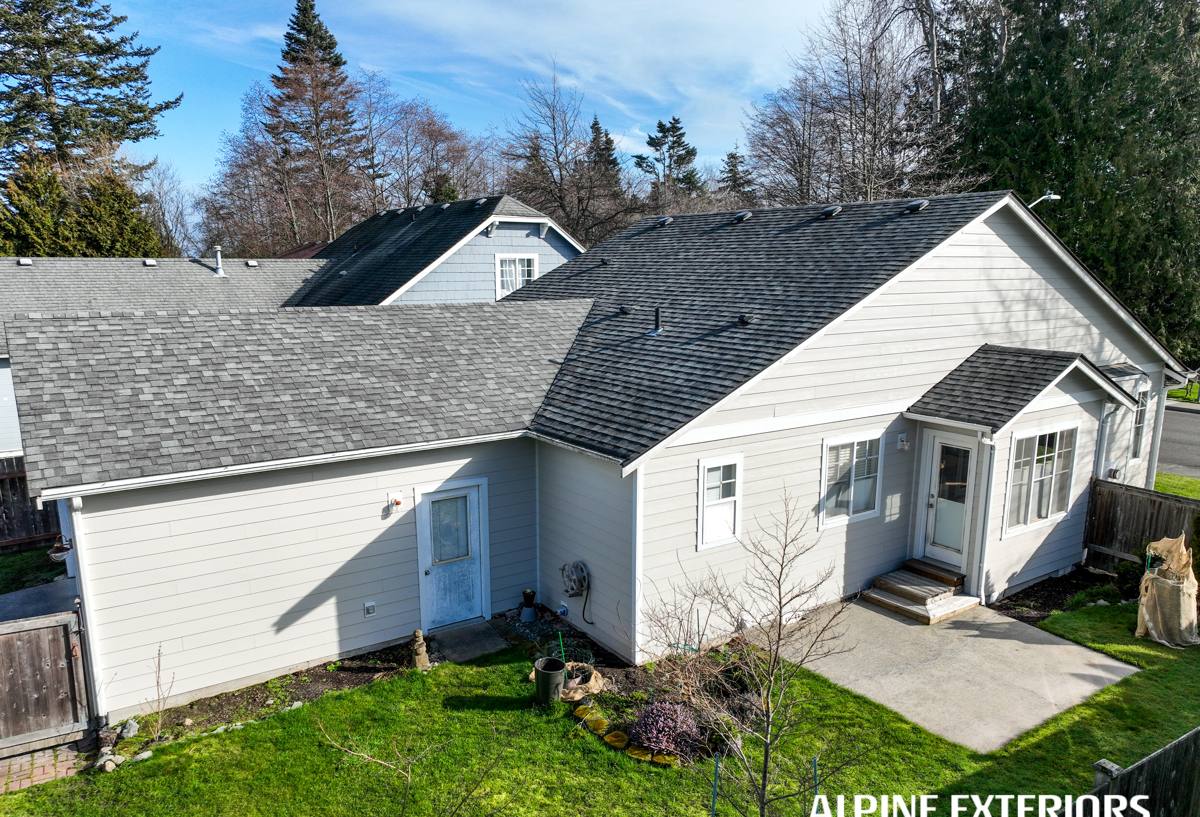
What the Local Climate Does to Siding
Nooksack doesn't get hurricane weather, but it gets something arguably harder on a house: persistence. The combination of driving rain, salt-tinged marine air, and a moss season that can run from fall through spring creates conditions that wear down the wrong siding material slowly and quietly, often before a homeowner notices anything is wrong.
Driving Rain and Wind-Driven Moisture
Storms coming off the water don't just drop rain straight down — wind pushes it sideways into wall assemblies, seams, and butt joints. Any siding product with weak joint performance or a tendency to absorb water at the edges is going to take on moisture over and over through the wet season, and that moisture has to go somewhere. Repeated wetting and drying cycles are one of the main reasons siding fails early in this region.
Salt Air
Even set back from the immediate shoreline, homes in this area sit within reach of salt-laden air moving off the Strait and Bellingham Bay. Salt accelerates corrosion on fasteners and trim hardware, and it degrades certain paints and coatings faster than inland climates would. Siding that isn't engineered with a coastal-adjacent environment in mind tends to show fading, chalking, or fastener staining sooner here than the manufacturer's marketing suggests.
Moss, Mildew, and a Long Wet Season
Whatcom County's moss season is long, and it isn't limited to roofs. North-facing walls, shaded siding runs under trees, and areas with poor airflow collect moss and mildew growth that traps moisture against the surface. On wood-based products, that trapped moisture is a direct path to rot. On products with weak factory finishes, it's a path to peeling paint and visible staining within a handful of years.
Why We Install Only James Hardie Fiber Cement
Most exterior contractors sell whatever the homeowner asks for — vinyl, LP SmartSide, cedar, whatever's cheapest that week. We don't. Every siding job we install is James Hardie fiber cement, and that's a deliberate standard, not a sales preference.
We made that call because of exactly the conditions described above. Fiber cement is a cement, sand, and cellulose fiber composite — it doesn't have the moisture-absorption problems of wood-based siding, and it doesn't have the expansion, contraction, and impact vulnerability that comes with vinyl. James Hardie is the manufacturer we trust to back that material with real engineering and a finish system that holds up.
Non-Combustible
Fiber cement is non-combustible, which matters in Washington regardless of how far a property sits from wildland areas — it's simply a safer material to put on a home, full stop.
Climate-Engineered Product Lines
James Hardie builds regional formulations — HZ5 for colder, wetter climates like ours — specifically to handle freeze-thaw cycling and sustained moisture exposure better than a one-size-fits-all product. That's a meaningful difference for a place with Nooksack's weather pattern.
ColorPlus Factory Finish
Rather than relying on field-applied paint, Hardie's ColorPlus finish is baked on at the factory in multiple coats, resists fading and chipping far better than most site-applied paint jobs, and comes backed by its own finish warranty separate from the product warranty.
Warranty Strength
Hardie backs its siding with a long, transferable limited warranty — a real asset when a home changes hands, and a sign the manufacturer is confident in how the product performs over decades, not just years.
We won't install LP SmartSide, vinyl, Cemplank, Allura, primed spruce, or raw cedar siding. Some of those are reasonable products in the right context — we simply don't think they hold up to this specific climate as well as Hardie does, and we'd rather turn down work than install something we don't believe in for a Whatcom County home.
James Hardie Product Lines We Work With
| Product | Best For | Look |
|---|---|---|
| HardiePlank Lap Siding | Most home styles, primary siding field | Classic horizontal lap, smooth or cedar-textured |
| HardiePanel Vertical Siding | Board-and-batten, modern or farmhouse styles | Vertical panels with batten strips |
| HardieShingle | Accent gables, dormers, Craftsman-style homes | Staggered or straight-edge shingle profile |
| HardieTrim | Corners, window and door casing, fascia | Smooth finish, paired with any siding line |
How a Siding Replacement Works, Start to Finish
A siding job around Nooksack usually follows the same core sequence, though the details shift depending on the home's age, current siding, and how much water intrusion or hidden damage turns up once the old material comes off.
- On-site evaluation — we walk the exterior, check for soft spots, existing moisture damage, and trouble areas like north-facing walls or spots with poor drainage.
- Tear-off — removal of the existing siding down to the sheathing, which is also when hidden rot or water damage becomes visible and gets addressed.
- Weather-resistive barrier and flashing — a correctly installed drainage plane and flashing details around windows, doors, and penetrations, since this is the layer that actually keeps wind-driven rain out of the wall assembly.
- Hardie installation to manufacturer spec — proper fastener spacing, clearances, and joint treatment, all of which affect how the warranty holds up later.
- Trim and finish detail — corners, trim boards, and caulking done to shed water rather than trap it.
- Final walkthrough — a check of the finished work with the homeowner before we call the job done.
Installation quality matters as much as the product itself. Fiber cement installed with the wrong fastener pattern, insufficient clearance at grade, or poor flashing will still develop problems — Hardie's own warranty terms depend on correct installation, which is one more reason to use a crew that installs it regularly rather than occasionally.
Beyond Siding: Roofing, Windows, and Decks
Siding doesn't work in isolation — it's one piece of a home's exterior envelope, and the same climate pressures that wear down siding around Nooksack hit roofing, windows, and decks too. We handle all four, which matters because problems in one area often show up as damage in another: a failing roof edge can rot the top course of siding, a leaking window can cause hidden wall damage long before it's visible from outside, and an aging deck ledger board is a common source of moisture intrusion into the house itself.
Because we work all four trades, we can flag issues in one area while we're already on-site for another, instead of a homeowner needing to bring in separate contractors who each only see their own slice of the problem.
What a Project Typically Costs
Every home is different, but these are the main factors that move the price of a siding project up or down. We don't quote sight-unseen — an actual estimate requires a walk of the property — but this gives a realistic sense of what drives cost.
| Factor | Why It Matters |
|---|---|
| Home size and wall complexity | More square footage and more corners, gables, and cutouts mean more labor and material |
| Current siding condition | Hidden rot or water damage found during tear-off adds repair work before new siding goes on |
| Product line and profile | Lap vs. panel vs. shingle accents, and plank width, affect material cost |
| Trim and detail work | Extensive trim, window casing, and accent details add labor time |
| Access and site conditions | Steep lots, tree cover, or tight access can slow the job down |
Why a Local Crew Matters Here
A contractor based in Ferndale who works this specific stretch of Whatcom County sees the same failure patterns repeatedly — the same north-facing walls that hold moss, the same trim details that trap water near grade, the same fastener corrosion patterns from salt air. That familiarity shapes how we detail flashing, where we pay extra attention to drainage, and which spots on a given home style tend to be the weak points.
It also means we're accountable locally. If something needs a follow-up visit, we're not driving in from out of the area — we're already working in Nooksack, Ferndale, and the towns around them on a regular basis.
Signs Your Siding May Need Attention
- Visible moss or dark streaking on north-facing or shaded walls
- Soft spots or give when pressed, especially near the bottom courses
- Peeling, bubbling, or chalking paint that keeps coming back after repainting
- Gaps or separation at seams, corners, or trim boards
- Warping, cupping, or visible swelling in panels or planks
- Rising energy bills that may point to compromised insulation behind failing siding
Get a Free, No-Pressure Estimate
If your home in Nooksack or the surrounding Ferndale area is showing signs of wear, or you're just planning ahead, we're happy to take a look and give you a straight answer about what we'd recommend and why. There's no pressure and no obligation — just a local crew's honest read on your home's exterior. Use the form below to request a free estimate.