 Ferndale Siding
 Bellingham's Exterior Climate Problem
Bellingham sits right on the water, framed by Bellingham Bay to the west and the foothills of the Cascades to the east, which gives it a exterior climate that's tougher on a home than most homeowners realize until they're dealing with the damage. The bay puts salt-laden air into the wind that moves through the city, and that air doesn't stay near the water — it travels with the weather up into neighborhoods well away from the shoreline. Add the region's long, wet fall-through-spring stretch, with rain that often comes in sideways off the Strait of Georgia rather than falling straight down, and you've got siding, trim, and roofing that stay damp for days at a time rather than drying out between storms.
Then there's moss. Whatcom County's combination of moisture, mild temperatures, and heavy tree cover means algae and moss don't just grow on roofs here — they colonize north-facing siding, shaded trim, and anywhere water sits or airflow is blocked. On a lot of Bellingham homes, especially older craftsman and mid-century houses with mature landscaping, that green film shows up on siding within a year or two of a wash, and it's more than cosmetic. Moss holds moisture against the wall assembly, and sustained moisture is what breaks siding down from the inside, regardless of what material it's made of.
Why We Standardized on James Hardie Fiber Cement
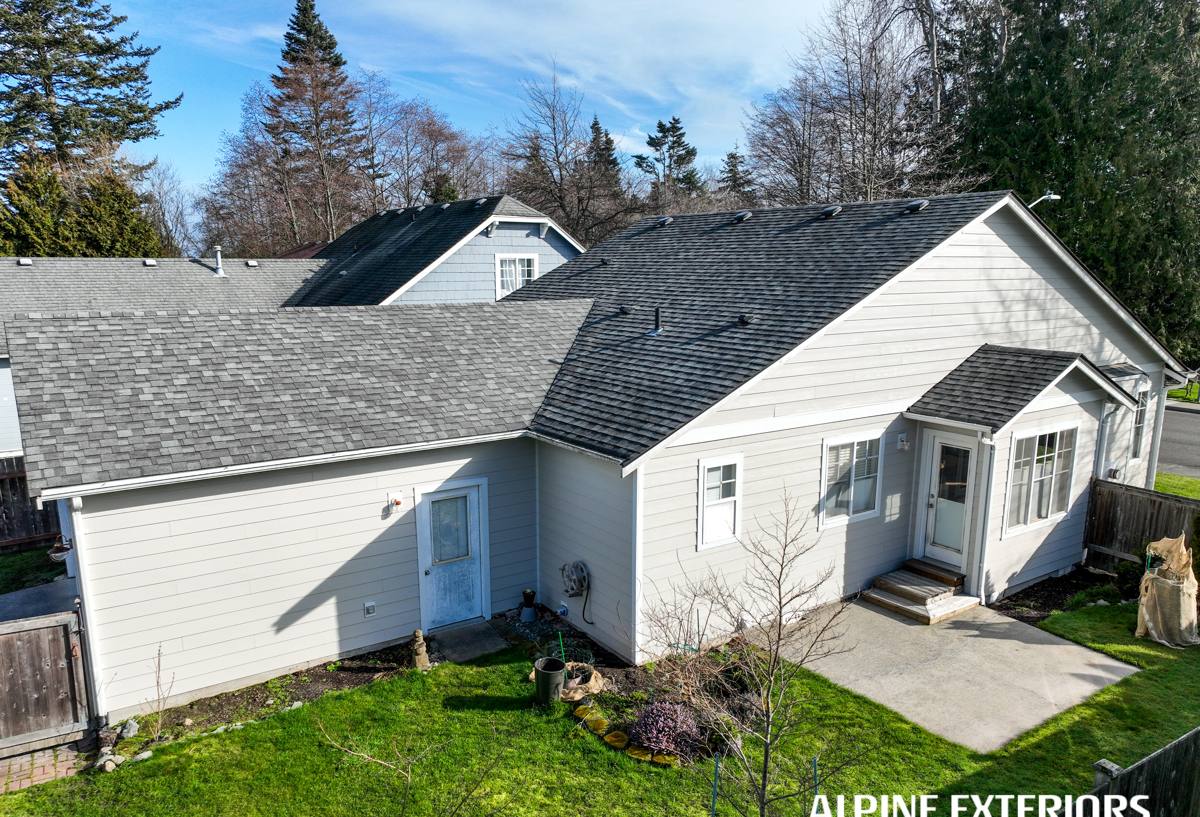
We install James Hardie fiber cement siding exclusively. We don't install vinyl, LP SmartSide, cemplank, Allura, primed spruce, or cedar, and that's a deliberate professional standard, not a sales angle. In a climate like Bellingham's, the material you put on a wall has to handle sustained dampness, salt air, and moss pressure year after year without becoming a maintenance project. Fiber cement is non-combustible, dimensionally stable in changing moisture conditions, and it takes Hardie's factory-applied ColorPlus finish, which holds color and resists the kind of fading and streaking that salt air and UV accelerate on painted or stained surfaces.
What This Means in Practice
Homes near the water in Bellingham take more airborne salt exposure than homes further inland in Whatcom County, and it shows up as pitting and corrosion on fasteners, trim, and lower-grade siding materials over time. Hardie's product lines are engineered with regional climate zones in mind — the HZ5 formulation used in the Pacific Northwest is built for freeze-thaw cycling and moisture exposure specifically, which matters more here than in drier climates where a general-purpose product might hold up fine.
Where the Common Alternatives Fall Short Here
Every siding material has honest trade-offs, and we'd rather explain them plainly than pretend one product is perfect.
Cedar
Cedar looks great and has a long track record in the Pacific Northwest, but it's a natural wood product, and wood needs a maintenance schedule — recoating, caulking, and vigilant moisture management — to hold up against a climate this wet. Skip a maintenance cycle or two in Bellingham's rain, and cedar starts cupping, checking, or hosting exactly the kind of moss and mildew growth this region is known for.
Vinyl
Vinyl is inexpensive and low-maintenance in the sense that it doesn't need painting, but it's a thin plastic product that can warp with heat and impact, and its seams and butt joints give moisture more places to find a way behind the cladding over a long wet season. It also doesn't offer the same fire resistance as fiber cement, which matters more each year given Washington's wildfire seasons.
LP SmartSide and Other Engineered Wood
Engineered wood products have improved a lot over the years, but they're still wood-based at the core, meaning the cut edges and any breach in the factory coating are vulnerable to moisture intrusion. In a climate where siding rarely gets a long dry stretch to recover, that's a real long-term risk we're not willing to take on for a Bellingham install.
| Material | Moisture Resistance | Maintenance | Typical Lifespan Locally |
|---|---|---|---|
| James Hardie Fiber Cement | Strong — engineered for PNW moisture | Low; occasional wash | 30+ years with correct install |
| Cedar | Moderate; needs a dry envelope | High; recoat/caulk on a schedule | 15-25 years with upkeep |
| Vinyl | Moderate; seams are weak points | Low, but limited repairability | 20-25 years |
| LP SmartSide | Moderate; edge sealing is critical | Moderate; edge/joint inspection | 20-25 years |
Installation Details That Matter in a Coastal Climate
Material choice only gets a Bellingham home halfway there. The other half is installation — and this is where a lot of siding problems in this region actually start, regardless of what product is on the wall.
Rain Screens and Drainage
Given how much sustained rain and humidity Whatcom County sees, we build in a drainage gap behind the siding wherever the wall assembly allows it, so bulk water and trapped moisture have somewhere to go instead of sitting against the sheathing. This matters even more on shaded, north-facing walls and anywhere landscaping or tree canopy blocks airflow and slows drying.
Flashing and Trim Details
Window heads, door casings, and butt joints are the spots where water finds its way behind siding, and it's almost always a flashing or sealant detail that failed, not the siding material itself. Correct flashing at every penetration, proper overlap at joints, and factory-mitered or properly sealed corners are non-negotiable parts of a Hardie install for us.
Fastener Selection
Salt air corrodes the wrong fasteners over time, so we use corrosion-resistant fasteners rated for coastal exposure rather than standard hardware, especially on homes closer to the bay.
Roofing, Windows, and Decks: The Whole Envelope
Siding doesn't work in isolation — it's one piece of a home's exterior envelope, and in a climate that stays wet as long as Bellingham's does, the roof, windows, and siding all need to work together to keep water out and moisture moving. We handle all four (siding, roofing, windows, and decks) so we can look at a home as one connected system rather than patching one component while ignoring how it interacts with the others.
Roofing
A roof that's shedding granules, holding moss, or leaking at a valley or flashing point will send water down behind siding it was never designed to handle. Moss on a roof here isn't just a shingle issue — left unchecked, it holds moisture against the roof deck and can work its way toward fascia and siding below.
Windows
Old or poorly flashed windows are one of the most common sources of hidden water intrusion we find when we open up a wall during a siding replacement. Replacing siding is a natural point to also address window flashing or aging window units, since the wall is already open.
Decks
Decks in this climate face the same sustained moisture exposure as siding, plus foot traffic and structural load, so ledger board flashing and proper drainage away from the house are just as important here as anywhere on the exterior.
Signs a Bellingham Home Needs Exterior Attention
- Green or black staining on siding, especially on shaded or north-facing walls
- Paint that's bubbling, peeling, or failing faster than expected between coats
- Soft spots or visible warping in wood-based siding or trim
- Rust streaking near fasteners, hardware, or metal flashing
- Visible gaps or separation at seams, corners, or window trim
- Persistent musty smell near exterior walls, which can indicate trapped moisture
- Moss buildup on the roof that's migrating toward gutters and fascia
What Working With a Local Crew Looks Like
We're based in Ferndale, in Whatcom County, which means the crew showing up at a Bellingham home already understands the local conditions — the salt exposure near the bay, the shaded lots under mature trees, the moss pressure that builds through a long wet season — without needing it explained. That local knowledge shapes real decisions on the job: where we prioritize drainage detailing, which fastener spec we use, and how we sequence work around this region's weather windows rather than working off a generic install checklist written for a drier climate.
It also means accountability doesn't disappear once the crew leaves. A local company has a reputation in this county to maintain, and that's a different incentive structure than an out-of-area crew that's on to the next job in another region entirely.
Cost Factors for a Bellingham Siding Project
| Factor | Why It Affects Cost |
|---|---|
| Home size and wall complexity | More square footage, corners, and trim details mean more material and labor |
| Extent of existing damage | Rot or moisture damage found during tear-off requires sheathing repair before new siding goes on |
| Siding profile and trim package | Lap width, trim style, and accent details affect material cost |
| Access and site conditions | Steep lots, mature landscaping, or limited access can add labor time |
| Scope beyond siding | Bundling roofing, window, or deck work can affect overall project cost and sequencing |
Every home is different, and the only way to get real numbers is to have someone look at the actual house, the actual exposure, and the actual condition of what's there now.
Get an Honest Look at Your Home
If you're in Bellingham and noticing moss, staining, or aging siding, trim, roofing, or decking, we're happy to come take a look and give you a straight assessment of what's actually going on and what your options are. There's no pressure and no obligation — just a local crew willing to tell you the truth about your home's exterior. Fill out the form below to request a free estimate.