 Ferndale Siding
 Why Blaine's Coastal Climate Is Hard on Siding
Blaine sits about as close to the water and the Canadian border as a Whatcom County home can get, and that location comes with a specific set of exterior problems. Salt-laden air moves in off the bay and settles on everything, including your siding. Add driving rain that comes in sideways during winter storms, near-constant humidity, and long stretches of shade and dampness that never fully dry out, and you have a climate that is genuinely tougher on a home's exterior than what you'll find a few miles inland.
None of this means Blaine homes are doomed to constant repair. It means the materials and installation details that work fine in a drier, more sheltered part of the county don't always hold up the same way here. We've replaced siding on enough coastal Whatcom County homes to know which failure points show up first in this environment, and we build our installations around avoiding them.
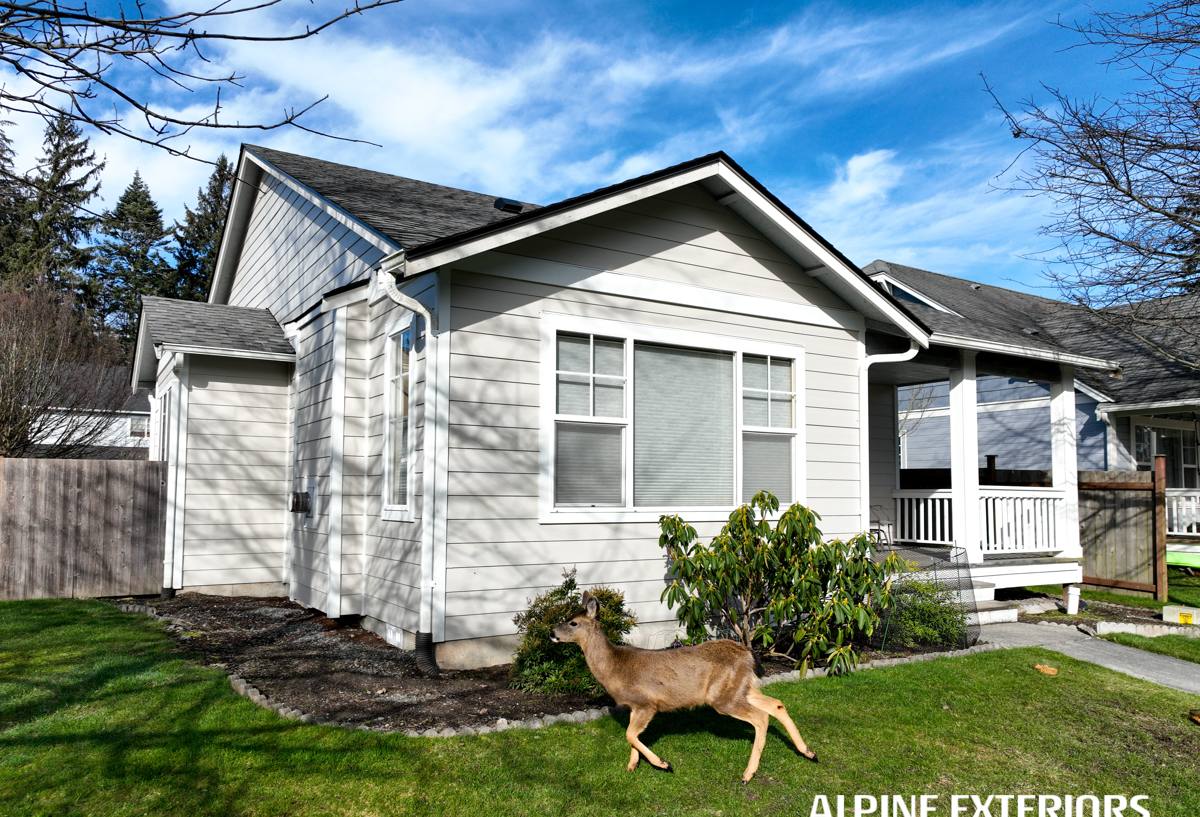
What Salt Air, Rain, and Moss Do to Different Siding Materials
Every siding material reacts differently to a marine environment. Salt accelerates corrosion on fasteners and trim. Constant moisture feeds moss and algae growth, especially on north-facing walls and anything shaded by trees or a neighboring structure. Wind-driven rain finds every gap in flashing and caulk that a calmer climate would never expose.
| Material | Salt Air Behavior | Moisture & Moss Behavior | Long-Term Maintenance |
|---|---|---|---|
| Vinyl | Can chalk, fade, and become brittle faster near salt air | Traps moisture behind panels if installed loosely; moss grows readily on the surface | Low upfront effort, but panels warp or crack over time and can't be spot-repaired invisibly |
| Primed wood / cedar | Salt accelerates paint and primer breakdown | Absorbs moisture, feeds rot in shaded, damp areas | Frequent repainting and caulk maintenance; highest long-term labor |
| LP SmartSide (engineered wood) | Edge and seam exposure is a real risk near salt spray | Vulnerable at cut edges and butt joints if moisture gets in | Manufacturer specifies strict caulking and paint maintenance schedules |
| James Hardie fiber cement | Non-combustible, dimensionally stable material resists salt-driven breakdown | Doesn't absorb and swell the way wood-based products do; factory finish resists moss adhesion better than bare wood | Lowest ongoing maintenance when installed correctly with proper gaps and flashing |
The table above is about behavior, not brand-bashing — every one of these products has a place somewhere. But for a home exposed to salt air and standing moisture on a regular basis, the margin for error with wood-based and vinyl products is smaller, and the consequences of a missed detail show up sooner.
Why We Install Only James Hardie Fiber Cement
This company made a decision to install James Hardie fiber cement siding exclusively, and coastal exposure like Blaine's is a big part of why. Hardie is non-combustible, holds its shape in wet-dry cycling far better than wood-based alternatives, and comes with a factory-applied ColorPlus finish that's baked on rather than field-painted, which matters a lot in an environment where paint film failure is a constant threat.
Hardie also builds climate-specific product engineering into its line. The HZ5 formulation is designed for regions that see the kind of moisture cycling and freeze-thaw swings the Pacific Northwest delivers, as opposed to a one-size-fits-all board. Combined with a transferable manufacturer warranty, that's a meaningfully different proposition than a product optimized mainly for cost or ease of handling.
We don't install vinyl, LP SmartSide, Cemplank, Allura, or primed spruce or cedar siding. Each of those has legitimate uses in the right setting, but we've made the call that for the homes we work on — many of them exposed to wind, rain, and salt air the way Blaine properties are — Hardie fiber cement is the product that holds up with the least amount of homeowner maintenance over the life of the siding.
What "ColorPlus" Actually Buys You
ColorPlus finish is a multi-coat, factory-cured color process rather than paint rolled or sprayed on-site after installation. In a marine climate, that matters because the finish bonds to the board under controlled conditions instead of curing outdoors in variable humidity. It resists fading and chipping better than field-applied paint and comes with its own finish warranty separate from the substrate warranty.
What Correct Installation Looks Like in a Coastal Setting
Fiber cement siding performs the way it's supposed to only when it's installed to spec. In a place like Blaine, a few details matter more than they would inland.
Flashing and Water Management
Every window, door, and horizontal trim piece needs flashing detailed to shed water outward, not trap it against the wall assembly. Driving rain off the bay will find any shortcut here faster than it would in a sheltered inland yard.
Gaps, Fasteners, and Clearances
Hardie specifies minimum gaps at butt joints and clearance from decks, roof lines, and grade. Fasteners need to be corrosion-resistant and set to the manufacturer's depth and spacing — over-driven or under-driven nails are one of the most common causes of premature siding failure, and salt air punishes the wrong fastener choice faster than it does elsewhere.
House Wrap and Drainage Plane
A functioning drainage plane behind the siding gives any moisture that does get past the surface somewhere to go besides your sheathing. This is standard practice everywhere, but it's not optional in a climate that stays damp as long as Blaine's does.
Signs Your Blaine Home Needs New Siding
- Persistent moss or dark streaking that comes back within weeks of cleaning, especially on shaded or north-facing walls
- Soft spots, bubbling, or visible warping in wood-based or engineered wood siding
- Cracked or brittle panels, particularly on vinyl exposed to direct wind and salt spray
- Paint that's chalking, peeling, or failing faster than the repaint cycle you'd expect inland
- Visible gaps, separated seams, or trim pulling away from the wall
- Rising energy bills that suggest the wall assembly behind the siding is no longer doing its job
- Rot or soft wood you can find with a screwdriver test at the base of walls or around window trim
Beyond Siding: Roofing, Windows, and Decks in a Coastal Environment
Siding is rarely the only part of a home's exterior under stress in Blaine. Roofing takes the same wind and rain exposure and benefits from the same attention to flashing and drainage detail. Windows are a common point of air and water infiltration if the flashing and sealant around them wasn't done right the first time, and replacing siding is often the right moment to address aging windows at the same time, since the wall is already open. Decks exposed to salt air and standing moisture need materials and fastener choices that account for the same corrosion and moisture cycling that affects siding. We handle all four — siding, roofing, windows, and decks — because they're connected systems on a coastal home, not separate projects.
What to Expect: Our Process for Blaine Homeowners
Assessment
We start with a walk-around of the home to look at the current siding condition, moisture damage if any is present, trim and flashing detail, and any other exterior work worth addressing at the same time.
Plan and Estimate
You get a clear scope of work and a written estimate before anything starts — no vague allowances, no pressure to decide on the spot.
Installation
Old siding comes off, the wall assembly gets inspected and repaired where needed, and Hardie fiber cement goes on to manufacturer spec, with attention to the flashing and fastening details that matter most in a coastal setting.
Final Walkthrough
We walk the finished job with you before calling it done.
Cost Factors for Siding Replacement in Blaine
| Factor | Why It Matters Here |
|---|---|
| Home size and wall complexity | More corners, gables, and trim detail mean more labor and flashing work |
| Extent of existing damage | Rot or moisture damage found behind old siding needs to be repaired before new siding goes on |
| Siding profile and color | Lap, shingle, and panel profiles vary in material and labor cost; ColorPlus finish options vary by line |
| Window and door count | Each opening adds flashing and trim work, which is especially important in a wind-driven-rain climate |
| Access and site conditions | Waterfront lots, steep grades, or limited access can affect scaffolding and staging |
We don't quote broad numbers without seeing the home, since the variables above genuinely change the scope. What we can tell you is that a proper coastal-grade installation costs more upfront than the cheapest available material and labor, and less over ten to twenty years than repeated repairs and repainting on something that wasn't built for this exposure.
Why a Local Crew Matters
A crew that works Whatcom County regularly knows the difference between how a wall performs in Bellingham and how it performs a few blocks from Boundary Bay. That's not a marketing point — it changes real decisions on the job, from where extra flashing attention goes to which walls are most likely to hold moss and need a slightly different detailing approach. We're not driving in from out of the area to do a job and move on; we're working in a climate we deal with on every project.
If your home in Blaine is due for new siding, or you want a second opinion on a repair that keeps coming back, we're glad to take a look. Request a free, no-pressure estimate using the form below and we'll walk the property with you and lay out exactly what we see.