 Ferndale Siding
 Building Exteriors for Life on Semiahmoo
Semiahmoo occupies one of the more exposed residential settings in Whatcom County — a narrow spit reaching out into Semiahmoo Bay near Blaine, with water pressing in from more than one direction. Homes and condos out here don't get the benefit of tree lines, hills, or neighboring structures to soften what comes off the water. Wind arrives with almost nothing to slow it down, salt air settles on every exterior surface, and the region's long wet season lingers longer here than it does a few miles inland. That combination puts real, measurable stress on siding, roofing, windows, and decks, and it's why exterior work on Semiahmoo needs to be approached differently than a standard inland remodel.
We handle siding, roofing, windows, and decks for homes in and around Semiahmoo, and we treat those four systems as one connected building envelope rather than four unrelated trades bid separately. Water that gets past a window doesn't stay at the window — it travels into the wall assembly and eventually shows up as siding damage, rot, or an interior stain nowhere near where the leak started. Understanding that connection is a big part of what separates exterior work that lasts thirty years from work that needs redoing in eight.
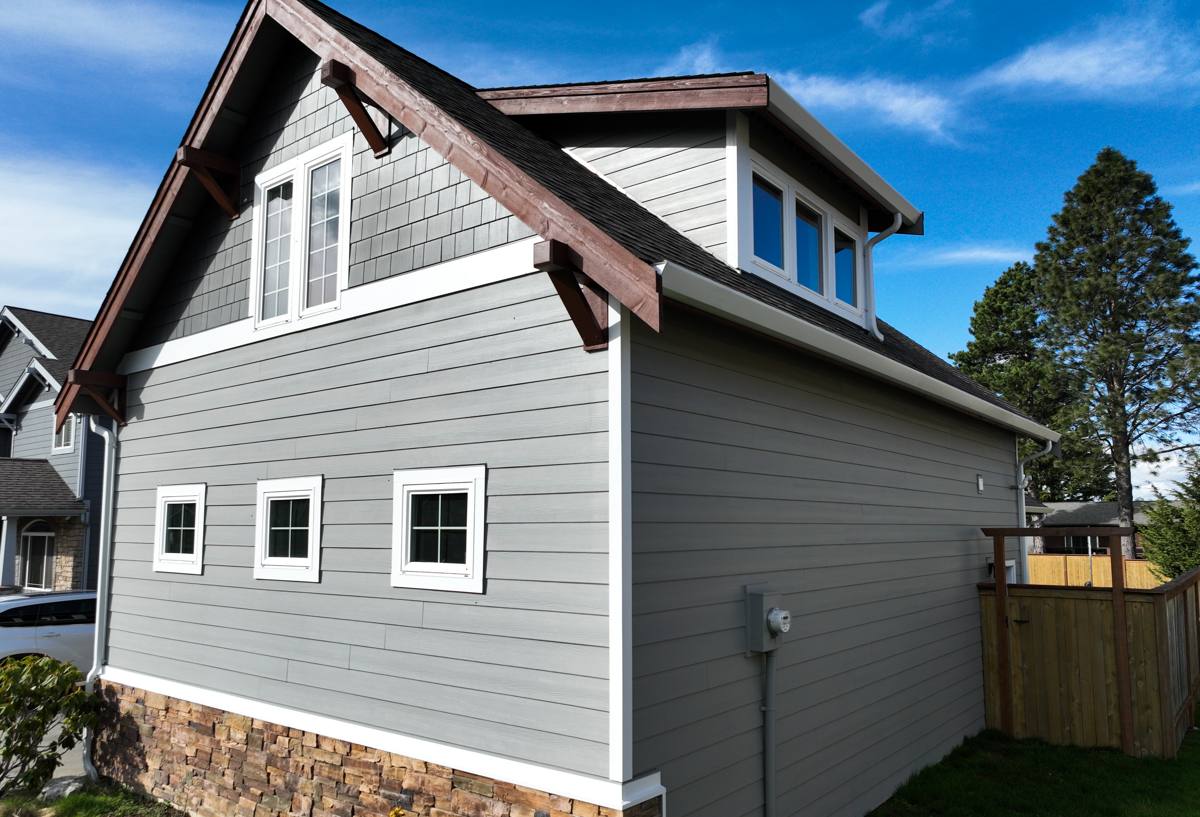
What the Spit Does to a House
Salt Air From More Than One Direction
Most coastal properties in Whatcom County deal with a single prevailing exposure to salt-laden air. Semiahmoo, sitting on a spit with water on multiple sides, doesn't get that break. Salt accelerates corrosion in fasteners, flashing, and any exposed metal trim, and it wears down lower-grade paints and finishes faster than a drier, more sheltered lot would ever see. On a property like this, corrosion resistance has to be part of the plan from the first fastener selected, not something addressed after rust streaks start showing up on the siding.
Wind-Driven Rain, Not Just Rainfall
Whatcom County's rainfall totals don't tell the whole story on Semiahmoo. With almost no windbreak, rain here often arrives sideways, driven by open wind straight off the bay, and it finds its way into wall assemblies, window flashing, and roof-to-wall transitions with a force that calmer inland sites rarely deal with. Installation details that perform fine on a sheltered lot in Ferndale proper can fail specifically because water is being pushed in laterally, through joints and laps never designed to handle that kind of pressure. This is one of the main reasons flashing and drainage detailing matter more here than almost anywhere else in the county.
A Long Moss and Mildew Season
Mild year-round temperatures, near-constant humidity, and shaded north-facing walls combine to give this part of Whatcom County a moss and mildew season that runs most of the year, and Semiahmoo's waterfront exposure doesn't shorten it. Roofs are usually the first place it shows up, followed by any porous or moisture-retentive siding material. Homes with mature landscaping, tight lot spacing, or heavy tree cover nearby tend to see it worst on the sides that get the least direct sun.
Why We Install Only James Hardie Siding
We didn't start out installing a single siding brand exclusively. That changed after years of service calls and tear-offs on exposed, salt-air properties like the ones out on Semiahmoo, where we kept seeing the same materials fail in the same predictable ways. The standard we settled on came from what we found in the field, not from a supplier relationship.
- Non-combustible core: Fiber cement doesn't feed a fire the way wood-based siding products can, which matters for both household safety and, in many cases, homeowner's insurance underwriting.
- Factory-applied ColorPlus finish: The color is baked on under controlled factory conditions rather than brushed on in the field, and it resists fading, chalking, and moisture intrusion far longer than site-applied paint.
- Climate-engineered HZ product lines: Hardie's HZ5 formulation is built specifically for regions with heavy moisture exposure and freeze-thaw cycling — a fit for waterfront Whatcom County.
- Dimensional stability: Fiber cement doesn't swell, cup, or warp the way engineered wood products can after repeated wetting through a long wet season.
- A strong transferable warranty: Hardie backs its product with one of the more substantial warranty structures in the industry, provided installation follows their published spec.
We do not install LP SmartSide, vinyl siding, Cemplank, Allura, primed spruce, or cedar. Every one of those products has a legitimate place in the market, and plenty of homeowners elsewhere are satisfied with them. But on an exposed property like this, we made a professional decision to stand fully behind one system rather than offer a lower-cost option that quietly shifts long-term maintenance risk onto the homeowner years down the road.
Installation Is Half the Performance
Fiber cement only performs the way it's engineered to when it's installed exactly to Hardie's published specifications — correct fastener type and spacing, proper clearance from grade and roof lines, drainage or rain-screen detailing where the assembly calls for it, and factory-mitered or properly caulked joints. A Hardie product installed loosely will still develop moisture problems in a climate like this one. The material is only as good as the crew putting it up.
Roofing Built for Wind and Moss
Roofing takes the most direct hit from this climate — sun, wind-driven rain, and moss all land on the roof plane before reaching anything else on the house. A roof system on Semiahmoo needs correct underlayment, properly lapped flashing at every penetration and wall transition, and ventilation that lets the attic and roof deck dry out between storms instead of trapping moisture against the sheathing. We treat those fundamentals as the baseline on every roof we build or repair here, not as an optional upgrade, because a roof that cuts corners on flashing or ventilation shows it within a few wet seasons.
Signs a Semiahmoo Roof Needs a Closer Look
- Moss buildup in valleys or on shaded, north-facing slopes that keeps returning after cleaning
- Granule loss showing up in gutters or at the base of downspouts
- Soft spots, sagging, or visible daylight in the attic near roof-to-wall transitions
- Interior ceiling stains near exterior walls, especially after a windy storm off the water
- Flashing that's visibly lifted, rusted, or missing sealant around chimneys, vents, and skylights
Windows: Where Flashing Decides the Outcome
Window performance on an exposed property like Semiahmoo comes down to flashing and installation just as much as the window unit itself. A high-end window installed with poor flashing integration will still leak under sustained wind-driven rain, while a mid-grade window installed correctly will often outperform it over time. We pay close attention to how new window flashing ties into the surrounding wall assembly and siding, since that transition is one of the most common points where water finds its way into a wall system on open, waterfront lots. Replacement projects also give us a chance to check the condition of the sheathing and framing behind the old window — problems there are far cheaper to catch during a window job than to discover later as a bigger repair.
Decks That Handle Salt, Sun, and Cycling Moisture
Decks on Semiahmoo face a combination most inland decks never see: near-constant salt exposure from more than one direction, strong UV off the open water, and repeated wetting-and-drying cycles that stress both fasteners and the decking material itself. That combination is hard on standard hardware and lower-grade decking alike. We use fasteners and structural connectors rated for corrosive marine exposure, and we walk homeowners through the real maintenance differences between wood and composite decking for this specific setting rather than pushing a one-size-fits-all recommendation. The right choice often comes down to how much upkeep a homeowner actually wants to commit to, not just upfront cost.
Comparing Exterior Materials in This Climate
| Material | Moisture Behavior | Maintenance in Salt Air | Typical Longevity Here |
|---|---|---|---|
| James Hardie fiber cement | Dimensionally stable, resists swelling | Low; factory finish resists fading and chalking | 30+ years with correct installation |
| Vinyl siding | Can warp or distort under heat and settle over time | Low upfront, but seams and fasteners are exposure points | Variable; shorter on high-wind waterfront lots |
| LP SmartSide / engineered wood | Wood-based core is moisture-sensitive at cut edges and joints | Moderate; edge sealing and caulk maintenance matter | Depends heavily on installation quality and upkeep |
| Cedar / primed wood | Absorbs and releases moisture readily | High; regular refinishing needed in wet, salty air | Shorter without consistent, ongoing maintenance |
What Drives Cost on a Semiahmoo Exterior Project
Pricing on any exterior project depends on more than square footage, and that's especially true on an exposed site like this one, where extra detailing isn't optional.
| Factor | Why It Matters Here |
|---|---|
| Existing wall or roof condition | Hidden rot or moisture damage found during tear-off adds scope that's hard to estimate sight unseen |
| Corrosion-resistant fastener and hardware upgrades | Salt exposure calls for hardware grades beyond standard inland specification |
| Flashing and drainage detailing | Wind-driven rain exposure means more careful, more time-intensive flashing work at every transition |
| Access and site conditions | Narrow lots, wind exposure, and proximity to water can affect scaffolding, staging, and scheduling |
| Material selection | James Hardie fiber cement carries a different cost profile than vinyl or engineered wood, offset by longevity and lower long-term upkeep |
Why a Local Crew Matters Out Here
A contractor who regularly works this specific stretch of Whatcom County coastline already knows how salt air, open wind, and prolonged moisture behave differently here than they do even a few miles inland in Blaine or Ferndale proper. That familiarity shows up in the small decisions — how flashing gets lapped, which fastener grade gets used, where extra drainage detailing gets added without being asked. Those details are exactly what determines whether an exterior system lasts one wet season or several decades on an exposed property like this. A crew unfamiliar with waterfront exposure can build to code and still miss the details that matter most here.
A Simple Checklist Before Hiring for Exterior Work on Semiahmoo
- Ask what siding material they install and why, and whether they stand behind it with a written warranty
- Confirm they carry current Washington contractor licensing and active liability insurance
- Ask how they detail flashing at windows, doors, and roof-to-wall transitions for wind-driven rain
- Ask about fastener and hardware corrosion resistance, particularly for decks and roofing near the water
- Get a clear, written scope of work and timeline before any contract is signed
How We Approach a Project on Semiahmoo
We start with an on-site assessment of the existing exterior — siding, roofing, windows, or decking, depending on what's being addressed — and look specifically for how the current system has handled moisture and salt exposure over time. That includes checking for early signs of hidden rot, corroded fasteners, or flashing that's already starting to fail, even if nothing is visibly wrong yet from the ground. From there we put together a clear, written scope and timeline before any work begins, so there are no surprises about what's included. Throughout the project, flashing, drainage, and corrosion-resistant fastening are treated as standard practice on a property like this, not as optional upgrades priced separately.
If you're weighing options for siding, roofing, windows, or a deck on a Semiahmoo property, we're happy to walk the exterior with you and give an honest read on what it actually needs. Reach out below for a free, no-pressure estimate.