 Ferndale Siding
 Siding Built for Lynden's Whatcom County Climate
Lynden sits inland from the coast compared to some of the towns we serve, but it doesn't escape what Whatcom County weather does to a house. Homes here still deal with long stretches of driving rain off the Pacific, humid air that keeps siding damp for days at a time, and the kind of persistent moss and algae growth that shows up on north-facing walls and anything shaded by trees or outbuildings. Add in the salt-laden air that drifts inland from the Strait of Georgia and Bellingham Bay, and you've got an exterior environment that is genuinely tough on building materials, not just an inconvenience.
Lynden's rural and semi-rural character means a lot of homes here have more exposed wall area, more mature landscaping close to the house, and in many cases outbuildings, barns, or shop structures that need the same weather protection as the main residence. We size up siding jobs with that in mind, not a one-size-fits-all approach borrowed from a denser suburb.
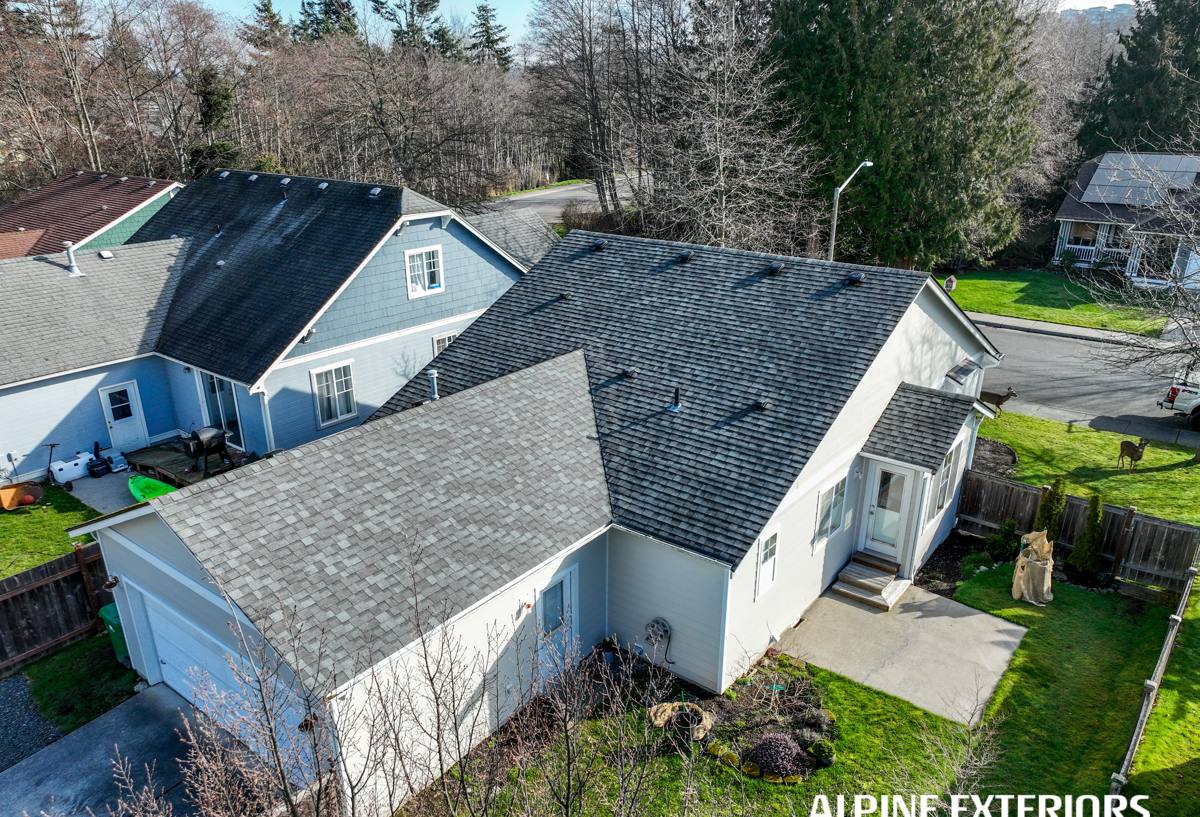
Why We Only Install James Hardie Fiber Cement
Ferndale Siding Replacement made a deliberate decision years ago to install one siding system: James Hardie fiber cement. We don't install vinyl, LP SmartSide, Cemplank, Allura, primed spruce, or cedar. That's not because those products have no merit — some of them are reasonable choices in the right application. It's because after years of installing and repairing siding in this climate, we concluded that fiber cement, and specifically the Hardie product line, gives Whatcom County homeowners the best combination of moisture resistance, fire performance, and long-term appearance retention for what our weather actually does to a house.
Wood-based products like primed spruce and cedar look excellent when new, but they require an ongoing maintenance commitment — recaulking, repainting, and moisture monitoring — that most homeowners underestimate until they're a few years in. In a county that sees months of sustained damp weather, any lapse in that maintenance schedule shows up fast as swelling, cupping, or rot at butt joints and fastener points. Vinyl sidesteps the rot problem but has its own trade-offs: it can warp or distort in direct sun exposure, it's more vulnerable to impact damage, and the color is baked into a thin material that fades over time with no way to touch it up. Engineered wood products like LP SmartSide perform reasonably well when installation details are followed exactly, but they still rely on an engineered wood substrate, which means the seams, cut edges, and fastener penetrations need to be sealed correctly and stay sealed — a single missed detail becomes a moisture entry point over time.
James Hardie fiber cement is cement, sand, and cellulose fiber — it doesn't have the same moisture-absorption pathway as wood-based sidings, it won't support the kind of rot that shows up on damp-climate installations, and it holds paint and factory finish far longer than wood substrates. It's also non-combustible, which matters given wildfire smoke seasons have become a regular late-summer feature even this far north. We're not saying other products are bad. We're saying that for the way weather behaves in this part of Washington, this is the material we're willing to stand behind.
What Correct Installation Actually Involves
- Proper rainscreen or drainage plane behind the siding so any incidental moisture has somewhere to go
- Correct fastener type, spacing, and placement per Hardie's published installation guide — not general carpentry judgment
- Factory-primed cut edges sealed in the field, since raw fiber cement edges are the most vulnerable point
- Flashing detail at every window, door, and roofline intersection, not just where it's visually obvious
- Manufacturer-specified clearances from grade, roof lines, and decks to keep the bottom edge of the siding out of standing water and splash-back
Hardie's warranty coverage assumes these details were followed. A crew that treats fiber cement like any other lap siding and skips the specifics is the most common reason a Hardie installation underperforms — the material isn't the problem, the installation is.
ColorPlus Finish and HZ5 Engineering
Two things distinguish a properly specified Hardie installation from a generic fiber cement job: the finish system and the climate zone engineering.
ColorPlus is Hardie's factory-applied finish, baked on under controlled conditions rather than painted on site after installation. It resists fading and chipping far better than field-applied paint, and because it's factory-controlled, the color consistency across a full elevation is better than what site painting typically achieves. For a homeowner, that means longer intervals between repainting — often a decade or more before touch-up is even a conversation — which matters in a climate where exterior paint jobs don't cure or last the way they would in a drier region.
Hardie also engineers its siding by climate zone. The HZ5 product line is built for regions that see freeze-thaw cycling and sustained moisture exposure, which describes Whatcom County's winter and spring pattern well. That engineering affects the board's moisture resistance and dimensional stability — it's not a marketing label, it's a formulation difference.
Siding, Roofing, Windows, and Decks — One Crew, One Point of Contact
We handle the full building envelope, not just siding. On a lot of Lynden properties, a siding project surfaces problems in adjacent systems: roofing that's due for replacement, windows with failed seals or rot at the sill, or a deck that's past its service life. Handling those together, when it makes sense, means fewer separate crews on your property, fewer scheduling headaches, and a contractor who takes responsibility for how all those systems interact — flashing at a roofline, window integration into a new siding plane, ledger board attachment for a deck. When trades are handled separately by different companies, the gaps between their work are often where problems start.
What Siding Replacement Typically Involves
1. Inspection and Assessment
We walk the exterior, check for moisture damage, rot, or failed flashing behind the existing siding, and assess what's driving the need for replacement — age, damage, moss and algae buildup, or a homeowner decision to upgrade before problems start.
2. Removal and Substrate Check
Old siding comes off and we inspect the sheathing and framing underneath. This is often the point where hidden moisture damage from a prior installation's failed details gets found and addressed before it's covered back up.
3. Weather Barrier and Drainage Plane
A correctly installed water-resistive barrier and drainage gap go on before any new siding, giving incidental moisture a path to escape rather than sitting against the wall assembly.
4. Hardie Installation to Spec
Boards are installed per manufacturer fastening, clearance, and flashing requirements, with cut edges sealed and joints detailed correctly.
5. Final Inspection and Cleanup
We walk the finished job, check every elevation, and clear the site.
Cost Factors for a Lynden Siding Project
| Factor | Why It Matters |
|---|---|
| Home size and elevation complexity | More linear footage, more corners, dormers, and roof intersections increase labor and material needs |
| Substrate condition | Rot or moisture damage found during tear-off adds repair scope before new siding can go on |
| Hardie product line and profile | Lap siding, shingle-style panels, and board-and-batten carry different material and labor costs |
| Trim and accessory work | Fascia, soffit, and trim replacement alongside siding affects total project scope |
| Access and site conditions | Rural lots, outbuildings, and landscaping close to the house can affect staging and labor time |
We give real numbers after walking the property — broad online estimates rarely reflect what a specific home actually needs.
Why a Local Crew Matters
A contractor based in Whatcom County knows what this climate does to a house because we see it on every job, in every season. We know what moss buildup on a north wall usually means underneath, what a decade of coastal humidity does to unsealed cut edges, and how wind-driven rain finds the gaps that get missed on lower-quality installations. That local knowledge shapes how we detail flashing, where we pay extra attention on an inspection, and which product choices we're willing to put our name behind for homes in this specific region — not a generalized national playbook.
Signs It's Time to Replace Your Siding
- Visible warping, cupping, or bulging in siding panels
- Cracking or splitting, especially near corners and butt joints
- Persistent moss, algae, or mildew that returns quickly after cleaning
- Paint that's failing or peeling faster than a normal repaint cycle would suggest
- Soft spots or visible rot when pressed near the base of exterior walls
- Rising energy bills that may point to a compromised weather barrier behind the siding
If you're seeing any of these signs on a Lynden home, or you're just planning ahead for a siding, roofing, window, or deck project, we're glad to come take a look. Estimates are free and there's no pressure — just an honest assessment of what your home needs.