 Ferndale Siding
 Why We Only Install One Siding Brand
Most siding contractors carry two or three product lines and let the homeowner pick based on price. We don't do that. We install James Hardie fiber cement siding and nothing else — not LP SmartSide, not vinyl, not Cemplank or Allura, not primed spruce or cedar. That's a narrower business model than most of our competitors run, and we're upfront about why: after years of tear-offs, warranty claims, and repeat service calls on other products in this climate, we stopped installing anything we wouldn't put on our own homes.
This isn't a marketing angle. It changes how we bid jobs, what we stock, and what our crews are trained on. When you call us for an estimate, you're not choosing between five siding brands — you're choosing whether Hardie is the right fit for your project, and we'll tell you honestly if it isn't (a small trim repair or an accessory building sometimes doesn't need it).
What "Only Hardie" Means for Your Project
Practically, it means our crews install one system all day, every day, instead of splitting attention across several product lines with different fastening schedules, clearances, and finish requirements. Installation errors on fiber cement are almost always the same handful of mistakes — wrong nail placement, missing clearances, caulked butt joints — and a crew that only works with Hardie has fewer chances to make them.
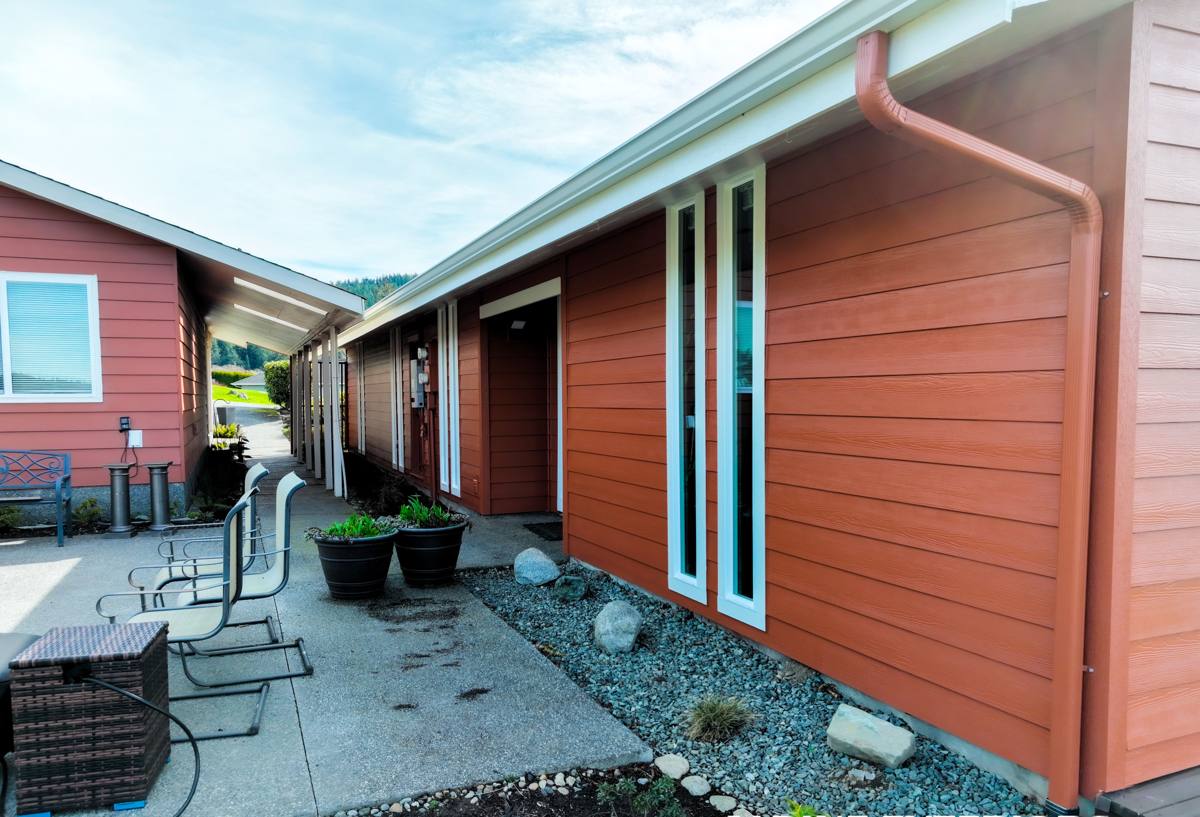
What Ferndale's Climate Actually Does to Siding
Ferndale sits close enough to the Strait of Georgia and Bellingham Bay that salt-laden air is a real factor here, not a coastal talking point borrowed from a brochure. Combine that with the driving rain that comes off Pacific storm systems through fall and winter, and Whatcom County's long, damp moss season, and you get a climate that's genuinely hard on exterior materials — harder than most manufacturer literature accounts for.
Three things matter most for siding performance in this area:
- Wind-driven rain that pushes moisture sideways into laps, seams, and fastener penetrations, not just straight down onto a flat surface
- Salt air that accelerates corrosion on fasteners, trim, and any metal flashing components
- Persistent shade and dampness on north-facing and tree-sheltered walls that keeps moss and algae established for most of the year
Any siding product can look fine on a sunny showroom sample. What separates products here is how they behave after ten winters of that combination — and that's the part most homeowners never get to see before they buy.
The Hardie System, Not Just a Board
James Hardie fiber cement is cement, sand, and cellulose fiber, cured into a rigid board that doesn't absorb water the way wood-based products do and won't degrade from UV exposure the way vinyl can over decades. But the reason we trust it in this climate isn't the raw material alone — it's the engineered system around it.
HZ5 Climate-Engineered Formulation
Hardie makes region-specific formulations (their HZ zone system) tuned for different climate stresses — freeze-thaw cycling in some regions, moisture exposure in others. The Pacific Northwest falls under a formulation engineered for our wet, moderate-freeze conditions, which matters more in a place like Ferndale than in a dry inland climate where any formulation would perform similarly.
ColorPlus Factory Finish
Most Hardie siding we install uses their ColorPlus finish — a multi-coat, baked-on finish applied at the factory under controlled conditions, not brushed or sprayed on site. It carries its own finish warranty separate from the substrate warranty, and it holds color and resists fading and chipping better than field-applied paint, which is the finish that fails first on most repainted siding jobs.
Hardie Product Lines and Where They Fit
Hardie isn't one product — it's a family of profiles, and picking the wrong one for the application is a common mistake we see on homes we didn't originally build.
| Product Line | Typical Use | Why It Fits |
|---|---|---|
| HardiePlank lap siding | Main wall cladding | Most common profile; wide range of textures and exposures |
| HardieShingle | Accent gables, dormers | Cedar-shingle look without the maintenance cycle |
| HardiePanel | Board-and-batten, modern facades | Vertical seams handle driving rain well when flashed correctly |
| HardieTrim | Corners, window and door casing | Matches the siding's moisture and finish behavior instead of mixing materials |
| HardieSoffit | Eaves, overhangs | Vented and non-vented options for moisture-prone eave conditions |
Mixing Hardie siding with wood trim, or vinyl trim with fiber cement panels, is common on cost-driven jobs and it's where a lot of long-term problems start — different materials move, weather, and age at different rates, which stresses the joints between them.
Why We Don't Install the Alternatives
We're not going to tell you LP SmartSide, vinyl, or cedar are bad products — each has a legitimate place, and other contractors do good work with them. Here's the honest trade-off reasoning behind our decision to skip them.
LP SmartSide and Engineered Wood
SmartSide is a strand-based wood product with a resin coating, and it performs reasonably well when the coating stays intact. The problem in a climate like ours is cut edges and fastener penetrations — any breach in that coating gives wind-driven rain a path into the wood substrate, and once moisture gets in, swelling and delamination follow. It's a maintenance-sensitive product in a maintenance-heavy climate, and we didn't want to be the ones doing warranty visits every time a caulk joint failed.
Vinyl Siding
Vinyl is inexpensive and low-maintenance in the sense that it doesn't need painting, but it's a thin, flexible material that expands and contracts significantly with temperature swings, can crack in impact events, and fades under UV over time with no practical way to refinish it short of replacement. It also isn't non-combustible, which matters more to some homeowners than others.
Cedar and Primed Spruce
Real wood siding, properly maintained, is a beautiful product — but "properly maintained" in Whatcom County means repainting or restaining on a tight cycle, plus staying ahead of moss and mildew on shaded walls. Most homeowners don't keep up that cycle, and we got tired of watching wood siding jobs turn into rot repair five to eight years later.
What Correct Hardie Installation Actually Involves
A lot of Hardie's real-world failures aren't the product's fault — they're installation shortcuts. Hardie publishes detailed installation requirements, and skipping them is how a 30-year product ends up needing repairs in year seven.
- Minimum clearance from siding bottom edge to roofing, decks, and grade (typically 6"+ to grade, 2"+ to roofing)
- Correct fastener type, spacing, and penetration depth — not just "whatever nail gun is loaded"
- Proper flashing at every horizontal joint, window, and door head, not caulk used as a substitute for flashing
- Butt joints backed with flashing or H-molding rather than sealed with caulk alone
- Weather-resistant barrier installed and lapped correctly behind the siding, not just stapled up quickly
- Field-cut edges primed or sealed before installation, since factory finish doesn't cover a fresh cut
These aren't optional refinements — they're what the manufacturer's own installation instructions require, and they're also what the transferable warranty is conditioned on.
Warranty: What's Actually Transferable
James Hardie backs its fiber cement products with a non-prorated limited warranty, and ColorPlus finishes carry a separate finish warranty, both of which are transferable to a subsequent homeowner within the coverage period if the transfer is handled properly. That transferability matters in a market where houses change hands — it's a real selling point when you eventually list the house, not just a comfort while you own it.
What voids or complicates a warranty claim almost always traces back to installation: missing clearances, unsealed cut edges, or fasteners driven wrong. That's the other reason we control installation end to end rather than subcontracting it out piecemeal.
Cost Factors Homeowners Should Understand
| Factor | How It Affects Price |
|---|---|
| Existing siding removal | Tear-off and disposal adds labor and dump fees versus siding over existing material where code allows |
| Wall complexity | Dormers, bump-outs, and multiple gables increase cutting, flashing, and trim work |
| Product line mix | Combining plank, shingle accents, and panel sections costs more than a single profile throughout |
| Moisture damage found underneath | Rotted sheathing discovered during tear-off is common on older Whatcom County homes and adds repair scope |
| Trim and finish level | Full HardieTrim packages cost more than pairing fiber cement siding with painted wood trim |
We won't know your real number until we've looked at the walls, but these are the variables that move a bid up or down, and we'll walk through each one with you during the estimate rather than handing you a single flat figure.
Is Hardie Always the Right Answer?
Almost always for full re-siding jobs in this area — but not universally. A small accessory structure, a temporary fix before a planned addition, or a tight budget with a short ownership horizon might call for a different approach entirely, and we'd rather tell you that upfront than force every job into one product just because it's what we carry. When it comes to full siding replacement on a house you plan to keep, though, we haven't found a product that holds up to Ferndale's rain, salt air, and moss better than Hardie installed to spec.
If you're weighing a siding replacement or just want a straight answer about what your walls actually need, we're happy to take a look and give you a free, no-pressure estimate — no obligation, and no pitch for a product we wouldn't use ourselves.