 Ferndale Siding
 Why Ferndale Siding Ages Differently Than Siding Inland
Ferndale sits close enough to the Salish Sea and the Nooksack lowlands that homes here take a different kind of weather beating than a house in, say, Bellingham's higher neighborhoods or out toward Deming. The combination matters: salt-laden air moving in off the water, long stretches of driving rain pushed sideways by wind, and a moss season that can run from October into May. None of these alone is unusual for Whatcom County. Together, applied to the same wall assembly year after year, they accelerate problems that homeowners in drier climates might not deal with for decades.
Siding failure is rarely dramatic. It doesn't usually announce itself with a hole in the wall. It shows up as a slow accumulation of small signs — a soft spot here, a streak there, a slightly different sound when you knock on a panel. Homeowners who catch those signs early spend hundreds of dollars on repairs. Homeowners who don't often end up replacing sheathing, insulation, and framing along with the siding itself.
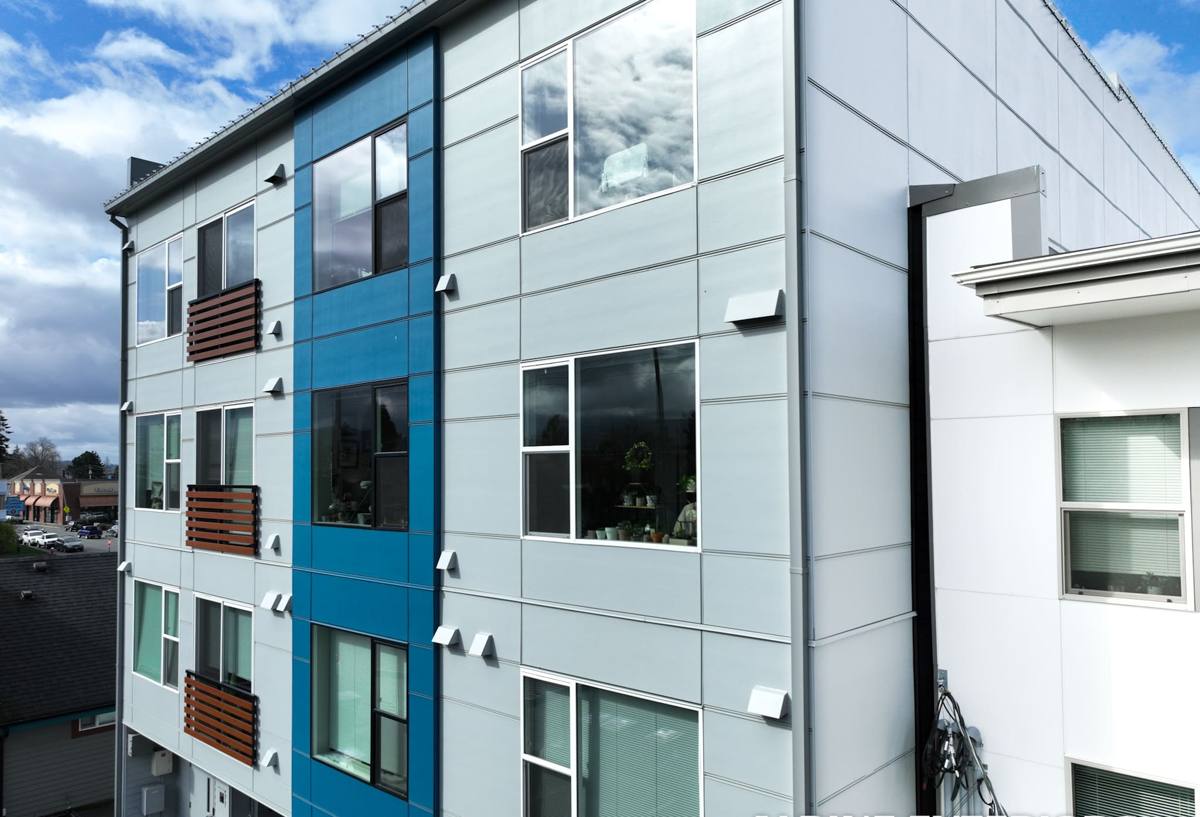
The Early Warning Signs Worth Walking Your House For
Visual Signs
- Paint that's peeling, bubbling, or chalking more on one side of the house than the others (usually the west or south-facing wall that takes the worst wind-driven rain)
- Dark streaking or green-black staining, especially under eaves, behind shrubs, or on the north side where sun never fully dries the surface
- Visible gaps opening up at seams, corners, or where siding meets trim, window flashing, or the foundation
- Panels that look slightly wavy, cupped, or bowed when viewed at a low angle in raking light
- Moss or algae establishing directly on the siding surface, not just on the roof or in gutters
Physical and Tactile Signs
- Soft, spongy give when you press on the siding near the bottom edge, around windows, or near downspouts
- A hollow or "crunchy" sound when you knock on a panel, compared to a solid thunk elsewhere on the wall
- Visible swelling or delamination at cut edges and panel ends, especially near corner boards
- Nail heads that have backed out or left rust streaks running down the face of the siding
- Caulk joints that have cracked, shrunk, or pulled away from the siding edge
Indoor Clues That Trace Back to Siding
Not every warning sign is visible from the yard. Musty smells in an exterior-wall closet, a slight discoloration on interior drywall near a window, or a spike in a room's humidity that doesn't match the rest of the house can all trace back to moisture working its way through failed siding and building paper. These are worth investigating before they become a bigger repair, because by the time they're noticeable indoors, moisture has usually been present in the wall cavity for a while.
Why Salt Air, Rain, and Moss Are a Specific Combination
Each of these three factors does something different to a wall assembly, and Ferndale gets all three at once.
Salt air is corrosive to fasteners and metal flashing long before it does anything visible to the siding material itself. A fastener that rusts and loosens creates a tiny gap — and a tiny gap is exactly what wind-driven rain needs to get behind the cladding.
Driving rain off Bellingham Bay and the Strait doesn't fall straight down; it hits siding at an angle, which means lap joints, butt seams, and any exposed edge get tested far more than they would in a calmer climate. Products and installation details that work fine in a low-wind, low-rain region can underperform here.
Moss holds moisture against the siding surface for extended periods rather than letting it run off and dry. A wall that stays damp for weeks at a time supports rot, coating failure, and substrate breakdown at a pace that a wall which dries out every few days simply doesn't experience.
The result is that siding systems get judged in Whatcom County by a tougher standard than they might face elsewhere. What holds up in a Spokane subdivision isn't automatically a safe bet on a lot two miles from tidal water in Ferndale.
How Long Should Siding Actually Last Here?
Manufacturers publish warranty periods, but warranty life and real-world performance in this climate aren't always the same number. The table below is a general guide based on how different siding materials tend to hold up under sustained coastal exposure with correct installation — not a guarantee, since installation quality, sun exposure, and maintenance history change the picture for any individual house.
| Material | Typical Realistic Lifespan in This Climate | Main Failure Pattern to Watch For |
|---|---|---|
| Vinyl siding | 15–25 years | Warping, cracking, fading, and gaps opening at seams as material ages |
| Primed wood (spruce/pine panel) | 10–20 years, heavily dependent on repainting schedule | Paint failure exposing raw wood, swelling, rot at butt joints |
| Cedar siding | 20–30 years with disciplined maintenance | Checking, moss growth, coating breakdown, cupping |
| Engineered wood (OSB-based) | Variable; performance is installation- and moisture-management-dependent | Edge swelling if cut edges aren't fully sealed and maintained |
| Fiber cement (factory-finished) | 30–50+ years | Coating wear over very long timelines; material itself resists moisture damage |
This is why we build our business around one material. When we walk a customer through why their old siding failed early, the answer usually traces back to a material or coating that simply wasn't built to hold up against this specific combination of salt, rain, and moss for the long haul — not to bad luck.
DIY Checks vs. When to Call a Professional
What a Homeowner Can Safely Check
- Walk the full perimeter of the house on a dry day and look at each wall in raking light
- Press firmly (not aggressively) on siding near the bottom courses and around penetrations like hose bibs and dryer vents
- Check caulk lines at windows, doors, and corner boards for cracking or gaps
- Look at downspout discharge points — siding right below a downspout that dumps water against the wall instead of away from it is a common early-failure spot
- Note any rooms with a persistent musty smell or a window that seems to fog or stay damp longer than others
When It's Time to Call Someone
If you find soft spots, hollow-sounding panels, visible gaps, or interior staining, that's the point to bring in a professional rather than keep monitoring. Moisture intrusion behind siding doesn't resolve itself, and the cost difference between catching it at the "soft spot" stage versus the "rotted sheathing" stage is significant. A contractor should be willing to explain what they're seeing and why — not just quote a number.
What We Look For on a Ferndale Siding Inspection
When we walk a property, we're checking the same things listed above, but also looking at how the house is built relative to its exposure: which walls face prevailing wind and rain, how close the property sits to tidal influence, roof overhang depth, gutter and downspout function, and how much shade or standing moss cover the north and west walls carry. Two houses on the same street can have very different siding conditions depending on those factors, even if the siding itself is the same age.
We also check what's happening at the transitions — where siding meets trim, foundation, roofline, and windows — because that's where the vast majority of real-world failures start. Flat, uninterrupted wall sections are rarely the problem. Corners, joints, and penetrations are.
Why We Standardized on James Hardie Fiber Cement
After years of repairing and replacing siding across Whatcom County, we made a deliberate decision to install one product system: James Hardie fiber cement, in the HZ5 formulation engineered for this climate zone. We don't install vinyl, LP SmartSide, Cemplank, Allura, or unfinished cedar or spruce, and we're upfront with customers about why.
Fiber cement is non-combustible, doesn't swell or rot the way wood-based products can when a cut edge or seam takes on moisture, and comes from the factory with a baked-on ColorPlus finish that isn't relying on a field-applied paint job to hold up against salt air and UV. It carries a strong transferable warranty, which matters to homeowners planning to sell within the warranty period. None of this means other products are unusable everywhere — it means that for this specific climate, with this specific combination of salt, rain, and moss, we decided we'd rather install one system extremely well than offer five and hope each one holds up.
A Practical Timeline for Homeowners
- Every spring: Walk the exterior after the wet season ends and check for new staining, soft spots, or moss growth that wasn't there last fall
- Every 3–5 years (painted wood siding): Reassess whether a repaint is due before the coating fully fails and exposes bare material
- At 10–15 years (any material): Have a professional check fastener condition, caulking, and flashing details, since these tend to fail before the siding panels themselves do
- At the first sign of a soft spot, gap, or interior moisture symptom: Don't wait for the next scheduled check — have it looked at
If you're noticing any of the signs above on your Ferndale home, or you'd just like an honest read on where your current siding stands, we're happy to walk the property with you and give you a straight answer — no pressure, no obligation. A free estimate is a good way to find out whether you're looking at a small repair, a maintenance item, or a replacement worth planning for.