 Ferndale Siding
 Why Semiahmoo Homes Need a Different Approach to Metal Roofing
Semiahmoo sits close enough to the water that salt air, wind-driven rain, and a moss season that can stretch from October into May are just part of owning a home there. A metal roof handles all three better than most other roofing materials, but only if it's specified and installed with those conditions in mind. A metal roof designed for an inland neighborhood and one designed for a shoreline-adjacent property in Whatcom County are not the same job, even if the panels look identical from the street.
We work throughout the Ferndale area, and Semiahmoo properties come with a specific mix of exposure conditions: salt-laden air that accelerates corrosion on the wrong fasteners and flashing metals, near-constant moisture that never fully lets a roof dry out between storms, and moss and algae growth that thrives in that combination of shade, humidity, and mild temperatures. None of these problems are exotic. They're predictable, and a roof built with that in mind will simply perform better for longer.
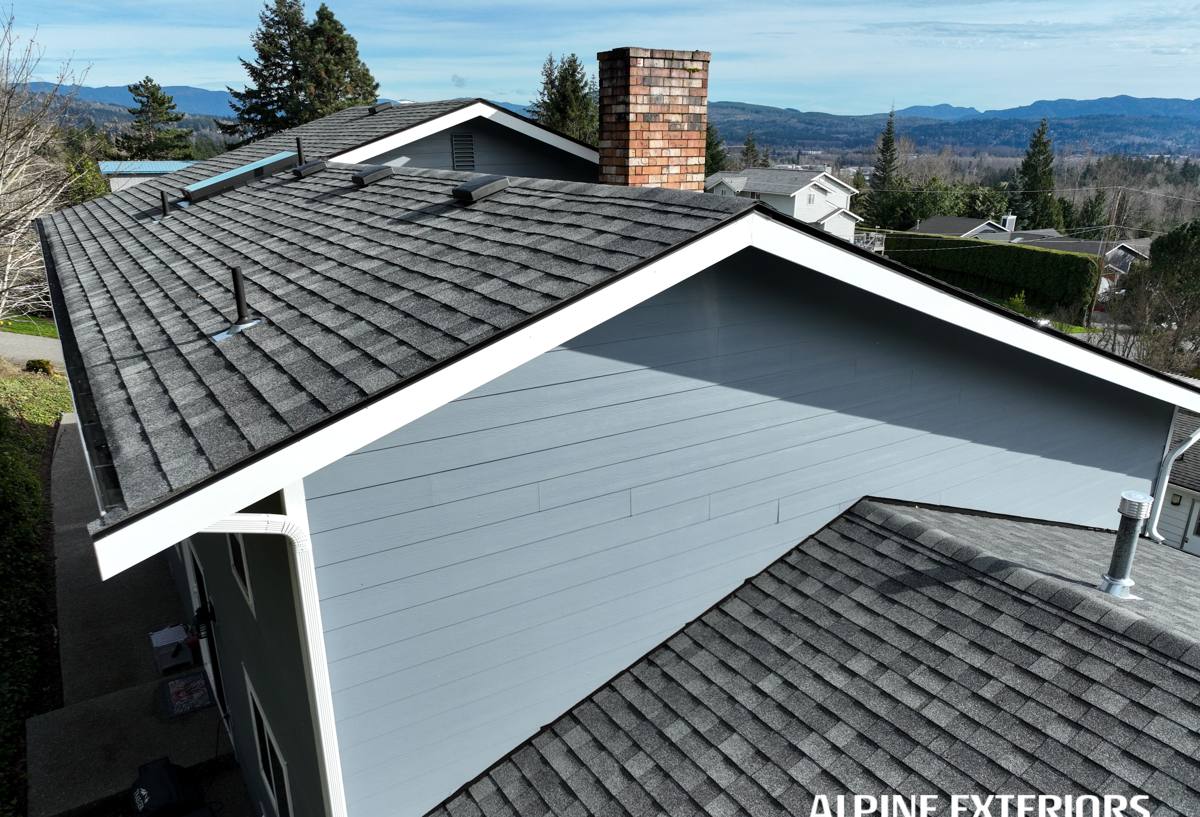
What Salt Air Actually Does to a Roof
Salt air is a slow, steady corrosive. It doesn't destroy a roof in one season, but it will find every piece of unprotected or mismatched metal and start working on it year after year. On a metal roofing system, the parts most at risk are the fasteners, the flashing, and any exposed cut edges where the protective coating has been compromised.
Where Corrosion Starts
- Fasteners that aren't rated for coastal exposure, especially exposed-fastener panel systems installed with the wrong screw type
- Dissimilar metals in contact with each other, which sets up galvanic corrosion between the panel and the flashing or trim
- Cut panel edges that weren't sealed or touched up after fabrication
- Low-quality or thin factory coatings that weren't rated for marine or near-marine environments
None of this is a reason to avoid metal roofing near the water. It's a reason to be deliberate about coating systems, fastener grade, and detailing. Done right, a metal roof is one of the more corrosion-resistant options available for a property like this.
Moss, Moisture, and the Whatcom County Roof Cycle
Whatcom County's long wet season means a roof rarely gets a real chance to dry out between fall and late spring. On roofing materials with any texture or seams that trap debris, that constant dampness is exactly what moss and algae need to establish. Once moss gets a foothold, it holds moisture against the roof surface, which is where the real damage starts — not from the moss itself, but from what it keeps trapped underneath it.
Metal roofing has a real advantage here. A properly installed metal roof has a smooth, hard, non-porous surface with few places for organic debris to catch and sit. Moss and algae struggle to establish on bare metal panels the way they do on more porous or textured surfaces. That doesn't mean a metal roof in Semiahmoo will never see any moss or algae growth, especially in heavily shaded areas or where debris from nearby trees is allowed to pile up in valleys — but the maintenance burden is meaningfully lower.
What Still Needs Attention on a Metal Roof
- Valleys and gutters, where fir needles and leaf litter collect and hold moisture against the panel
- North-facing and heavily shaded slopes, where the roof surface stays damp longer
- Areas around penetrations (vents, chimneys, skylights) where debris and standing water tend to gather
What Correct Metal Roofing Installation Looks Like Here
A metal roof is only as good as its details. The panel itself is the easy part — the flashing, fastening, underlayment, and ventilation decisions are what actually determine whether the roof holds up through a decade of driving rain and salt air.
Underlayment and Deck Prep
We don't install metal panels directly over a deck without a proper underlayment system. A high-temperature synthetic or self-adhered underlayment gives the roof a second line of defense against wind-driven rain that can work its way under panel laps in exposed, water-facing locations. We also check the deck itself for existing moisture damage before anything goes down, because covering up a wet or rotting deck with a new roof just hides the problem.
Fastener and Flashing Selection
For coastal-adjacent installs, fastener grade matters more than it does inland. We match fasteners and flashing metals to the panel material to avoid galvanic corrosion, and we favor coatings and hardware rated for marine or coastal exposure rather than standard-grade components that were never meant to sit a few miles from salt water.
Ventilation
A metal roof that isn't ventilated correctly can trap moisture underneath the panels, which leads to condensation issues on the underside of the deck — a problem that has nothing to do with the roof's ability to shed rain and everything to do with airflow. We size and place intake and exhaust ventilation based on the actual roof geometry, not a one-size-fits-all assumption.
Panel Seams and Fastening Style
Standing seam systems, where panels are joined with raised interlocking seams and hidden fasteners, generally hold up better in high-wind, high-rain exposure because there are no exposed fastener heads for water to work around over time. Exposed-fastener panel systems can still perform well and cost less, but they depend more heavily on correct fastener torque and periodic inspection since every exposed screw is a potential point of entry if it backs out or its washer degrades.
Comparing Roofing Approaches for a Semiahmoo Property
| Factor | Standing Seam Metal | Exposed-Fastener Metal | Asphalt Composition |
|---|---|---|---|
| Salt air resistance | Strong, with correct coating and flashing metals | Good, but fastener maintenance matters more | Moderate; granule loss accelerates near salt air |
| Moss/algae resistance | Strong on clean, smooth panel surface | Strong, similar to standing seam | Lower; textured surface holds moisture and debris |
| Wind-driven rain performance | Excellent; interlocking seams shed water well | Good with correct install and maintenance | Adequate; more dependent on shingle age and sealing |
| Expected service life | Long, often decades with proper care | Long, slightly shorter than standing seam typically | Shorter, especially in wet, salt-influenced climates |
| Maintenance needs | Low; occasional debris clearing and inspection | Moderate; check fastener condition periodically | Higher; moss treatment and granule wear over time |
This isn't a case against asphalt roofing everywhere — it has its place. But for a property that's taking on more salt air and staying wet longer than an inland home, metal roofing's low-maintenance, moisture-shedding qualities carry more weight than they might elsewhere in Ferndale or Whatcom County.
Our Process for a Semiahmoo Metal Roof
Every roof gets assessed on-site before we recommend a system, not from a photo or a phone call alone. Wind exposure, tree cover, roof pitch, and how close the home sits to open water all factor into fastener choice, panel style, and detailing.
- On-site assessment: we walk the roof and the property, checking exposure direction, existing moisture damage, ventilation, and drainage paths
- System recommendation: panel style, gauge, coating, and fastener specification matched to the home's actual exposure, not a generic package
- Written estimate: materials, labor, tear-off (if applicable), flashing and ventilation work all itemized so there are no surprises
- Installation: deck inspection and repair as needed, proper underlayment, correctly matched fasteners and flashing, and ventilation sized to the roof
- Final walkthrough: we go over the finished roof with the homeowner, including what routine maintenance (if any) is worth doing seasonally
Why Local Experience in Semiahmoo Matters
A contractor who mainly works inland jobs can install a technically sound metal roof and still get the details wrong for a coastal-exposed property, because the failure points aren't the same. Fastener grade that's perfectly fine forty minutes inland can underperform near open water. Ventilation strategies that work fine in a drier microclimate can trap moisture in a home that sits in salt air and fog more often.
Working this area regularly means we've seen how these homes age — where moss actually tends to build up, which roof orientations take the worst of the wind-driven rain, and which coating and fastener combinations hold up over years rather than just passing inspection on day one. That's the kind of judgment that only comes from doing the work here repeatedly, not from a spec sheet.
Signs Your Current Roof Is Losing the Fight
- Rust streaking near fasteners, flashing, or panel seams
- Moss or algae buildup that keeps returning even after cleaning
- Soft spots, sagging, or visible deck damage from the interior (stains on ceilings or in the attic)
- Fasteners that are visibly backing out or washers that have cracked or degraded
- Granule loss, curling, or missing shingles if you're currently on an asphalt roof and considering a switch
Any one of these is worth a look. None of them mean an immediate emergency, but they're the kind of thing that gets more expensive to fix the longer it's left alone in a wet, salt-influenced climate like this one.
Getting an Honest Estimate
Every Semiahmoo property is a little different depending on how close it sits to open water, how much tree cover it has, and what condition the existing roof and deck are in. We'd rather look at the actual roof and give you a straight answer about what it needs than guess over the phone. If you'd like a free, no-pressure estimate on a metal roof for your Semiahmoo home, the form below gets you on our schedule — no obligation either way.