 Ferndale Siding
 A Coastal Climate That Doesn't Forgive Cheap Siding
Homes in and around Lummi Nation sit close to the water — Bellingham Bay, Hale Passage, and Lummi Bay all bring salt-laden air onshore almost every day of the year. Add Whatcom County's long wet season, frequent wind-driven rain off the Strait of Georgia, and the deep shade that keeps moss growing on north-facing walls for months at a stretch, and you have one of the harder climates in Western Washington to keep siding looking and performing well. This isn't a place where "good enough" siding survives on schedule. It's a place where the wrong material shows its weaknesses early — and where the right material, installed correctly, earns its keep for decades.
We've worked on homes throughout this stretch of Whatcom County long enough to know which failures repeat themselves here specifically: swelling at butt joints from trapped moisture, paint that chalks and peels years ahead of schedule from salt exposure, and moss creeping up from grade on shaded elevations. None of that is inevitable. It's a product and installation problem, and it's fixable.
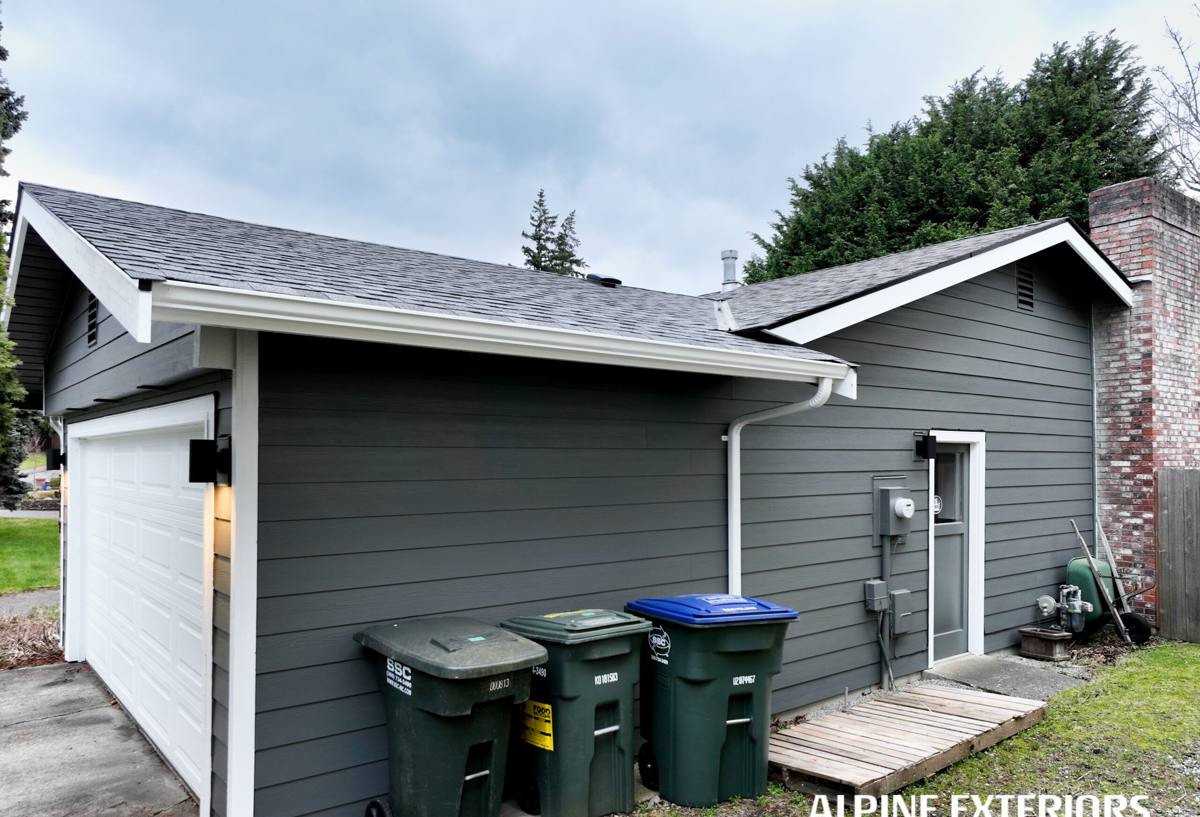
What Salt Air, Rain, and Moss Actually Do to Siding
Salt Air
Airborne salt is corrosive to metal fasteners and trim, and it's abrasive to painted surfaces over time. Wood- and composite-based sidings that rely on a surface coating for protection tend to lose that coating faster near saltwater than they would twenty or thirty miles inland. Once the coating goes, the substrate underneath is exposed to the next problem: moisture.
Driving Rain
Wind off the water doesn't just drop rain straight down — it pushes it sideways into wall assemblies, working into laps, seams, and any gap around windows, doors, or penetrations. A siding system with weak joints or a installer who rushed the flashing details will let water behind the cladding, where it can sit against sheathing and framing for weeks at a time in a climate that rarely dries out completely between storms.
Moss
Shaded, damp walls — common on the north and east sides of homes tucked into trees or facing away from the sun — grow moss readily. Moss holds moisture directly against the siding surface. On materials that absorb water or swell, that's a slow path to rot and paint failure. On materials that don't absorb water, moss is a cosmetic nuisance you can rinse off, not a structural threat.
Why We Install Only James Hardie Fiber Cement
We made a decision years ago to install one siding system and install it right, rather than offer a menu of products with different weak points. James Hardie fiber cement is engineered from cement, sand, and cellulose fiber — materials that don't feed rot, don't provide food for moss or mildew, and don't swell the way wood-based products can when they take on moisture. It's also non-combustible, which matters in a region that has seen more wildfire smoke and dry-season fire risk in recent years even this far north.
We don't install vinyl, LP SmartSide, Cemplank, Allura, primed spruce, or cedar. Each of those products has legitimate uses and each has real strengths — this isn't a claim that they're bad products. But every one of them asks a homeowner to accept a trade-off we're not willing to install and stand behind on a coastal Whatcom County home: a factory finish that doesn't hold up as long near saltwater, a substrate that's more sensitive to sustained moisture, or a warranty structure that doesn't match what James Hardie backs its products with. We'd rather install fewer products correctly than more products with an asterisk.
The Right Product Line for This Climate
James Hardie engineers its siding by climate zone under its HardieZone system, and most of Western Washington's marine coastline — including the Lummi Nation area — falls into the wetter, milder HZ10 zone rather than the harder freeze-thaw zones found further inland or at elevation. HZ10 products are formulated for regions that see a lot of moisture and relatively few hard freezes, which matches what this stretch of Whatcom County actually experiences most winters.
ColorPlus Factory Finish
For a saltwater-adjacent home, the factory-applied ColorPlus finish matters more than it might inland. It's baked on in a controlled environment, cures fully before the boards ever reach the jobsite, and resists fading and chalking better than field-applied paint exposed to salt air and UV. It also comes with its own finish warranty, separate from the substrate warranty, so the color and the board are both covered.
Product Options
- HardiePlank lap siding — the standard choice for most single-family homes, available in several exposure widths and textures.
- HardiePanel vertical siding — often used for accent gables, shed-style sections, or a more modern look on newer builds.
- HardieTrim — matched trim boards around windows, doors, and corners so the whole envelope is the same non-combustible, moisture-resistant material, not just the field siding.
- HardieSoffit — for areas where damp, shaded eaves are a recurring moss and mildew spot.
What a Correct Installation Actually Involves
Fiber cement siding is only as good as the installation behind it. In a climate that pushes rain sideways and keeps humidity high for months, the details most homeowners never see are the ones that determine whether the siding lasts 30-plus years or starts having problems in five.
- Weather-resistive barrier and flashing first. The siding is the last line of defense, not the only one. A properly lapped weather barrier and correctly integrated flashing at windows, doors, and penetrations keeps bulk water out of the wall assembly before a single board goes up.
- Rainscreen gap where it's warranted. On homes with heavier moisture exposure, furring strips create an air gap behind the siding that lets any incidental moisture drain and dry instead of sitting against the back of the board.
- Correct fastening. Fasteners need to be corrosion-resistant, set at the manufacturer's specified depth and spacing, and driven into framing — not just sheathing. Near saltwater, using the wrong fastener is one of the fastest ways to get streaking and premature corrosion.
- Proper clearances. James Hardie specifies minimum clearances from grade, roofing, and decks. Skipping these is one of the most common shortcuts we see on older installs, and it's a direct path to moisture wicking up from below.
- Caulked and sealed penetrations, not painted over. Every fixture, vent, and fastener head needs the right sealant, not a coat of paint standing in for one.
- Butt joints backed and sealed. This is one of the most common failure points on rushed jobs — an unsupported or unsealed butt joint is where water gets behind the board first.
Our Process
1. On-Site Assessment
We walk the exterior with you, checking which elevations take the most weather, where moss and staining already show up, and where the existing siding or trim has failed. On homes near the water, we pay particular attention to north- and west-facing walls and anything close to grade.
2. Written Estimate
You get a clear scope — product line, exposure width, trim details, and what's included for tear-off, moisture barrier, and flashing — before any work starts. No verbal promises that don't make it onto paper.
3. Prep and Moisture Check
Before new siding goes up, we check the sheathing underneath for existing rot or moisture damage. Covering a problem with new siding doesn't fix it — this step is non-negotiable.
4. Installation to Manufacturer Spec
Fastening, clearances, flashing, and joint treatment follow James Hardie's published installation requirements, which is also what keeps the manufacturer's warranty intact.
5. Final Walkthrough
We go around the house with you at the end so you know what was done and what to watch for over the following seasons.
What Drives Cost on a Coastal Home Like This
| Factor | Why It Matters Here |
|---|---|
| Existing sheathing condition | Long-term moisture exposure near the water increases the odds of hidden rot that needs repair before new siding goes up |
| Home height and access | Multi-story or steep-lot homes near the shoreline often need more staging and scaffolding time |
| Trim and detail work | Homes with more windows, gables, and architectural detail need more precision cutting and flashing |
| Tear-off vs. re-side | Removing failed wood or composite siding down to sheathing costs more upfront but avoids hiding existing damage |
| Rainscreen assembly | Adding a furring-strip air gap on heavily exposed elevations adds labor but reduces long-term moisture risk |
| Color and texture choice | Custom ColorPlus colors and certain textures carry different material costs than standard options |
We don't quote a number without seeing the house — a moss-covered north wall with hidden rot behind it is a different job than a well-maintained south-facing elevation, even on the same street.
Keeping It Looking Right After Installation
- Rinse siding annually with a garden hose to remove salt residue and loose debris — a pressure washer isn't necessary and can force water into joints if used carelessly
- Trim back vegetation and tree limbs that keep any wall shaded and damp longer than the rest of the house
- Check caulking at trim and penetrations once a year and re-seal any spots that have cracked or pulled away
- Keep gutters clear so overflow doesn't run down the face of the siding repeatedly in the same spot
- Watch clearances at grade and decks — mulch, soil, or new landscaping that creeps up over the years can bring siding below its minimum clearance without anyone noticing
Why Local Experience on This Coastline Matters
A crew that's only worked drier, inland jobs doesn't automatically know to add a rainscreen gap on a west-facing wall that catches wind off the water, or to double-check clearance at a low spot where a yard slopes toward the house. Those judgment calls come from having done the work in this specific climate — salt air, driving rain, and a moss season that runs longer here than in most of the state. We've built our process around those conditions, not around a generic install that happens to also get used near the coast.
If you're weighing a siding replacement on a Lummi Nation home, we're glad to come out, look at what you're dealing with, and give you a straight answer on what it needs. There's no cost and no pressure for the estimate — just a clear look at the job and what it would take to do it right.