 Ferndale Siding
 A deck built for Fairhaven and the surrounding Ferndale area has to survive a climate most builders never design for. Salt-laden air off the water, driving rain that comes in sideways for days at a time, and a moss season that can stretch from October through May all work against wood, fasteners, and finishes faster than they would twenty miles inland. A deck that would hold up fine in a drier part of the state can start showing rot, rust streaks, and slick green growth within a couple of seasons here if it wasn't built with this specific climate in mind. This page covers what actually matters when building a deck in this part of Whatcom County — the materials, the hidden structural details, and the process that keeps a deck sound and safe for decades instead of years.
Why Fairhaven's Climate Is Hard on Decks
Three things stack up against a deck here, and most homeowners only find out about them after a deck starts failing. First is the salt air — even at a distance from the water, airborne salt accelerates corrosion on any fastener, hanger, or screw that isn't rated for it. Second is the rain pattern. This isn't just total rainfall; it's the duration and the wind-driven angle of it, which pushes moisture into joints, ledger connections, and end grain that a dry-climate deck would never have to deal with. Third is the moss and mildew season. Long stretches of damp, low-light weather let moss and algae establish on any horizontal surface that doesn't drain and dry quickly, and once established it holds moisture against the wood or decking surface even longer.
None of these are exotic problems, but they compound. A deck that handles one of them fine can still fail if the other two aren't accounted for. That's the difference between a deck that looks good for a season and one that's still solid in fifteen years.
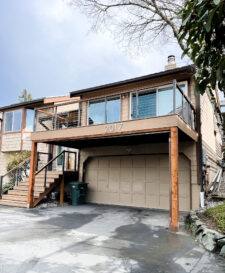
What a Correctly Built Deck Needs Here
Framing and Fasteners
Standard interior-rated fasteners have no place in a deck built this close to salt air. Structural screws, joist hangers, and hanger nails need to be hot-dip galvanized at minimum, and stainless steel is worth the upgrade in high-exposure spots like ledger bolts and any hardware within a few feet of grade. Mixing metals matters too — an aluminum flashing paired with the wrong fastener can set off galvanic corrosion that eats through both over time.
Ledger Attachment and Flashing
The ledger board — where the deck attaches to the house — is the single most common failure point on decks in wet climates, and it's almost always a flashing problem, not a framing problem. Water that gets behind an improperly flashed ledger has nowhere to go and sits against the house's structural framing, which can cause hidden rot long before anything looks wrong from outside. A correct ledger detail uses proper flashing integrated with the house's existing water-resistive barrier, not just caulk and hope.
Footings
Footings need to be sized and set to local frost depth and soil-bearing requirements, not guessed at. Undersized or shallow footings are one of the more common shortcuts on lower-bid deck jobs, and they're invisible until the deck starts to shift or settle unevenly.
Decking Material Options for This Climate
There's no single "right" decking material for every homeowner — it depends on budget, maintenance appetite, and how the deck will be used. Here's how the common options actually perform in a salt-air, high-rain, moss-prone environment:
| Material | Moisture & Moss Resistance | Maintenance | Typical Lifespan |
|---|---|---|---|
| Pressure-treated wood | Fair — needs sealing to perform well | Annual cleaning and re-sealing recommended | 10-15 years with upkeep |
| Cedar | Good natural resistance, but surface still needs care | Periodic cleaning, oil or stain every 1-2 years | 15-20 years with upkeep |
| Capped composite | Very good — non-porous cap resists moisture and moss buildup | Occasional washing, no sealing or staining | 25-30+ years |
| PVC decking | Excellent — fully synthetic, doesn't absorb moisture | Occasional washing only | 25-30+ years |
We don't push one product on every homeowner. Wood costs less up front and has a warmer, traditional look that some people prefer regardless of the extra maintenance. Composite and PVC cost more initially but make sense for homeowners who don't want to be out there scrubbing moss off boards every spring or re-sealing every year. The honest trade-off is time and money now versus time and money over the life of the deck — we'll walk through both with you rather than assume which one you'd choose.
Substructure Details That Prevent Rot Before It Starts
The parts of a deck nobody sees are usually what determine how long it actually lasts. Joist tape or a similar waterproof membrane on top of every joist keeps standing water from soaking into end grain and fastener holes — a small material cost that prevents the most common source of hidden rot. Proper spacing and airflow underneath the deck matters too; a deck built too close to grade or without ventilation traps moisture underneath and gives moss and mildew a place to thrive year-round, out of sight. Post bases should sit on top of the concrete footing, not embedded directly in it, so wood posts aren't sitting in a spot that holds water against them.
Our Deck Building Process
- On-site consultation. We look at the site, discuss how you'll use the deck, and talk through material options and budget honestly.
- Design and layout. We plan footing locations, ledger attachment, and framing to match the site's grade, drainage, and sun/rain exposure.
- Permitting. We handle the permit application and inspection scheduling so you don't have to navigate that process yourself.
- Footings and framing. Footings are dug to proper depth, framing is built with corrosion-rated hardware, and the ledger is flashed correctly before any decking goes down.
- Decking and railing installation. Boards and railing are installed per manufacturer spec (critical for composite and PVC warranty coverage), with attention to drainage gaps and airflow.
- Final walkthrough. We go over the finished deck with you, including what maintenance it does or doesn't need going forward.
Moss, Drainage, and Long-Term Maintenance
Even a well-built deck needs some ongoing attention in this climate — the goal is to minimize it, not pretend it doesn't exist. Good drainage design, proper board spacing, and the right decking material all reduce how much moss and mildew take hold, but a little seasonal upkeep goes a long way toward keeping a deck safe and looking good.
- Sweep leaves and debris off the deck surface regularly through fall and winter so moisture doesn't sit trapped underneath organic matter
- Rinse or lightly scrub visible moss or algae before it has a chance to spread across boards
- Check that gaps between boards stay clear so water can drain through rather than pool
- Inspect railing posts and stair connections once a year for looseness or corrosion at fasteners
- Re-seal or re-stain wood decking on the schedule appropriate to the product — don't wait until it's visibly weathered
- Keep an eye on the area underneath the deck for standing water or poor drainage after heavy rain events
Permits and Code Basics in Whatcom County
Most new deck construction in this area requires a building permit, particularly for decks attached to the house or built above a certain height off grade. Guardrails are typically required once a deck reaches a certain height, and stair and railing spacing follow standard building code requirements for spindle gaps and rail heights. Footing depth requirements are tied to local frost depth and soil conditions. We handle the permit process as part of the job so the work passes inspection the first time, rather than leaving you to sort out paperwork or correct a failed inspection later.
What Affects the Cost of a Deck Project
| Cost Factor | Why It Matters |
|---|---|
| Deck size and shape | More square footage and complex angles mean more framing, footings, and labor |
| Decking material | Pressure-treated wood costs less upfront; composite and PVC cost more but need less ongoing maintenance |
| Height off grade | Taller decks need more substantial footings, framing, and often stairs and additional railing |
| Site access and grade | Sloped or hard-to-access sites add labor for excavation and material handling |
| Railing and stair design | Custom railing styles and multiple stair sets add material and labor cost |
| Permit and inspection requirements | Larger or taller decks may require engineering review, adding time and cost |
Every deck is different, which is why we walk the site and give you real numbers instead of a generic estimate. Broadly, a straightforward pressure-treated deck costs less than a similarly sized composite or PVC deck, but the gap narrows over time once you account for maintenance and replacement cycles.
Why Hiring a Crew That Already Works This Area Matters
A contractor who builds decks in Fairhaven and the Ferndale area regularly already knows how the local climate behaves on a job site — how fast moss establishes on a north-facing deck, how driving rain finds gaps in a ledger flashing detail that would hold up fine somewhere drier, and what footing depth and soil conditions actually look like locally rather than what a generic spec sheet assumes. That local experience shows up in the details that don't get inspected but determine how the deck holds up ten years from now — the flashing behind the ledger, the fastener grade, the drainage underneath. It also means we're familiar with the local permitting process and can move a project through it without unnecessary delays.
If you're planning a new deck or replacing one that's showing its age, we're happy to come take a look and walk you through honest options for your site, budget, and how you plan to use the space. Reach out for a free, no-pressure estimate using the form below.