 Ferndale Siding
 Why Decks Wear Out Faster in Point Roberts
Point Roberts sits right on the water, and that location cuts both ways. It's part of what makes the area worth living in, but it's also hard on exterior building materials — decks especially. Salt-laden air off the Strait of Georgia and Boundary Bay accelerates corrosion on anything metal: nails, screws, joist hangers, railing brackets. Once those fasteners start to rust and weaken, the deck they're holding together weakens with them, often well before the decking boards themselves look worn out.
Add in Whatcom County's long wet season — steady, driving rain for months at a stretch — and you get decks that rarely get a chance to fully dry out between storms. Moisture sits in end grain, in fastener holes, and underneath boards where airflow is limited. That sets up the conditions for rot in framing and ledger boards, which is a structural problem, not a cosmetic one.
Then there's moss. The same damp, mild climate that's great for the region's evergreens is also ideal moss habitat, and a horizontal wood or composite surface exposed to shade and moisture for most of the year is exactly where it thrives. Moss holds moisture against the decking surface, stains it, and turns stairs and low-traffic areas slick and genuinely dangerous underfoot.
The Combined Effect
None of these three factors — salt air, rain, and moss — is unique to Point Roberts on its own. What's notable here is how consistently all three show up together, year-round, on a property that's essentially surrounded by water. A deck built to a generic spec, without attention to fastener grade, drainage, and airflow, tends to show real problems years earlier here than the same deck would inland.
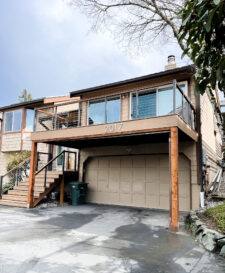
Signs a Deck Needs Replacing, Not Just Repair
Not every tired-looking deck needs a full teardown. But there's a point where patching individual boards or re-tightening railings is just delaying a bigger job — and in some cases, masking a safety issue. Here's what tells us a deck has crossed that line:
- Soft, spongy, or spring-y decking underfoot, especially near the house or stair landings
- Rust streaks below fastener heads or joist hangers
- Visible gaps, splitting, or checking that runs the length of multiple boards
- A ledger board (where the deck attaches to the house) that's discolored, soft, or separating slightly from the siding
- Wobbly railings or posts that move when pushed, rather than just needing a tightened bolt
- Persistent moss or algae that returns within weeks of cleaning, indicating the wood underneath is staying wet
- Footings or support posts that have shifted, settled, or show cracking
If you're only seeing one or two of these, and only in isolated spots, repair may genuinely be the right call. When several show up together, or when the ledger or framing is involved, replacement is almost always the more honest recommendation — patched framing rarely holds up as well as new, and it's not worth risking a collapse over saving a few boards.
What a Correct Deck Replacement Involves
A deck replacement isn't just pulling up old boards and screwing down new ones. Done right, it addresses everything underneath the surface too:
Structure First
Footings get inspected and, where undersized or shifted, replaced to current code depth and bearing requirements. Framing — joists, beams, posts — gets rebuilt with lumber rated for ground contact or exposure as appropriate, and spaced to handle current load requirements, not whatever spacing happened to be standard when the original deck went in years ago.
The Ledger Connection
This is the single most important — and most commonly under-built — part of any deck attached to a house. The ledger board needs proper flashing that directs water away from the house's wall assembly, not into it. In a climate with this much rain, a poorly flashed ledger is one of the fastest ways to end up with hidden rot inside the wall itself, not just in the deck.
Fasteners and Hardware
Given the salt air, we don't treat hardware as an afterthought. Stainless steel or high-grade hot-dip galvanized fasteners and connectors cost more up front than standard coated hardware, but standard hardware corrodes noticeably faster this close to saltwater, and replacing rusted-through hangers means tearing into a deck that otherwise still has years left in it.
Decking and Drainage
Board spacing, airflow underneath the deck, and grading beneath it all affect how fast the structure dries out after a storm. We build in enough clearance and gap spacing to let the deck actually shed water and dry, rather than trapping it — which is also the single best long-term defense against moss.
Decking Material Options
There's no universal right answer here — it depends on budget, how much upkeep you want to do, and how close to the water your specific lot sits. Here's how the common options compare for a Point Roberts property:
| Material | Upfront Cost | Maintenance | Moisture/Salt Behavior |
|---|---|---|---|
| Pressure-treated wood | Lowest | Annual cleaning, periodic sealing | Performs fine if sealed regularly; neglect leads to graying, splintering, and faster rot in wet spots |
| Cedar | Moderate | Sealing every 1-2 years for color; can be left to weather naturally | Naturally rot-resistant, but still needs airflow underneath; salt air will gray it faster than an inland cedar deck |
| Composite decking | Higher | Occasional washing, no sealing or staining | Doesn't rot, but can trap surface moisture if boards aren't spaced and ventilated correctly; moss still grows on the surface without cleaning |
| PVC decking | Highest | Lowest — mostly just washing | Fully moisture-proof surface; best resistance to salt air and staining, but relies entirely on correctly built substructure underneath |
We don't push one material over another as a default. What we will say plainly: whatever decking you choose, the framing, flashing, and hardware underneath it matter more to how long the deck lasts here than the surface material does. A composite deck built on undersized, poorly flashed framing will still fail early.
Permits and Working in Point Roberts
Point Roberts is a U.S. exclave — the only way to drive here is through Canada, since it sits on a peninsula cut off from the rest of Washington by the border. That's not a small detail for a construction project. It affects how materials get delivered, how quickly a crew can get back out for a follow-up visit, and how scheduling needs to be planned in advance rather than adjusted on the fly.
Deck work here still falls under Whatcom County permitting requirements, and a permitted deck replacement generally means an inspector reviews footings and framing before decking goes down, and again at final. We handle that permit process as part of the job rather than leaving it on the homeowner's plate.
Our Process
- On-site assessment — we check the framing, ledger, footings, and hardware condition, not just the decking surface, and give you a straight answer on repair vs. replacement
- Written scope and estimate — materials, structural work, and timeline laid out clearly before anything is torn out
- Permit filing — handled on your behalf with Whatcom County where required
- Tear-out and structural rebuild — old decking, framing, and any compromised ledger flashing removed and rebuilt to current code
- Decking, railing, and stairs installed — using the material you've chosen, with fastener grade suited to the marine air
- Final walkthrough and cleanup — site cleared, hardware checked, and any inspection sign-off completed
What Affects the Cost
Every deck is different, so we won't quote a number without seeing the site, but these are the factors that move the price most:
| Factor | Why It Matters |
|---|---|
| Deck size and height | More square footage and elevated decks with stairs require more framing, footings, and railing |
| Decking material | Composite and PVC cost more upfront than wood, but reduce future maintenance |
| Extent of structural damage | A ledger or framing rebuild adds cost beyond a straightforward surface replacement |
| Railing style and code requirements | Custom railing or code-driven guardrail changes add labor and material |
| Site access | Tight or sloped lots, and Point Roberts' logistics generally, can affect delivery and labor time |
Broadly, a straightforward wood deck replacement tends to sit at the lower end of the range, while a larger composite or PVC deck with structural rebuild work sits higher. We'll walk you through exactly where your project falls before any work starts.
Why Local Experience with Point Roberts Matters
A contractor who's worked in Point Roberts before already knows the border logistics, has a feel for how the salt air and moss season affect material choices, and doesn't need to relearn those lessons on your project. That translates into fewer surprises mid-job, better material decisions from the start, and a deck that's actually built for the conditions it's going to sit in — not a generic spec pulled from an inland job.
If your deck is showing its age, or you just want an honest read on whether it needs replacing or can hold on a bit longer, we're glad to take a look. Reach out for a free, no-pressure estimate using the form below.