 Ferndale Siding
 Why Blaine's Coastal Climate Is Hard on Siding
Blaine sits right up against the water at the top corner of Whatcom County, and that location comes with a specific set of problems for the outside of a house. Salt-laden air moves in off Semiahmoo Bay and Drayton Harbor on a regular basis, and it doesn't stay near the shoreline — wind carries it inland and it settles on siding, trim, and fasteners all over town. Add in driving rain that comes sideways during winter storms, and a moss season that can run eight months or more in a shaded, damp northwest corner of the state, and you've got an exterior that's under near-constant attack.
Most siding products are engineered for a national average climate, not for a coastal Pacific Northwest border town. Salt air accelerates corrosion on fasteners and metal flashing. Driving rain finds every gap, seam, and poorly lapped joint and pushes water behind the cladding instead of shedding it. Moss and algae hold moisture against a wall surface for months at a time, which is exactly the condition that rots wood-based products and lifts paint. A siding system that isn't built and installed with those three things in mind will show problems in Blaine years before it would in a drier, inland climate.
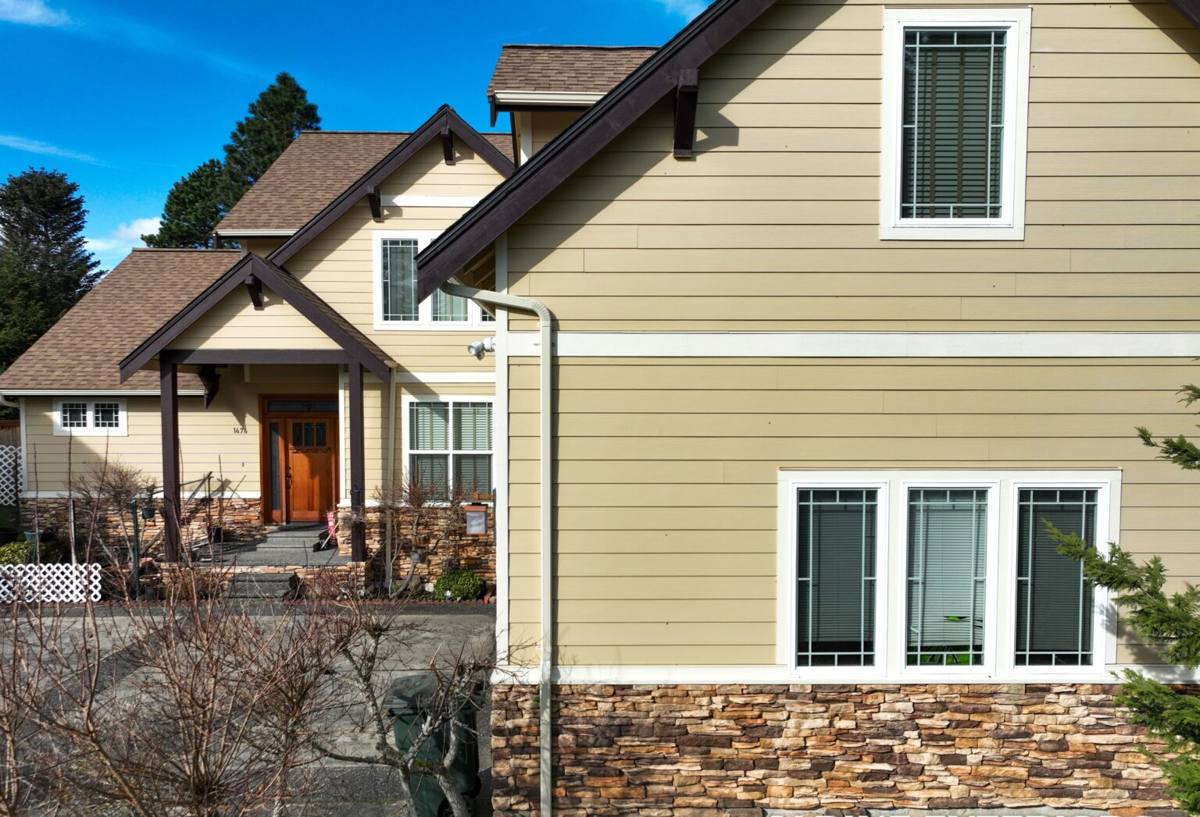
Why We Only Install James Hardie Siding
We install James Hardie fiber cement siding exclusively — no vinyl, no LP SmartSide, no Cemplank or Allura, no primed spruce or cedar. That's not a marketing position, it's a decision based on what actually holds up on homes in this climate. Vinyl expands and contracts with temperature swings and can crack or warp under sustained driving rain and wind exposure. Wood-based engineered siding like LP SmartSide relies on the integrity of its sealed edges and factory coating; once that's compromised by a bad cut, a missed touch-up, or years of moss holding moisture against it, it's a wood product with a wood product's vulnerabilities. Cedar is a beautiful natural material, but it demands ongoing maintenance — staining, sealing, moss treatment — that most homeowners underestimate until the siding is already showing damage.
James Hardie fiber cement is cement, sand, and cellulose fiber. It doesn't rot, it isn't a food source for moss and algae the way wood is, it's non-combustible, and it holds its shape through the temperature and moisture swings that are normal here. It's not maintenance-free — nothing exposed to a coastal climate is — but the maintenance it needs is realistic: periodic washing and caulk checks, not repainting or sealing on a recurring schedule.
The Right Hardie Product Line for a Blaine Home
James Hardie makes climate-engineered product lines, and choosing the right one for a coastal Whatcom County property matters more than most homeowners realize. Their HZ10 line is formulated for wetter, colder climates like ours, with different moisture-resistance performance than the HZ5 line built for hot, dry regions. We spec HZ10 products for Blaine installations because that's what the product was engineered to handle.
Beyond the climate line, homeowners choose between a few plank and panel styles:
- Lap siding — the traditional horizontal board look, available in different exposure widths and smooth or cedar-textured finishes
- Board and batten (vertical siding) — a more modern look that also sheds driving rain well due to its vertical seams
- Shingle-style panels — for homes that want a cedar-shake appearance without the maintenance of actual cedar shakes
- Trim boards — matched fiber cement trim at corners, windows, and fascia so the whole exterior system performs the same way
The right choice depends on the home's architecture and what look the owner wants, but the underlying material and climate rating should never be an afterthought on a property this close to the water.
ColorPlus Factory Finish vs. Field Painting
One of the most important decisions on a James Hardie project is whether to use ColorPlus factory-finished siding or have the siding field-painted after installation. ColorPlus is baked on at the factory in multiple coats under controlled conditions, and it comes with its own dedicated finish warranty separate from the product warranty. For a home exposed to salt air and driving rain, that factory-cured finish holds color and resists fading and chipping in a way that a field-applied coat — dependent on weather conditions at the time of painting — often can't match over the long run.
Field painting is sometimes the right call, particularly for color-matching an existing structure or an unusual custom color, but for most Blaine homeowners we recommend ColorPlus. It's one less maintenance item, and it's one less variable in a climate that's already asking a lot of the exterior.
What Correct Installation Involves
James Hardie siding is only as good as the installation behind it, and that's especially true in a wet coastal environment. A correct install includes:
- Proper water-resistive barrier (house wrap) installed and lapped correctly before any siding goes up
- Rainscreen or furring strip gap where conditions call for it, so water that gets behind the cladding can drain and the wall can dry
- Correct fastener type, spacing, and depth — over- or under-driven nails are one of the most common causes of early Hardie siding failure
- Manufacturer-specified clearances at grade, roof lines, decks, and other siding terminations, so water doesn't wick into the bottom edge of the boards
- Properly flashed and sealed windows, doors, and penetrations, since those transitions are where driving rain actually gets in
- Following Hardie's published installation instructions for the specific climate zone and product line being used
Skipping any one of these doesn't necessarily show up on day one — it shows up two, five, or ten years later as staining, soft spots, or paint failure at specific points on the house. That's why installation quality matters as much as the product choice itself, and why we treat both as part of the same job.
Our Process, Start to Finish
Every project starts with an on-site look at the home — the existing siding condition, what's underneath it, moisture or rot issues if any, and the specific exposures the house faces given its orientation and surroundings. From there we walk the homeowner through product line, style, and color options and put together a written estimate with no pressure to decide on the spot.
Once a project is scheduled, the work generally follows this sequence: removal of the old siding, inspection and repair of the sheathing underneath (this is where hidden moisture damage sometimes turns up, and we flag it before covering anything back up), installation of the water-resistive barrier and rainscreen where applicable, installation of trim and siding to Hardie's specifications, and a final walkthrough with the homeowner before we consider the job done. We keep the homeowner informed at each stage rather than disappearing until the crew shows back up with a final invoice.
Cost Factors on a Blaine Project
Every home is different, and we don't quote a number without seeing the house, but these are the main factors that move the price on a James Hardie project in this area:
| Factor | Why It Affects Cost |
|---|---|
| Siding style (lap, board and batten, shingle-style) | Panel and trim products vary in material cost and labor time |
| Finish (ColorPlus vs. field-painted) | ColorPlus adds material cost but removes a future painting expense |
| Existing wall condition | Sheathing repair or rot remediation found during tear-off adds labor and material |
| Home size and wall complexity | Cutting, corners, and detail work around windows and rooflines add labor time |
| Removal and disposal of old siding | Vinyl, aluminum, and old wood siding all haul and dispose of differently |
| Trim and accessory scope | Matching fiber cement trim at all corners and openings vs. reusing existing trim |
Broadly, a full James Hardie re-side is a mid-to-upper-tier exterior investment compared to vinyl, but it's also a system built to last decades with minimal upkeep, which changes the real cost picture over the life of the siding.
Choosing a Contractor Who Already Works This Area
A crew that regularly installs siding in Whatcom County's coastal communities already knows how to detail a house for salt exposure and driving rain — it's not a special case they're figuring out on your roof. Before hiring anyone for a James Hardie project in Blaine, it's worth checking a few things:
- Are they a certified or trained James Hardie installer, or do they install several different siding brands with no particular specialization?
- Do they explain rainscreen, flashing, and fastener details specific to this climate, or just talk about color and style?
- Do they carry proper licensing and insurance for exterior work in Washington?
- Will they put the product line (HZ10 vs. HZ5), finish type, and installation details in writing on the estimate?
- Do they have experience with older homes in this area where sheathing or moisture issues are common under existing siding?
A contractor who treats every siding job the same regardless of location is more likely to miss the details that matter on a home exposed to salt air and sustained coastal rain.
Living With James Hardie Siding After Installation
James Hardie siding doesn't need painting or sealing on a recurring schedule, but it isn't zero-maintenance. In this climate, we recommend an annual rinse-down to knock salt residue and organic buildup off the siding before it has a chance to sit there through another wet season, a periodic check of caulking at trim and window joints, and prompt attention to any moss or algae growth on north-facing or shaded walls before it spreads. None of that is heavy work, and it's a fraction of what cedar or field-painted products typically require to look right and perform well over time.
If you're planning a siding project in Blaine and want an honest look at what your home actually needs, we're happy to walk the property with you and put together a straightforward, no-pressure estimate.