 Ferndale Siding
 Building a Deck That Actually Holds Up in Everson
Everson sits far enough inland from the coast that people assume it's sheltered from the weather that batters Ferndale and the rest of Whatcom County. It isn't. The same marine air pattern that pushes salt-laden moisture up from Bellingham Bay still reaches this far up the valley, and the low, flat farmland around Everson holds humidity and river-bottom moisture longer than higher ground does. Add driving rain off the water and a moss season that can run eight months of the year, and you've got a climate that's genuinely rough on outdoor structures — decks especially, because they take the weather from every direction at once: rain from above, splash-back and standing moisture from below, and constant freeze-thaw cycling through the coldest months.
A deck built the way it might get built in a drier climate does not last here. This page covers what a deck actually needs to survive Everson's conditions, how we build for that, and why it matters to work with a crew that already knows this part of Whatcom County.
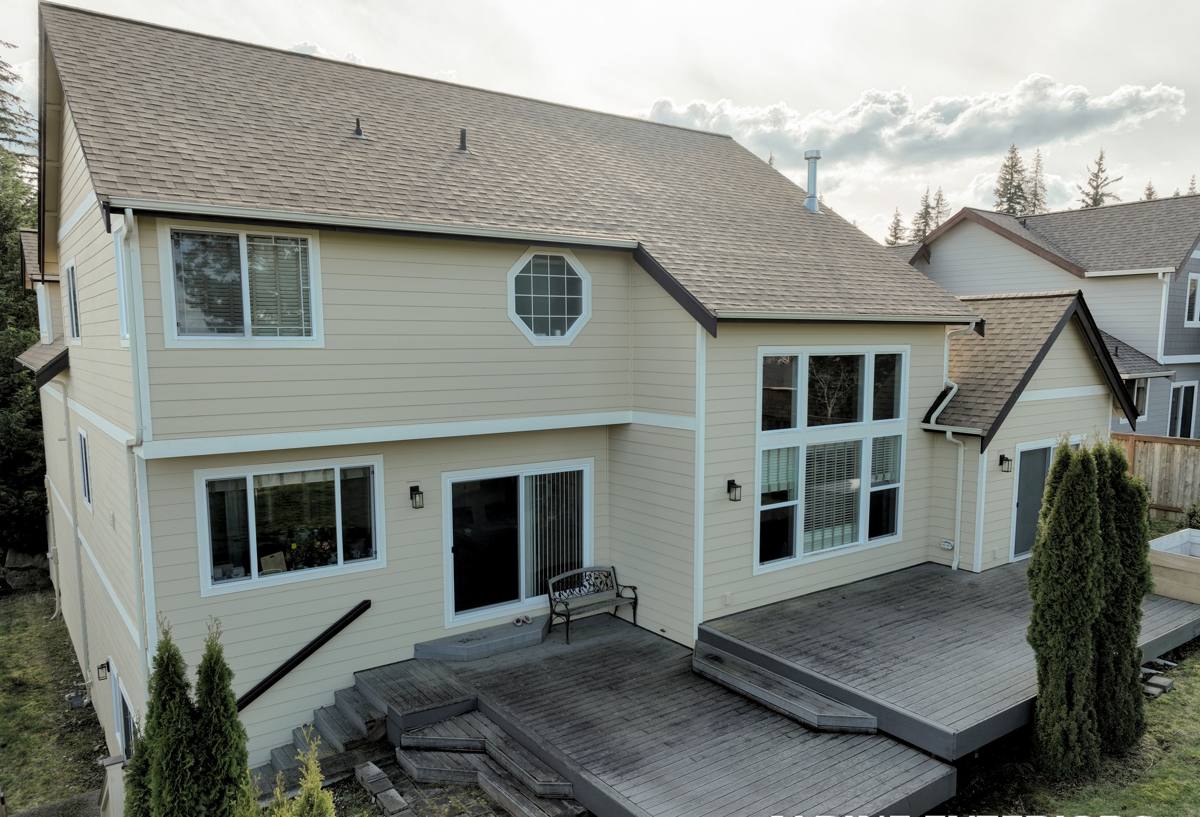
What Everson's Climate Does to an Ordinary Deck
We get called out to look at failing decks in and around Everson often enough to know the pattern. It's almost always one of the same few things:
- Moss and algae growth on horizontal surfaces that hold moisture from morning fog and dew, not just rain
- Ledger board rot where the deck attaches to the house, from flashing that was skipped or installed wrong
- Fastener corrosion — black streaking and eventual failure where the wrong screws were used with treated lumber or near salt-influenced air
- Joist and beam softening underneath the decking where airflow is poor and moisture just sits
- Footing movement on the soft, low-lying soil common around Everson's river-bottom farmland
None of these are exotic problems. They're the predictable result of building a deck for a dry climate and installing it in a wet one. Every part of a correct build below addresses one of them directly.
Salt Air, Driving Rain, and Moss — Not Separate Problems
It helps to think of these three as one combined stress rather than three separate issues. Salt-tinged marine air keeps metal fasteners and hardware corroding slowly even when it isn't raining. Driving rain gets pushed sideways under railings and against the house wall where a plain deck design offers no protection. And once wood surfaces stay damp for days at a time, moss and algae move in and hold even more moisture against the material, which speeds up everything else. A deck design that only accounts for one of these — say, a design that sheds rain well but uses the wrong hardware — still fails early.
What a Correctly Built Deck Needs Here
Footings Below Frost Depth, Sized for the Soil
Around Everson, ground near the Nooksack River and its floodplain tends to be softer and wetter than higher ground closer to Ferndale. Footings need to be sized and set deep enough to reach stable soil and below the local frost line, not just poured to a generic minimum. On lots where the ground stays saturated for long stretches of the year, we'll sometimes recommend larger footing pads or additional support posts even where code would technically allow fewer — it's cheaper to oversize a footing at construction than to jack and relevel a deck five years in.
Ledger Flashing That's Actually Sealed
The single most common point of hidden rot on an attached deck is the ledger board — the piece that bolts the deck to the house. It needs proper flashing, correct fastener spacing, and a water-resistant barrier behind it, not just lag screws through the siding. This is also the point where deck work and siding work overlap directly: if the flashing detail isn't right where the deck meets the wall, it doesn't just threaten the deck, it can send water behind your siding too.
Fasteners and Hardware Rated for the Conditions
We use corrosion-resistant, coated fasteners and structural hardware rated for exterior and treated-lumber contact — not standard interior-grade screws that streak and weaken within a couple of seasons in this air. This is a small line item on an estimate and one of the most common places corners get cut on lower-bid deck jobs.
Airflow Underneath
Low decks built tight to the ground with no ventilation trap moisture underneath, which is exactly what accelerates joist rot. Where grade and height allow, we build in ventilation gaps and skirting details that let air move instead of pooling.
Choosing a Decking Material for Everson Conditions
There's no single right answer — the right material depends on your budget, how much upkeep you want to do, and how the deck will be used. Here's how the common options actually compare in this climate, honestly:
| Material | How it handles rain & moss | Maintenance | Typical lifespan |
|---|---|---|---|
| Pressure-treated lumber | Sheds water fine if sealed regularly; moss grows on it like anything else without upkeep | Needs cleaning and re-sealing every 1-2 years | 15-20 years with upkeep |
| Cedar | Naturally rot- and insect-resistant, but still needs sealing to fight moss and graying | Annual cleaning, periodic sealing | 15-25 years with upkeep |
| Composite decking | Doesn't rot or absorb water like wood; some early composite products stayed damp and grew mildew, newer capped boards handle it much better | Occasional washing, no sealing or staining | 25-30+ years, manufacturer-dependent |
| PVC/cellular decking | Fully synthetic, sheds water and resists moss growth the best of the group | Lowest — periodic washing only | 25-30+ years |
We install all of these. Where we push back is on unsealed, low-grade treated lumber with no maintenance plan — not because the material itself is bad, but because in Everson's climate, an unmaintained wood deck will show moss and soft spots faster than the homeowner usually expects. We'll tell you that honestly at the estimate instead of letting you find out the hard way.
Design Choices That Matter on Everson Properties
Everson's mix of larger rural lots, farmland-adjacent properties, and closer-set residential streets means deck projects here vary more in scale than a typical subdivision job. A few things we weigh specifically for this area:
- Drainage and grading — on flatter, low-lying lots, we make sure the deck and surrounding grade don't trap water against the footings or the house foundation
- Distance and orientation — larger lots often mean more sun and wind exposure with no neighboring structures to break it, which changes how fast wood surfaces dry out (or don't) after rain
- Setback and property-line requirements — rural and semi-rural parcels around Everson can have different setback rules than in-town lots; we check this before design, not after
- Matching the house — since we're a siding company first, we build decks that actually integrate with the home's existing trim, color, and flashing details instead of looking bolted on
Permits and Local Requirements
Most new decks and any deck attached to the house require a building permit in Whatcom County, and the specifics — footing depth, guardrail height, stair geometry, ledger attachment method — are all inspected. On soft or low-lying ground near the river, an engineer's sign-off on footing design is sometimes required or simply the smarter move even when it isn't. We handle the permit application and coordinate inspections as part of the job; you shouldn't have to be the one chasing down the county.
Our Process, Start to Finish
- On-site estimate: we walk the property, look at grade, drainage, sun/wind exposure, and how the deck will tie into the house
- Design and material selection: we go over the honest trade-offs between wood, composite, and PVC for your budget and maintenance preference
- Permitting: we prepare and submit what the county requires and schedule inspections around the build
- Footings and framing: footings set below frost depth and sized for the soil, framing built with corrosion-resistant hardware throughout
- Ledger and flashing: the attachment point to your house gets flashed and sealed correctly before decking ever goes down
- Decking, railing, and finish work: installed to manufacturer spec so warranties stay intact
- Final walkthrough: we go over care and maintenance specific to whatever material you chose
Maintaining a New Deck Through Whatcom County's Wet Season
Even the best-built deck needs some seasonal attention in this climate. A simple, honest checklist we give Everson customers:
- Sweep debris off the deck regularly in fall — trapped leaves hold moisture and feed moss growth
- Rinse or lightly scrub surfaces a couple times a year to knock back algae and moss before it establishes
- Check and re-seal wood decking on the schedule appropriate to the product (usually every 1-2 years)
- Keep gutters and downspouts near the deck clear so runoff isn't dumping directly onto or under it
- Look at the ledger flashing and any spots where the deck meets the house once a year for early signs of moisture
- Address soft or spongy boards immediately — waiting lets rot spread to the framing underneath
Why It Matters to Hire a Crew That Already Works in Everson
A lot of deck-building advice online is written for a generic climate that doesn't exist here. Contractors who mostly work in drier regions or don't build in Whatcom County regularly can miss the details that actually matter locally — the footing depth appropriate for river-bottom soil, the flashing detail that keeps water out of both the deck and your siding, the fastener grade that won't streak and weaken in this air. We're a Ferndale-based exterior contractor that already works throughout Whatcom County, including Everson, so we're not learning the local conditions on your project — we're building to what we already know works here, and we're close enough to come back for warranty work or a maintenance check without it being a special trip.
Cost Factors to Expect
Every deck is priced around its own footprint, material, and site conditions, so we won't quote a number without seeing the property — but these are the main things that move the price up or down:
| Factor | Effect on cost |
|---|---|
| Deck size and shape | Larger footprints and multi-level or non-rectangular designs increase framing and material cost |
| Decking material | Composite and PVC cost more upfront than treated lumber but need far less long-term maintenance |
| Height and grade | Taller decks or steep/uneven lots require more substructure, stairs, and railing |
| Soil conditions | Soft or low-lying ground near the river may need larger footings or engineering, adding cost |
| Railing and guardrail style | Cable, glass, or custom railing systems cost more than standard baluster railing |
| Permitting complexity | Engineered footing plans or unusual setback situations can add time and fees |
If you're planning a custom deck in Everson or anywhere else around Ferndale and Whatcom County, we're glad to come take a look and put together a straightforward, no-pressure estimate — you can reach us through the form below.