 Ferndale Siding
 Decking Built for Everson's Climate, Not Just Any Climate
Everson sits along the Nooksack River in Whatcom County, tucked in among mature trees, farmland, and a lot of seasonal shade. That combination means more standing moisture on outdoor surfaces than homeowners closer to open ground get, and a longer stretch of the year where a deck simply doesn't dry out between rains. Add in the broader Whatcom County pattern of long wet winters, heavy dew, and a moss season that can run from October well into April, and you have a climate that is hard on any decking material that isn't specifically chosen and installed for it.
Composite decking exists largely to solve this problem. It doesn't absorb water the way wood does, it doesn't feed algae and moss growth the way untreated lumber does, and it holds up to repeated wet-dry cycling without cupping, splintering, or rotting from the inside out. But composite decking is only as good as its installation — a poorly built substructure or wrong fastening approach will let moisture problems show up anyway, just in different places.
Why Composite Makes Sense for This Area Specifically
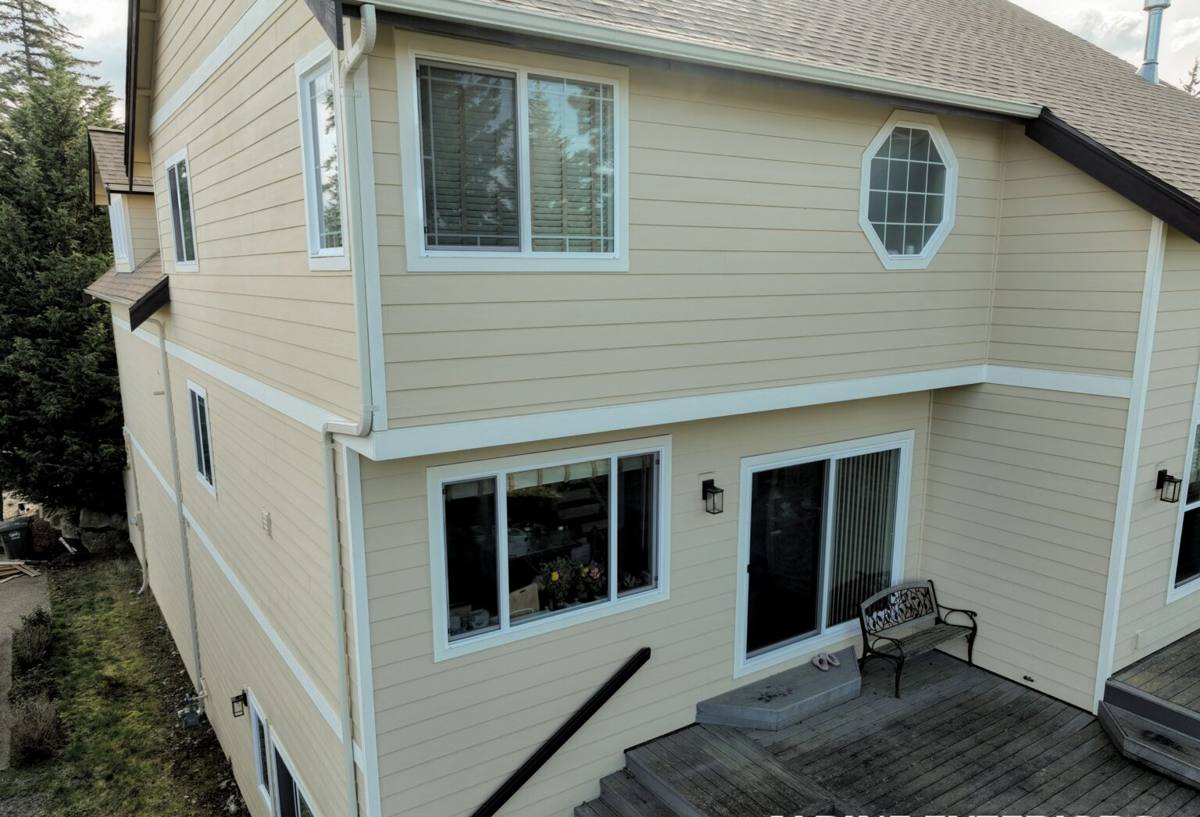
Wood decking has a real place in some builds, and we're honest about that when it's the right call. But for a typical Everson property — shaded lot, river-valley humidity, gutters and downspouts draining toward the yard, moss creeping across every horizontal wood surface by midwinter — composite decking solves problems that wood decking creates every single year:
- No annual sanding, staining, or sealing to keep water out of the wood fibers
- Surface resists the moss and algae film that forms on shaded wood decking in wet months
- No splintering as boards age, which matters for kids and bare feet
- Consistent color and board dimension over time — no warping, cupping, or twisting boards to replace
- Better long-term value once you account for the maintenance labor wood decking requires here
The trade-off is upfront cost — composite boards cost more per square foot than standard lumber. For most Everson homeowners planning to keep the house more than a few years, the maintenance savings and the fact that the deck still looks good in year eight make that math work out.
Where Wood Still Makes Sense
We're not going to pretend composite is right for every situation. If budget is the deciding factor for a smaller, low-use deck, or if you specifically want the option to refinish or change the look of the wood over time, pressure-treated or cedar decking is still a legitimate choice — it just needs a realistic maintenance commitment in this climate, and we'll tell you that upfront.
What a Correct Composite Deck Installation Actually Involves
Composite boards are more forgiving than wood in some ways, but they're less forgiving in others — mainly around framing spacing, fastening, and drainage. A deck that looks fine going in can develop problems within a year or two if these steps get skipped or rushed.
Substructure and Framing
Composite decking is heavier and behaves differently under thermal expansion than wood, so joist spacing has to match the manufacturer's specification for the board profile — this is often tighter than what wood decking allows, especially at angles, stairs, or picture-frame borders. We also use joist tape or an equivalent moisture barrier on top of the framing, which matters more here than in a drier climate because it keeps rainwater and condensation off the wood joists underneath the composite surface.
Fastening and Board Gapping
Hidden fastener systems are standard on most composite decking now, and they matter for more than looks — proper board gapping lets water drain through instead of pooling on the surface, which is exactly what you want given how often Everson decks sit wet after rain. Gapping that's too tight traps moisture and debris between boards; too wide and the deck feels and looks unfinished. This is a spec, not a guess, and it varies by board width and expected seasonal expansion.
Drainage Beneath the Deck
On a lot with any grade toward the house, or with a deck built low to the ground, we look at where water actually goes once it passes through the board gaps. A deck that traps water underneath just relocates the moisture problem instead of solving it — that's a common shortcut on lower-cost installs and it shows up as mildew smell or soft framing a few years later.
Our Process
- On-site assessment — we look at sun exposure, tree cover, drainage, and how the deck will attach to the house, since that connection point is the most common source of long-term moisture problems.
- Material selection — we walk through board tiers and color options based on your budget and how much sun versus shade the space gets, since heat build-up and fade resistance vary by product line.
- Framing and structural work — joists, ledger board flashing, and any footing or beam work needed to meet code and support the composite decking's weight and spacing requirements.
- Board installation — hidden fastening, correct gapping, and clean transitions at stairs, borders, and house connections.
- Final walkthrough — we check board alignment, fastening, and drainage with you before calling the job done.
Composite Decking Product Considerations
Not all composite decking is built the same way, and the differences matter more in a wet climate than in a dry one. Here's how the main categories generally compare:
| Type | Moisture Behavior | Maintenance | Typical Lifespan |
|---|---|---|---|
| Uncapped composite | Can absorb moisture at the surface over time; more prone to staining and mold in shaded, wet spots | Occasional cleaning; more sensitive to standing water and debris | 15–20 years |
| Capped composite | Polymer shell resists moisture absorption and staining; handles our wet season well | Periodic rinsing; minimal upkeep | 25+ years |
| PVC decking | Fully synthetic, essentially moisture-proof | Low; lighter material, can show scratches more | 25–30+ years |
| Pressure-treated wood | Absorbs and releases moisture constantly; highest risk for moss, splitting, and warping here | Annual cleaning, sealing, and inspection | 10–15 years with upkeep |
For most Everson properties with shade and river-valley humidity, we generally recommend capped composite as the best balance of cost, durability, and low maintenance. We'll walk through specific manufacturer options and warranty terms once we've seen the site — brand and board profile availability shifts, and we don't want to quote a product line before confirming what fits the framing and budget.
Cost Factors to Plan Around
Composite decking costs vary by project, but the main drivers are consistent across jobs. Understanding these upfront helps you plan a realistic budget before we even get to a number.
| Factor | Why It Affects Cost |
|---|---|
| Deck size and shape | Complex angles, curves, or multi-level decks require more cutting, framing, and labor |
| Board tier (capped vs. uncapped vs. PVC) | Higher-performing boards cost more per square foot but reduce long-term maintenance |
| Substructure condition | Existing framing that needs repair or replacement adds to the scope before decking goes down |
| Railing and stair details | Composite or metal railing systems, custom stair layouts, and lighting add to material and labor cost |
| Site access | Tree cover, slope, or limited equipment access can add labor time |
We give straightforward, itemized estimates rather than a single lump number, so you can see what's driving the cost and where there's room to adjust the scope if needed.
Maintenance in a Moss-Prone Climate
Even low-maintenance composite decking benefits from a little seasonal attention here, mainly because of how much moss and organic debris this region generates:
- Sweep leaves, needles, and debris off the deck regularly through fall, especially under tree cover
- Rinse the surface periodically to clear pollen, dust, and the thin biofilm that can form in shaded, damp spots
- Keep gutters and downspouts clear so water isn't dumping onto or near the deck surface
- Check board gaps once a year for trapped debris that can hold moisture against the boards
- Confirm any furniture feet or planters aren't blocking drainage gaps for long stretches
None of this is the sealing-and-staining routine wood decking demands — it's basic upkeep that takes an hour or two a few times a year, which is the whole point of choosing composite in a climate like this.
Why a Crew That Already Works Everson Matters
A lot of what makes a composite deck perform well here isn't in the product spec sheet — it's in how the job accounts for local conditions. We already know how Everson's tree cover and river-valley humidity affect drainage and drying time, what joist spacing and flashing details hold up through a full Whatcom County winter, and how ledger board connections need to be sealed against a house that's going to see driving rain from multiple directions most of the year. That's the difference between a deck that looks right on installation day and one that still looks right in year ten.
Get a Straightforward Estimate
If you're weighing composite decking for a home in Everson, we're glad to come take a look, walk through board options that fit your budget and site conditions, and give you a clear, itemized estimate — no pressure, no upsell. Use the form below to get started.