 Ferndale Siding
 Why Sumas Homes Need Siding Built for This Climate
Homes in and around Sumas sit in one of the wetter, greener corners of Whatcom County, and the siding on those homes works harder than siding almost anywhere else in the state. You've got moisture moving in from three directions at once: marine air pushing in off the Salish Sea, driving rain that comes sideways during fall and winter storms, and a moss and algae season that can stretch eight months or more when the sun doesn't get a real chance to dry things out. Add in the freeze-thaw cycles that show up most winters, and you have a set of conditions that will find every weak point in a siding system within a few years, not a few decades.
This isn't a scare story — it's just what the material has to survive. Wood-based sidings swell, split, and rot when they can't dry out between rain events. Vinyl gets brittle and can crack in a hard freeze, then buckles when it's stretched by summer heat. Some fiber cement competitors handle the moisture fine but chalk, fade, or need repainting well before their siding is structurally worn out. If you're replacing siding on a Sumas-area home, the climate should be the first thing that shapes your material decision, not the last.
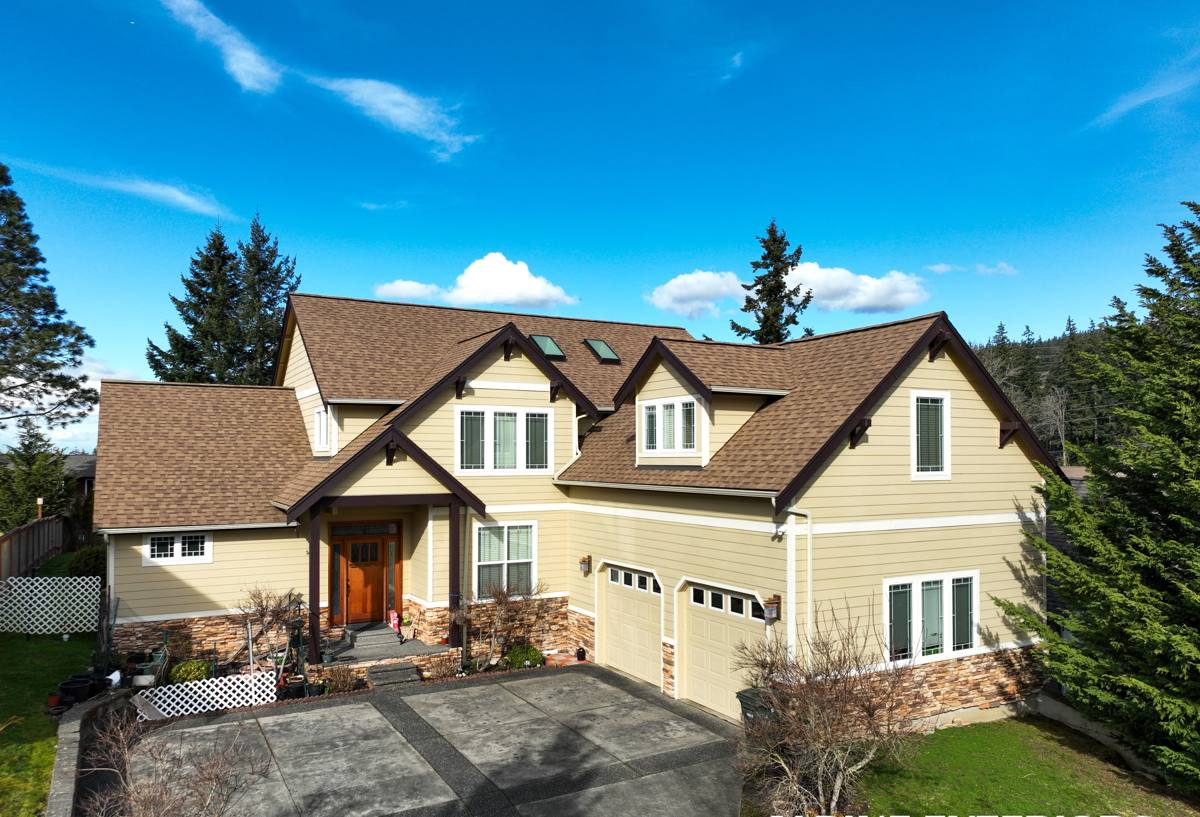
What We Install: James Hardie Fiber Cement, Exclusively
We install James Hardie fiber cement siding and nothing else. Not vinyl, not LP SmartSide, not Cemplank or Allura, not primed spruce or cedar. That's a deliberate standard, not a sales preference. Hardie's fiber cement is a blend of cement, sand, and cellulose fibers, engineered to be non-combustible and dimensionally stable — meaning it doesn't expand and contract with moisture and temperature the way wood-based products do. For a climate like Whatcom County's, where siding sits wet for long stretches of the year, that stability is the difference between a wall system that lasts decades and one that starts failing at the seams within ten years.
The HZ5 Engineering Advantage
James Hardie makes climate-specific product lines, and the HZ5 line is engineered for the Pacific Northwest's wet, marine-influenced conditions. It's formulated to resist moisture intrusion and to hold up under the freeze-thaw stress that's common in Whatcom County winters. That's a meaningfully different product than a generic fiber cement board made for a dry climate, and it's one reason we don't treat "fiber cement" as a single interchangeable category — the engineering behind the specific product matters.
ColorPlus Factory Finish
Most of what we install uses Hardie's ColorPlus finish — a color baked onto the board at the factory under controlled conditions, rather than field-painted after installation. Field-applied paint on fiber cement is more exposed to adhesion problems in a wet climate, and touch-ups become an ongoing maintenance item. A factory finish holds its color and its bond far more consistently over the life of the siding, which matters even more here than in drier parts of the state.
Why We Don't Install the Alternatives
Homeowners in Sumas and the surrounding area sometimes ask about vinyl or engineered wood siding because they're familiar or cheaper up front. We're upfront about why we don't put them on homes here.
| Material | What it gets right | Why it's a poor fit for this climate |
|---|---|---|
| Vinyl siding | Low upfront cost, no painting required | Becomes brittle in freezing temps and can crack under impact; doesn't handle the area's driving wind-driven rain at seams as well as a rigid, factory-finished board |
| LP SmartSide (engineered wood) | Lighter weight, easier to cut and install | Wood-based core is more vulnerable to moisture wicking at cut edges and joints; long-term performance depends heavily on perfect caulking and maintenance in a wet climate |
| Primed spruce / cedar | Natural look, traditional appeal | Requires ongoing repainting and sealing; wood siding in a high-moisture, long-moss-season climate is one of the highest-maintenance choices available |
| Cemplank / Allura (other fiber cement) | Similar core material to Hardie, competitive pricing | Different manufacturing standards and regional engineering; we standardized on one product line so we can guarantee installation practices and warranty support to spec |
None of these are "bad" products in every application — they just don't line up with what we've seen hold up best on homes that face this much sustained moisture. We'd rather stand behind one system we know inside and out than install several we can't fully vouch for in this climate.
What Correct Installation Actually Involves
Fiber cement siding is only as good as its installation. A huge share of the siding failures we get called out to inspect aren't a material problem — they're an installation problem. For a Sumas-area home, a few details matter more than usual because of the moisture load:
Weather Barrier and Drainage Plane
Correct installation starts with a continuous weather-resistant barrier behind the siding, with a drainage gap that lets any moisture that does get behind the boards find its way back out instead of sitting against the wall sheathing. In a climate with this much sustained rain, a missing or poorly lapped drainage plane is one of the most common causes of hidden rot years down the road.
Fastening and Clearances
Hardie's installation specs call for specific fastener types, spacing, and penetration depth — get this wrong and you compromise both the warranty and the board's wind resistance, which matters when you're getting driving rain on exposed elevations. Ground clearance and clearance from roof lines, decks, and other flashing also need to be held to spec so water sheds away from the siding instead of wicking up into it.
Joint Sealing and Flashing
Butt joints, corners, and every penetration (vents, hose bibs, light fixtures) need proper flashing and sealant compatible with the ColorPlus finish. A joint that's caulked but not flashed will eventually let water in behind the caulk — flashing is what actually keeps water out long term.
- Continuous weather-resistant barrier with a functioning drainage gap
- Manufacturer-spec fasteners at correct spacing and penetration depth
- Proper clearance from grade, roofing, decks, and other siding terminations
- Flashed (not just caulked) joints, corners, and penetrations
- Factory-cut or properly sealed field cuts to protect the board's core from moisture
- Ventilation details that let the wall assembly dry if moisture ever does get in
Our Process for Sumas-Area Projects
We walk every project the same way, whether it's a full re-side or a section replacement:
- On-site inspection. We look at your current siding, sheathing condition, and any moisture staining or soft spots, especially on north-facing and weather-exposed walls that take the brunt of driving rain.
- Written estimate. You get a clear scope of work and pricing before anything is scheduled — no vague allowances.
- Prep and tear-off. Old siding comes off, and we inspect the sheathing underneath for rot or damage that needs to be addressed before new siding goes up.
- Weather barrier and drainage plane installation. This step gets done right, every time, regardless of whether it's visible in the finished product.
- Hardie siding installation to manufacturer spec, including correct fastening, flashing, and joint treatment.
- Final walkthrough so you can see the finished work and ask questions before we consider the job done.
Cost Factors for a Sumas Siding Project
Every home is different, but a few factors consistently drive the price on projects in this area:
| Factor | Why it affects cost |
|---|---|
| Current siding removal | Tear-off and disposal of old material adds labor, especially with multiple layers or wood rot underneath |
| Sheathing repair | Moisture damage found during tear-off (more common on homes with a history of wood or vinyl siding here) needs to be repaired before new siding goes on |
| Home size and complexity | Roof lines, dormers, and multiple stories add cutting, flashing, and labor time |
| Product line and profile | HardiePlank lap siding, HardiePanel, and shingle-style profiles carry different material and install costs |
| Trim and accessory work | Fascia, soffits, and trim boards done at the same time affect total scope |
We don't quote broad numbers over the phone without seeing the home — too many of these factors are site-specific, especially moisture damage that's only visible once the old siding is off.
Why a Crew That Already Works in This Area Matters
Siding crews that mostly work in drier parts of the state sometimes cut corners on drainage planes and clearances that don't cause visible problems for years in a low-moisture climate — but those same shortcuts fail fast in Whatcom County. A crew that regularly works Ferndale, Sumas, and the rest of the county knows which details can't be skipped: the drainage gap, the flashing at every penetration, the ground clearance that keeps splashback and standing moisture away from the bottom course. That local pattern recognition is worth more than it sounds like on paper — it's the difference between siding that looks fine at installation and siding that's still performing in year fifteen.
Maintenance: What to Expect After Installation
Correctly installed Hardie siding with a ColorPlus finish is genuinely low-maintenance, but "low" doesn't mean "none," especially with a long moss season working against you.
- Rinse siding annually to remove dirt, pollen, and early moss or algae buildup before it takes hold
- Keep gutters clear so overflow doesn't run down the siding face repeatedly in one spot
- Trim back vegetation and tree cover that keeps siding shaded and damp longer than it needs to be
- Inspect caulking at trim and penetrations every couple of years and have any gaps resealed
- Address any impact damage (a dented or cracked board) promptly rather than letting moisture get into an exposed edge
None of this is heavy upkeep compared to repainting wood siding every few years, but it's worth planning for if you want the siding to reach its full service life in this climate.
Get a Free, No-Pressure Estimate
If you're weighing siding options for a home in the Sumas area, we're happy to come take a look, walk you through what we're seeing, and give you a straightforward estimate — no pressure, no upsell into a product we wouldn't put on our own homes. Use the form below to get started.