 Ferndale Siding
 Lynden's Climate Is Tougher on Siding Than It Looks
Lynden sits a little farther inland than Ferndale's coastline, but it still sits squarely inside the same wet, marine-influenced weather pattern that defines Whatcom County. The direct salt air that hits homes closer to the Salish Sea is less of a factor here, but the driving rain, high humidity, and long stretch of gray, moisture-heavy months are not. If anything, Lynden's mix of open farmland and tree-lined residential streets creates its own version of the same problem: siding that stays damp longer than it should, moss and mildew that get a head start in shaded areas, and wood-based products that quietly absorb water for months before anyone notices a problem.
Moss season in this part of Washington isn't a two-week nuisance. It's a condition that starts in early fall and doesn't fully let go until well into summer. Siding that isn't engineered to handle that kind of sustained moisture exposure — or that isn't installed with the right clearances and flashing details — ages faster here than it would in a drier climate, even if it looks fine on the surface for the first few years.
What "Correct" Siding Installation Actually Means
Siding installation isn't just cutting boards to fit and nailing them up. In a climate like Lynden's, the difference between siding that lasts decades and siding that fails early almost always comes down to details that aren't visible once the job is done:
Water Management Comes First
Every correct installation starts with a drainable water-resistive barrier, properly lapped and taped, with flashing at every window, door, and roofline transition. Siding is not the primary defense against water — it's the second line. The barrier behind it is what actually keeps a wall assembly dry when wind-driven rain gets past the surface, which it will, repeatedly, over the life of the house.
Clearances and Gaps
Fiber cement siding needs a minimum gap from grade, roof lines, decks, and any hard surface, plus proper caulking or gapping at butt joints depending on the manufacturer's spec. Skipping these clearances is one of the most common shortcuts we see, and it's also one of the fastest ways to trap moisture right where it does the most damage.
Fastening to Spec
Fiber cement has specific nailing patterns, fastener types, and blind-nail vs. face-nail requirements depending on the product line and exposure. Installed wrong, siding can crack, buckle, or loosen years before it should — problems that often get blamed on the product when the real cause was the install.
Why We Only Install James Hardie Fiber Cement
We don't install vinyl, LP SmartSide, primed spruce, cedar, or other fiber cement brands. That's a deliberate standard, not a sales pitch, and it's worth explaining honestly.
Vinyl is affordable and low-maintenance in the sense that it doesn't need painting, but it's a thin plastic product that expands and contracts with temperature swings, can warp or crack in impact, and simply doesn't hold up the same way against decades of wind-driven rain and freeze-thaw cycling. Wood-based products like primed spruce or engineered wood siding perform well when maintained perfectly, but they depend on an unbroken paint film to keep moisture out — and in a climate with this much sustained dampness, that film is under constant stress. A single missed touch-up spot can turn into a moisture problem that spreads under the surface before it's visible.
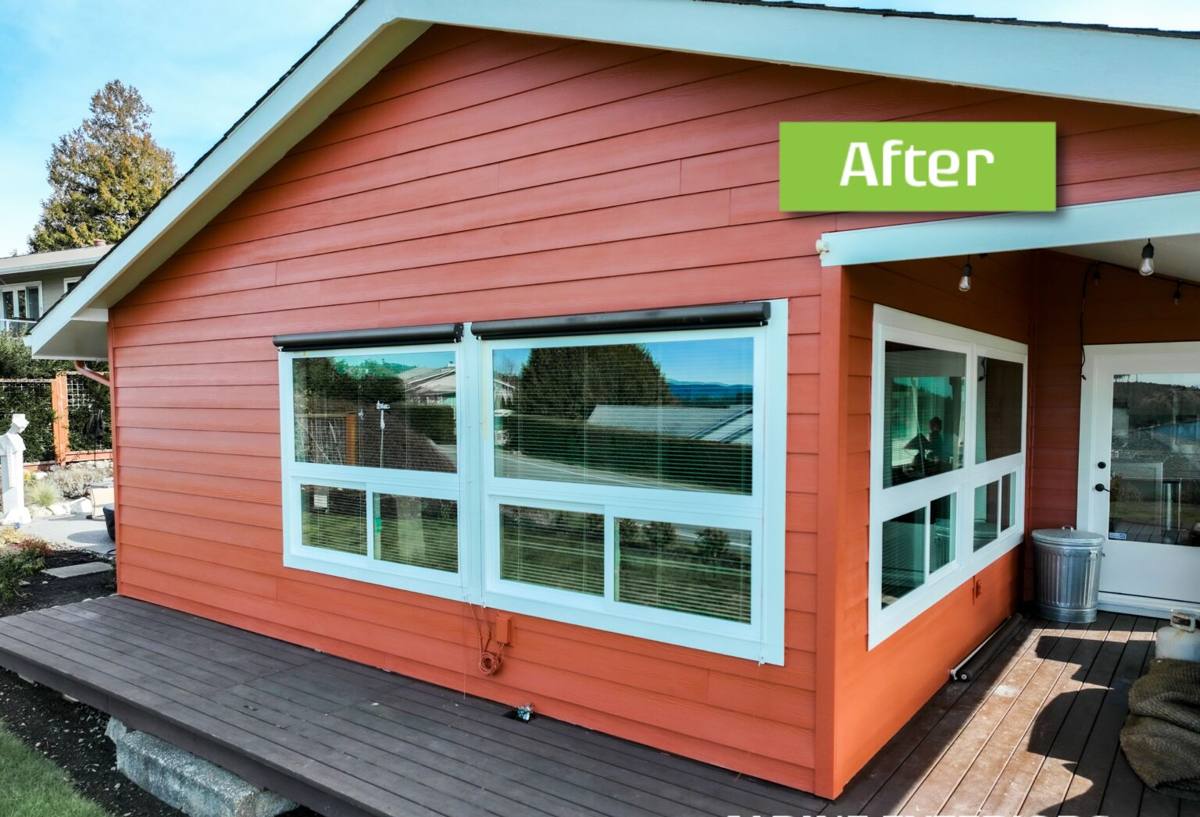
James Hardie fiber cement is engineered specifically to resist the conditions that cause the most damage here: it's non-combustible, dimensionally stable, and doesn't swell, rot, or feed moss and mildew the way wood-based products can. Hardie also builds specific product lines engineered for different climate zones — the HZ5 line used in this region is formulated for colder, wetter conditions, which matters more in Whatcom County than in most of the country. The factory-applied ColorPlus finish is baked on under controlled conditions, which gives it more consistent coverage and a longer service life than field-applied paint, and it carries a strong, transferable manufacturer warranty that follows the house, not just the original owner.
None of this means other products are junk. It means that after years of doing this work in this specific climate, we standardized on the one product system that consistently holds up the way it's supposed to, and we'd rather turn down a job than install something we don't believe will perform here.
Our Installation Process for Lynden Homes
1. On-Site Assessment
We start by walking the exterior, checking existing siding condition, looking for signs of trapped moisture, rot, or prior water intrusion around windows and rooflines, and evaluating whether a full tear-off or a re-side over new sheathing is the right call.
2. Tear-Off and Sheathing Check
Old siding comes off, and the sheathing underneath gets inspected. This is often the first time anyone has seen the actual condition of a wall in years, and it's the step that catches problems before they get sealed behind new siding.
3. Water-Resistive Barrier and Flashing
A new drainable barrier goes on with proper overlaps, and flashing is installed at every penetration and transition point — this is the step that determines how the wall performs during the next twenty years of Whatcom County rain, not the siding itself.
4. Hardie Installation to Manufacturer Spec
Panels or planks go on following James Hardie's fastening, clearance, and joint requirements exactly, including the caulking and gapping details specific to the product line chosen for the home.
5. Trim, Caulking, and Final Detail Work
Trim boards, corner details, and final caulking get finished to a standard that holds up to inspection, not just to a quick look from the curb.
Signs Your Current Siding Is Already Failing
Homeowners in Lynden often call us after noticing one of these signs, not realizing how long the underlying problem may have been developing:
- Soft or spongy spots when you press on the siding, especially near the bottom courses
- Persistent moss or mildew staining that comes back within weeks of cleaning
- Visible cracking, warping, or buckling boards
- Peeling or bubbling paint that keeps recurring in the same spots
- Gaps or separation at butt joints and corners
- Rising utility bills that suggest the wall assembly isn't insulating the way it should
Any one of these is worth a look. Several together usually mean the water-resistive barrier or flashing has failed, not just the surface material.
Cost Factors for a Lynden Siding Project
Every home is different, and we don't quote pricing without seeing the property, but the factors that move cost up or down are consistent. This gives you a realistic sense of what drives the number before you get an estimate.
| Factor | Why It Matters | Typical Cost Impact |
|---|---|---|
| Tear-off vs. re-side | Removing old siding and inspecting/repairing sheathing takes more labor than siding over sound existing sheathing | Medium to High |
| Home size and wall complexity | More corners, dormers, and roof transitions mean more cutting, flashing, and detail work | Medium to High |
| Siding profile chosen | Lap siding, panel systems, and shingle-style Hardie products all have different install labor and material costs | Low to Medium |
| Existing moisture damage | Rotted sheathing or framing found during tear-off adds repair scope before new siding goes on | Variable, sometimes significant |
| Trim and color detail | Custom trim packages and multi-color schemes add labor time | Low to Medium |
Why Hiring a Local Ferndale Crew Matters
Siding crews that work Whatcom County regularly develop a feel for this climate that outside crews don't have. That shows up in small, practical ways: knowing which wall orientations in Lynden take the worst weathering, understanding how long moss season actually runs here, and building in the water-management details that matter most in a marine-influenced climate rather than following a generic install checklist written for a drier region.
It also matters for accountability. A crew based near Ferndale isn't disappearing after the final payment clears — we're still working in this area next season, and next year, which is part of why we don't cut corners on flashing or clearances that won't show a problem for a few years.
What to Expect During Your Project
A siding installation is disruptive by nature — it's construction happening on the outside of an occupied home. Here's what a well-run project should look like from the homeowner's side:
- A clear, written scope of work before anything starts, including whether it's a full tear-off or re-side
- A realistic timeline based on home size and weather windows, since fiber cement installation depends on dry working conditions
- Daily site cleanup, since tear-off debris and old siding materials add up quickly
- Direct communication if hidden damage is found behind the old siding, before any repair work proceeds
- A final walkthrough where trim, caulking, and finish details are checked together, not just glanced at from the driveway
Get a Straight Answer About Your Home
If your siding is showing signs of wear, or you're simply planning ahead before the next wet season sets in, it's worth getting a professional look at what's actually going on behind the surface. We offer free, no-pressure estimates for Lynden homeowners — no obligation, just an honest assessment of what your home needs and what a correct James Hardie installation would involve. Use the form below to get started.