 Ferndale Siding
 Roofing in Sandy Point: A Different Set of Conditions
Sandy Point sits right up against the water in Whatcom County, and that location changes what a roof has to deal with compared to homes just a few miles inland in Ferndale. Salt-laden air off the Strait of Georgia works its way into metal fasteners, flashing, and vents. Wind-driven rain doesn't just fall straight down here — it gets pushed sideways under eaves and around roof penetrations. And the shade from mature trees combined with our long wet season means moss and moisture have months at a time to work on a roof surface. None of this is unusual for the area, but it does mean a roof built for a drier, more sheltered part of the county won't necessarily hold up the same way on a Sandy Point lot.
When we quote a new roof installation for a home in this neighborhood, we're not just looking at square footage. We're looking at how close the home sits to the water, how much tree cover shades the roof plane, which slopes take the worst of the weather, and what that means for material choice, fastener selection, and detailing at every edge and penetration.
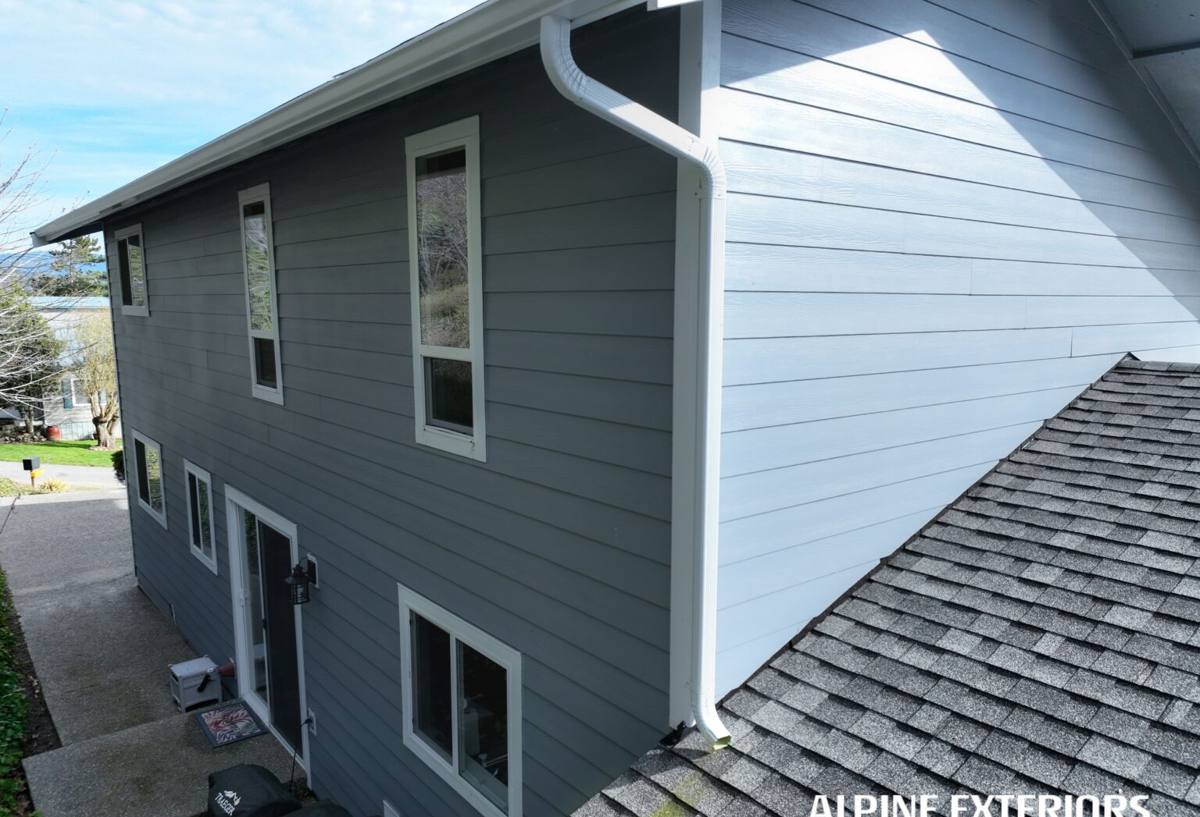
What Salt Air, Rain, and Moss Actually Do to a Roof
Salt Air and Metal Components
Salt in the air accelerates corrosion on exposed metal — flashing, drip edge, nail heads, vent stacks, and any exposed fasteners. Standard galvanized fasteners can start showing rust streaks well before the rest of the roof shows its age. On a coastal install, we pay close attention to fastener and flashing material so the metal isn't the weak point in an otherwise sound roof.
Driving Rain and Water Intrusion
Wind-driven rain is a detail problem, not a material problem. Most leaks on coastal homes don't happen because the shingles or panels failed — they happen because water got pushed sideways under a flashing lap, around a vent boot, or into an under-sized valley. A correct install accounts for this with proper underlayment coverage, generous flashing laps, and extra attention at every roof-wall intersection and penetration.
Moss and Moisture Retention
Shaded, north-facing slopes and roofs under tree cover stay damp longer after a storm than roofs in open sun. That extended moisture window is exactly what moss needs to establish. Once moss takes hold, it lifts shingle edges, traps water against the roof deck, and shortens the life of the roofing material — sometimes years before you'd expect it to need replacing.
Signs a Sandy Point Roof Needs Replacing, Not Just Repairing
- Granule loss showing up in gutters or at downspout outlets, especially after wind events
- Moss or dark streaking covering large sections rather than isolated spots
- Soft or spongy decking felt underfoot in the attic or during a walk-on inspection
- Rusting flashing, vent boots, or fasteners visible from the ground or attic
- Daylight visible through the roof deck at eaves, ridges, or penetrations
- Repeated patch repairs in the same area that keep reopening after storms
- Interior water stains on ceilings near exterior walls, valleys, or chimneys
A roof showing one or two of these can often be repaired. Several at once, or a roof already past its expected service life, usually means replacement is the more honest recommendation — and the more cost-effective one over time.
What a Correct New Roof Installation Involves
Tear-Off and Deck Inspection
We remove the existing roofing down to the deck rather than layering over it. That's the only way to actually see the condition of the sheathing, check for soft spots or rot from past moisture intrusion, and confirm the framing is sound before anything new goes on. Any damaged decking gets replaced before underlayment goes down — covering over a compromised deck just hides a problem that will resurface.
Underlayment and Ice/Water Protection
Given how much wind-driven rain this stretch of coastline sees, we don't treat underlayment as an afterthought. Full synthetic underlayment coverage, with self-adhering ice and water membrane at eaves, valleys, and penetrations, gives the roof a second line of defense if wind ever pushes water past the surface material.
Flashing and Penetration Detail
This is where most coastal roof failures actually originate. Step flashing at walls, counter-flashing at chimneys, and properly lapped valley flashing all need to shed water even when it's coming in sideways. We use flashing and fasteners suited to a marine-influenced environment rather than whatever is cheapest to source.
Ventilation
Balanced intake and exhaust ventilation keeps the attic dry and temperature-regulated, which matters for both shingle life and moisture control. Poor ventilation traps humid air against the underside of the deck — exactly the kind of damp environment that speeds up rot and, indirectly, moss growth on the surface above it.
Final Material Installation and Cleanup
Once the deck, underlayment, and flashing are right, the finish material goes on to manufacturer spec — correct nailing pattern, exposure, and overlap. We do a full magnetic sweep and site cleanup before calling the job done.
Material Options for a Coastal Whatcom County Home
| Material | How It Handles Salt Air & Moisture | Moss Resistance | General Lifespan |
|---|---|---|---|
| Architectural asphalt shingle | Good with corrosion-resistant fasteners and flashing | Moderate; benefits from algae-resistant granules | 25–30 years |
| Metal (standing seam or panel) | Excellent when specified with coastal-grade coatings and fasteners | High; smooth surface sheds moss more easily | 40–50+ years |
| Synthetic/composite shingle | Good; resists moisture absorption better than wood | Moderate to high depending on product | 30–50 years |
| Cedar shake | Requires more upkeep in salt air; can be done well but needs a maintenance commitment | Low without regular treatment | 20–30 years with upkeep |
We don't push a single product on every home. What we do is explain the trade-offs honestly — maintenance burden, upfront cost, how a material behaves specifically in salt air and shade, and what the warranty actually covers — so the decision fits the house and the budget, not just a sales script.
Our Process for Sandy Point Homeowners
- On-site assessment: We walk the roof (or inspect from the attic and ground when a walk-on isn't safe), check the deck, ventilation, and existing flashing, and note the site-specific factors — tree cover, exposure, water proximity.
- Written estimate: A clear scope of work and cost breakdown, with material options explained rather than a single take-it-or-leave-it number.
- Scheduling around the weather: Roofing work depends on dry windows. We plan the install to minimize the time your deck is exposed and communicate if weather pushes the timeline.
- Installation: Tear-off, deck repair as needed, underlayment, flashing, ventilation, and final material — done in that order, not skipped for speed.
- Final walkthrough: We go over the finished roof with you before considering the job complete.
Why Local Experience on This Coastline Matters
A crew that mainly works drier, more sheltered neighborhoods can still do competent work, but they're not necessarily thinking about salt exposure on fasteners or the extra flashing attention a wind-driven rain event demands. Working regularly in Sandy Point and along this part of the Whatcom County coastline means we've seen how roofs actually age here — where moss tends to establish first, which details fail under sideways rain, and how salt air shortens the life of standard hardware if it isn't accounted for up front. That's knowledge that shows up in the small decisions during an install, not just in the finished look of the roof.
Maintenance That Extends the Life of a New Roof
- Keep gutters and downspouts clear so water isn't backing up under the roof edge
- Trim back overhanging branches to reduce shade and debris buildup on the surface
- Have moss treated or gently removed before it spreads rather than after it's established
- Schedule a periodic visual inspection, especially after major windstorms off the water
- Address minor flashing or fastener issues promptly rather than waiting for a leak
A well-installed roof in this environment can still lose years off its service life without basic upkeep. None of this requires a big time investment — it's mostly about not letting small issues sit through another wet season.
Get a Free, No-Pressure Estimate
If your Sandy Point roof is showing its age, or you'd rather plan a replacement on your own timeline than wait for a leak to force the issue, we're happy to take a look and give you a straightforward assessment. There's no obligation and no pressure — just an honest read on where your roof stands and what your options are. Use the form below to request a free estimate.