 Ferndale Siding
 Everson's Climate Is Harder on Siding Than It Looks
Everson sits inland from the Salish Sea, tucked into the Nooksack River valley, and homeowners here sometimes assume that distance from open water means their siding gets an easier ride than homes right on Bellingham Bay. It doesn't, not really. Whatcom County's marine air pushes up the valleys on the prevailing westerlies, carrying salt-tinged moisture with it, and the same low, gray weather system that soaks Ferndale settles over Everson too. Add the valley's tendency to hold humidity after a storm passes — cold air draining down from the foothills at night, fog sitting in low spots through the morning — and you get siding that stays damp longer than it would in a drier inland climate.
That combination of driving rain, salt-bearing wind, and a moss season that can run eight or nine months a year is exactly the environment that separates siding materials that hold up from siding materials that don't. Wood-based products swell, delaminate at the edges, and feed moss and mildew. Vinyl doesn't rot, but it doesn't stop the moisture problem underneath it either, and it becomes brittle and faded well before most homeowners expect to replace it. Fiber cement, installed correctly, is the material that actually matches what this specific climate demands.
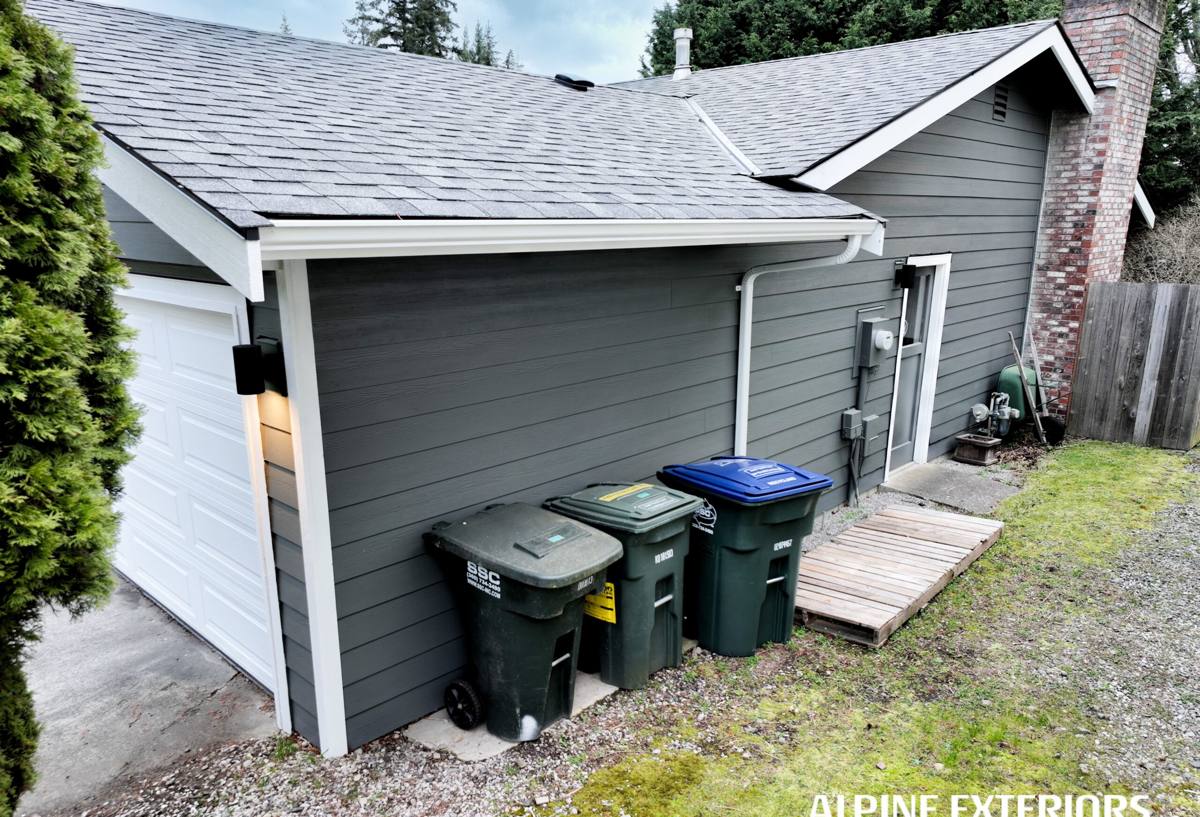
Why Fiber Cement Is the Right Call for This Area
Fiber cement siding is made from cement, sand, and cellulose fiber, pressed and cured into a dense, stable board. It doesn't absorb water the way wood does, so it doesn't swell, cup, or delaminate when it takes on rain — and in Everson, siding takes on rain often. It also doesn't provide the organic food source that wood-based siding gives to moss and mildew, which matters enormously in a county where moss season isn't really a season, it's most of the year.
It's also dimensionally stable across temperature swings, which keeps joints and caulk lines tight over time instead of opening up gaps that let water behind the cladding. And because it's non-combustible, it holds up to the drier, warmer late-summer stretches Whatcom County has seen more of in recent years without adding fuel to a structure the way wood siding does.
What This Means Day to Day
- No repainting every 3-5 years to keep water out of failing seams
- No soft, spongy spots developing at butt joints or bottom edges
- Far less moss and algae growth to pressure-wash off each spring
- Color that's baked into the board at the factory, not just brushed on afterward
What a Correct Installation Actually Involves
Fiber cement is only as good as the install underneath it. Most of the problems homeowners eventually deal with — cracking near fasteners, staining at the bottom edge, boards that look fine for a few years and then start failing all at once — trace back to installation shortcuts, not the material itself. In a wet climate like this one, those shortcuts show up faster.
The details that matter most in Everson's climate
- Clearance from grade and hardscape: siding needs a minimum gap above soil, decking, and paved surfaces so splash-back and standing moisture don't wick into the bottom edge of the board.
- Rain-screen or drainage plane behind the siding: a proper water-resistive barrier and, ideally, a drainage gap lets any moisture that gets behind the siding drain and dry instead of sitting against sheathing.
- Flashing at every penetration: windows, doors, hose bibs, light fixtures, and roof-to-wall transitions all need correctly lapped flashing — this is the single most common failure point on homes we're called to repair.
- Fastener placement and depth: fiber cement cracks or blows out if fasteners are driven too deep, too shallow, or through the wrong zone of the board — manufacturer fastening schedules exist for a reason.
- Factory-cut edges kept intact: ColorPlus finished boards are engineered to seal at the factory edge; every field cut needs to be sealed with the correct touch-up product before it goes on the wall.
- Caulking only where specified: over-caulking traps water behind boards just as often as under-caulking lets it in — joints are designed to either seal or drain, not both improvised.
How Our Process Works
We keep the process the same on every Everson-area job because consistency is what prevents the mistakes above.
- On-site assessment: we look at your existing siding, sheathing condition, trim, and any moisture damage before quoting anything, so the estimate reflects your actual wall, not a generic number.
- Tear-off and sheathing check: once old siding is off, we inspect the sheathing underneath for rot or soft spots — this is often where hidden water damage from a previous installation shows up.
- Weather barrier and flashing: we install or verify the water-resistive barrier and flash every window, door, and penetration before a single piece of siding goes up.
- Installation to manufacturer spec: proper clearances, fastening pattern, and joint treatment, following James Hardie's published installation requirements rather than a generalized approach.
- Trim, caulk, and touch-up: factory-finished trim, sealed field cuts, and a final detail pass so seams and corners look finished, not patched.
- Final walkthrough: we go around the house with you before we consider the job done.
The James Hardie Lines We Install
We install James Hardie fiber cement exclusively — not LP SmartSide, not Cemplank, not Allura, not vinyl, and not primed wood siding. That's a deliberate standard, not a sales pitch. Hardie's ColorPlus factory finish, HardieZone engineering for regional climate demands, and warranty structure are built specifically to hold up in exactly the conditions Whatcom County produces. We'd rather turn away a lower-cost alternative than install something we know will need attention again in five to ten years.
Common product choices for this area
| Product | Best Use | Why It Fits Here |
|---|---|---|
| HardiePlank Lap Siding | Most single-family homes | Traditional lap look, engineered for HZ5 wet-climate performance |
| HardieShingle | Accent gables, dormers | Textured detail without wood's moisture absorption |
| HardiePanel Vertical Siding | Modern facades, porch accents | Clean lines, same non-combustible, moisture-stable core |
| HardieTrim | Corners, fascia, window/door trim | Matches board performance instead of pairing cement siding with wood trim that fails first |
What Affects Cost on an Everson-Area Home
Every home is different, and we won't quote a number without seeing the house, but these are the factors that actually move the price up or down.
| Factor | Effect on Cost |
|---|---|
| Full tear-off vs. siding over existing layer | Tear-off costs more upfront but is the only way to inspect and fix sheathing damage |
| Home size and wall complexity | More corners, gables, and dormers mean more cutting, flashing, and labor time |
| Existing moisture or rot damage | Hidden sheathing repair, found once old siding is off, is the most common source of a revised estimate |
| Siding profile and accents | Mixing lap siding with shingle or panel accents adds material and labor over a single flat profile |
| Trim scope | Full trim replacement costs more than reusing sound existing trim, but mismatched materials rarely age well together |
Maintaining Fiber Cement in This Climate
Fiber cement cuts maintenance dramatically compared to wood, but "low-maintenance" isn't "no-maintenance" — especially with Whatcom County's moss season working against you year-round.
- Rinse siding with a garden hose once or twice a year to clear pollen, dust, and early moss growth before it takes hold
- Avoid direct high-pressure washing at close range — it can force water behind joints and butt seams
- Keep gutters clear so overflow doesn't run down the siding face repeatedly in the same spot
- Trim back shrubs and trees so foliage isn't holding moisture against the wall
- Recaulk any joint that shows a gap or cracking as soon as you notice it, rather than waiting for the next paint cycle
- Watch bottom courses near grade and at deck ledgers — these are the first places moisture problems tend to show up
Why It Matters That We Already Work This Area
A crew that installs siding across Whatcom County regularly already knows how the Nooksack valley's damp, moss-friendly conditions behave differently from a drier inland climate, and adjusts flashing, clearances, and drainage details accordingly instead of applying a one-size-fits-all approach. We're not learning this area's quirks on your house — the moisture patterns, the moss growth, the way marine air moves up the valley — we've already accounted for them on other homes nearby. That familiarity shows up in fewer callbacks and fewer surprises once the old siding comes off.
If you're weighing a siding replacement on an Everson-area home, we're happy to come take a look, walk the exterior with you, and give you a straightforward estimate — no pressure, no inflated urgency, just what we actually see on your walls. Use the form below to get started.