 Ferndale Siding
 Energy-Efficient Windows for Nooksack Homes
Nooksack sits out in the river valley on the eastern side of Whatcom County, close enough to the Nooksack River and the surrounding farmland that its climate has its own character compared to homes closer to Bellingham Bay. It's a damp, wind-exposed setting — storms carry marine-influenced moisture in from the Salish Sea, driving rain moves sideways more often than it falls straight down, and the valley holds humidity longer than higher, better-drained ground does. That combination is hard on window seals, frames, and glazing over time, and it's also exactly the environment where an inefficient window shows up fastest — on a heating bill, on a fogged-over pane, on a draft you can feel standing next to the glass on a cold January morning.
We install and replace windows for homes throughout this part of Whatcom County, and on energy-efficient window work specifically we treat the installation detail as being just as important as the window unit itself. A high-performance window that's flashed and sealed correctly will hold its efficiency for decades. The same window installed with gaps at the rough opening, or with caulk standing in for real flashing, will leak both water and heated air within a few seasons — no matter what the spec sheet says.
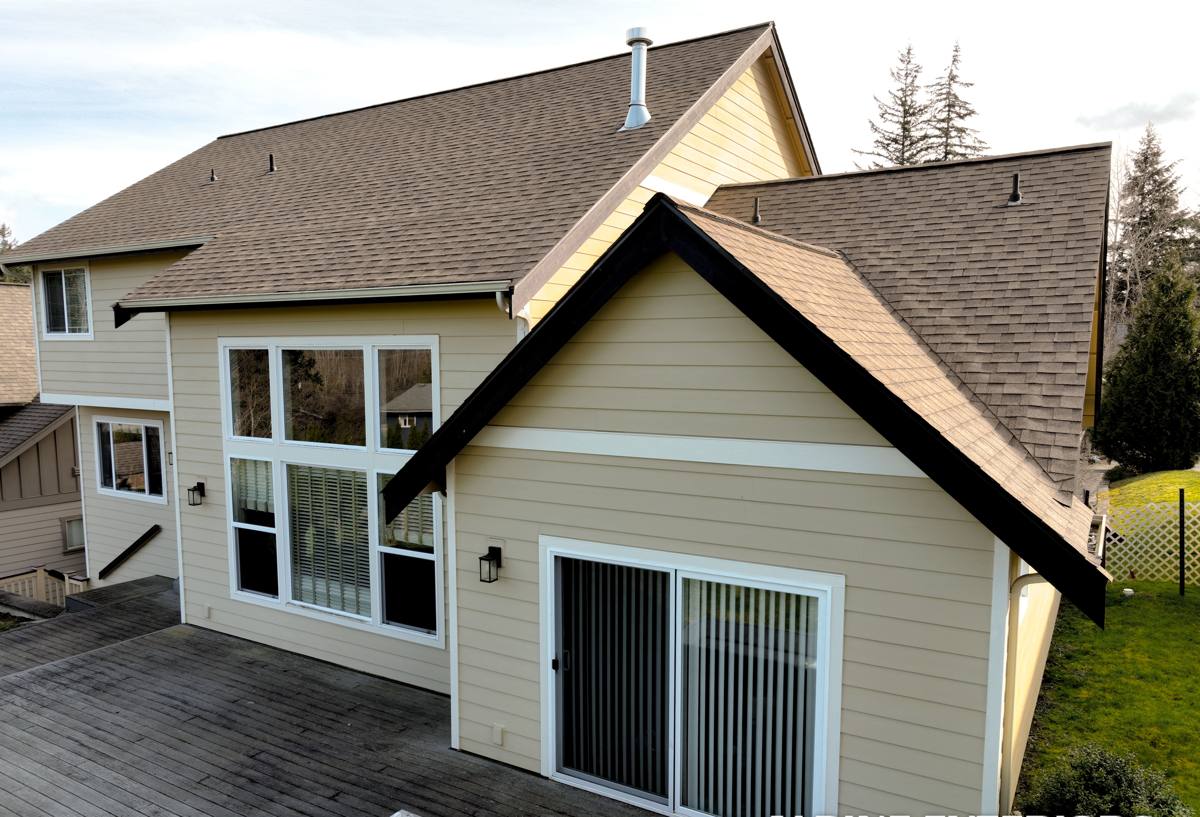
What Nooksack's Climate Does to Window Performance
Driving Rain and Wind Exposure
Open valley and farmland terrain around Nooksack doesn't offer much of a wind break, so storms moving through push rain sideways into wall assemblies and window openings rather than letting it run cleanly off the glass. Wind-driven rain finds gaps around a window frame that would never see water in a calmer, more sheltered setting, and once water is getting behind a frame, energy performance is usually already breaking down too — a compromised seal lets in both moisture and outside air.
Valley Damp and River Bottomland Moisture
Nooksack's position in the river valley means the air here tends to stay damp longer after a storm than it would on higher, better-drained ground elsewhere in the county. That sustained humidity puts steady pressure on window seals, sashes, and the wood or composite trim around older frames, and it's a big part of why window components that would hold up fine in a drier climate start failing years earlier out here.
A Long Moss and Mildew Season
Mild temperatures and near-constant valley moisture add up to a moss and mildew season that runs across much of the year on shaded walls and north-facing window trim. It's more than a cosmetic issue — sustained growth on window sills and casings holds moisture directly against the frame, which is exactly the condition that leads to soft wood, failed seals, and rot if it isn't cleaned off and addressed.
Winter Temperature Swings and Condensation
Cold, damp winter stretches paired with heated interior air create real condensation pressure on window glass and frames. Older single-pane or failing double-pane windows show this constantly — fogging between panes, moisture pooling on interior sills, or a cold radiant feeling near the glass even when the furnace is running. That's a sign a seal has already failed, not just an inconvenience to live with.
What Actually Makes a Window Energy-Efficient
"Energy-efficient" gets used loosely in window marketing, so it's worth being specific about what actually determines how a window performs in a climate like this one.
U-Factor
U-factor measures how well a window resists heat transfer — the lower the number, the better it holds heated air inside during Whatcom County's long damp, cold stretches. For this climate zone, a lower U-factor matters more than it would somewhere with milder winters.
Solar Heat Gain Coefficient
Solar heat gain coefficient (SHGC) measures how much solar heat a window lets through the glass. In a climate with as much cloud cover as this region gets, SHGC is a smaller factor than it would be in a sunnier state, but it still affects how a south- or west-facing window performs on the clearer days this area does get.
Air Leakage
Air leakage measures how much outside air actually infiltrates around the sash and frame. This is often the single biggest factor in real-world comfort and energy loss, and it's determined as much by installation quality — how tightly the frame is sealed into the rough opening — as by the window unit's own rating.
Glazing and Gas Fill
Double- and triple-pane glazing packages with low-E coatings and inert gas fill between the panes cut heat loss significantly compared to older single-pane or basic dual-pane glass. Low-E coatings also help reduce interior condensation during cold, damp stretches, which is a common complaint we hear from homeowners with older windows in this area.
Signs Your Windows Are Losing Energy
- Fogging or visible moisture trapped between the panes of a double-pane window
- Noticeable drafts or cold spots near the frame even with the window fully closed and locked
- Interior sills that feel cold to the touch or collect condensation regularly through winter
- Rooms near windows that are harder to keep at a comfortable temperature than the rest of the house
- A heating bill that's crept up without any other obvious cause
- Wood trim or sills that feel soft, look discolored, or show visible rot near the frame
- Visible daylight or gaps where the frame meets the surrounding siding or trim
Repair vs. Replacement: How We Make the Call
Not every underperforming window on a Nooksack property needs full replacement. A window with a failed seal but a sound frame and functional hardware is often a reasonable repair or reglaze candidate. A window with rotted framing, a warped sash, or persistent air leakage that sealing hasn't fixed usually isn't — at that point continuing to patch it costs more over time, in both labor and lost energy, than a proper replacement would.
| Condition | Repair Often Works | Replacement Usually Makes Sense |
|---|---|---|
| Fogged glass, sound frame and hardware | Yes — reglaze or seal replacement | Only if the frame is also compromised |
| Stiff, broken, or corroded hardware | Yes — hardware replacement | Not usually on its own |
| Soft or rotted wood framing | Rarely a lasting fix | Yes |
| Persistent draft despite fresh sealing | Sometimes, if flashing is the real cause | Yes, if the unit itself is the source |
| Single-pane, no upgraded glazing | Possible short-term fix | Yes, for real energy and comfort gains |
Choosing the Right Frame and Glazing Package
We install vinyl and fiberglass window systems suited to this region's wet, mild climate, and we walk homeowners through real trade-offs rather than pushing one brand as the only correct answer. What matters most for a Nooksack property is a tight, well-engineered frame, a glazing package suited to sustained cold and damp conditions, and hardware that holds up under continuous valley moisture — not the name on the label.
| Factor | What to Look For | Why It Matters in Nooksack |
|---|---|---|
| Frame material | Vinyl or fiberglass, properly reinforced | Both resist rot in a way uncladded wood frames don't, which matters given how much moisture this valley holds |
| Glazing package | Double or triple-pane with low-E coating | Cuts heat loss and reduces interior condensation during long damp, cold stretches |
| Gas fill | Argon or krypton between panes | Improves insulating performance over an air-filled gap at minimal added cost |
| Hardware grade | Corrosion-resistant locks and hinges | Holds up longer against the sustained valley humidity than standard-grade hardware |
| Weatherstripping | Compression-fit, replaceable seals | Directly determines air leakage performance over the life of the window |
Manufacturer warranties on the glass and frame are only as good as the installation behind them, which is why we treat our own installation workmanship as a separate commitment from the product's factory warranty.
Installation Detail: Why It Determines Whether Efficiency Claims Hold Up
Flashing and Rough Opening Sealing
A window's U-factor and glazing rating are tested under lab conditions, not with wind-driven rain hitting it sideways in a river valley. Real-world energy performance depends just as much on how the window is set into the rough opening — flashing that laps correctly with the surrounding weather-resistive barrier, insulation packed properly around the frame without being overcompressed, and every seam sealed with materials rated for sustained moisture exposure. This is standard practice on every window we install, not an upgrade homeowners have to request.
Common Installation Mistakes We See on Older Homes
On repair and replacement calls in this area, the most common source of both water intrusion and energy loss isn't the window unit failing — it's a rough opening that was never insulated evenly, or caulk used as a substitute for proper flashing instead of a supplement to it. Caulk alone cracks and breaks down over time; it was never meant to be the only line of defense against wind-driven rain or the only seal against outside air.
Cost Factors for Energy-Efficient Window Projects in Nooksack
| Factor | What It Affects | Why It Matters Here |
|---|---|---|
| Number and size of openings | Total material and labor cost | Larger homes or homes with many window openings scale cost accordingly |
| Frame material and glazing package | Unit cost per window | Higher-performance glazing costs more upfront but pays back faster given this climate's heating demand |
| Existing frame condition | Whether a full-frame or insert replacement is possible | Rotted or out-of-square openings often require full-frame replacement rather than a simpler insert |
| Trim and siding integration | Labor to properly tie flashing into the surrounding wall | Correct integration is what actually determines long-term performance in this valley's wind and rain |
| Order lead time | Project timeline, not direct cost | Custom-sized windows built for a specific opening often take several weeks to arrive |
Exact pricing depends on the specific property, its window count, and current frame condition, which is why we walk the home in person before giving a real number instead of quoting off a generic price sheet.
Our Process — and Why a Local Crew Matters
We start with an on-site look at the existing windows, checking frame condition, seal integrity, hardware function, and how the current flashing ties into the siding around each opening. From there we give a straightforward read on which windows are reasonable repair candidates and which make more sense to replace, along with a written scope before any work begins. Flashing, insulation, and drainage detailing are handled as standard practice on every job — not offered as an optional add-on.
A crew that works this part of Whatcom County regularly already understands how wind-driven rain and sustained valley moisture behave on real homes here over a full year, not just how a product performs on a spec sheet. That experience shapes the small decisions on install day — how much lap a flashing detail gets, how evenly a rough opening gets insulated, which hardware grade actually holds up against continuous river-valley humidity — and those decisions are what determine whether a window installation delivers real energy savings for one winter or for decades.
Questions Worth Asking Before You Hire
- How do you handle flashing and rough opening sealing, not just which window brand you sell
- Do you separate the manufacturer's product warranty from your own installation warranty
- What's the realistic lead time on ordering, given this region's typical scheduling
- Can you explain, window by window, why you're recommending repair versus replacement
- Are you licensed and insured to do exterior work in Washington state
If your Nooksack home has drafty, foggy, or hard-to-close windows — or you're simply not sure whether repair or replacement makes more sense — we're glad to take a look and give you an honest read. Reach out using the form below to schedule a free, no-pressure estimate.