 Ferndale Siding
 Building a Deck That Actually Holds Up in Sandy Point
Sandy Point sits close enough to the water that every deck out here is fighting a different battle than one built ten miles inland in Ferndale or elsewhere in Whatcom County. Salt-laden air, wind-driven rain off the Strait, and a moss season that can stretch from October well into spring all work on a deck's fasteners, framing, and surface at the same time. A deck built to a generic spec sheet will show problems in a few years — loose railings, corroded hardware, slick boards, soft spots where water sat too long. A deck built for this specific location holds its finish and its structure much longer.
This page is about deck building specifically for Sandy Point homes: what the environment demands, what a correct build actually involves, and how our process handles the details that get skipped when a crew isn't used to working this close to the water.
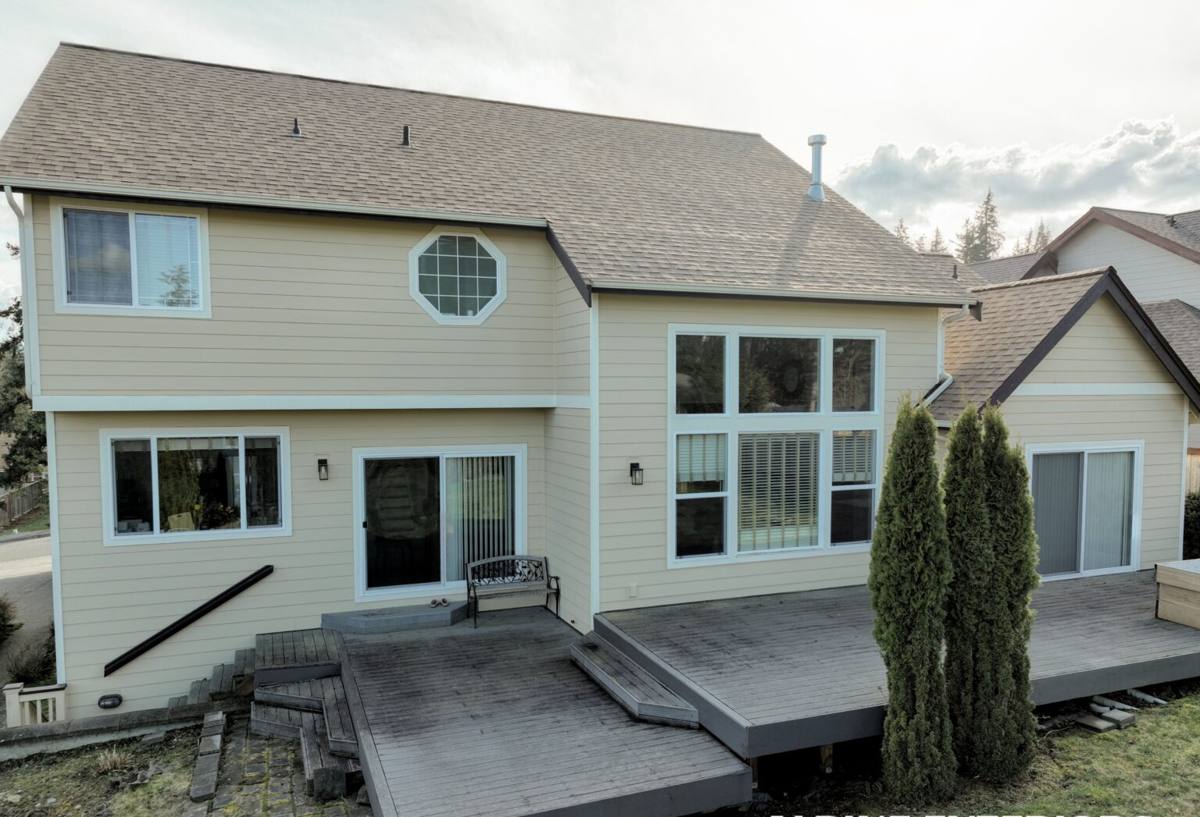
What Salt Air, Rain, and Moss Actually Do to a Deck
Salt Air and Metal
Airborne salt accelerates corrosion on anything metal — fasteners, joist hangers, railing brackets, bolts. Standard hot-dip galvanized hardware can start showing rust streaks and pitting within a few years this close to the water. Once a fastener corrodes, it loses holding strength long before it looks obviously bad, which is why railings and stair connections are the parts most likely to fail quietly.
Driving Rain
Rain that comes in sideways off the water finds every gap a calmer climate would forgive — under flashing laps, around post bases, into end grain that isn't sealed. Water that gets into a joint and can't drain or dry out is what causes rot, not rain that simply falls and runs off.
Moss and Constant Damp
A long moss season means extended stretches where deck surfaces stay damp and shaded, especially under trees or on the north side of a house. Moss and algae hold moisture against the decking surface, and on wood that means slower drying and faster surface decay. On any material, a damp, mossy deck is also a slip hazard.
Choosing Decking Material for This Location
There's no single "right" decking material for every Sandy Point property — it depends on budget, how much upkeep you want to do, and how exposed the deck is to wind and salt spray. Here's how the common options actually compare in this environment, in plain terms.
| Material | How it handles salt air & rain | Maintenance | Typical lifespan here |
|---|---|---|---|
| Pressure-treated wood | Fine if fasteners and flashing are corrosion-resistant; the wood itself needs sealing | Annual cleaning, re-sealing every 1-2 years | 10-15 years with upkeep |
| Cedar | Naturally rot-resistant but still needs finish maintenance in salt air | Regular cleaning, periodic staining/sealing | 15-20 years with upkeep |
| Composite decking | Doesn't absorb water or rot; some boards can still show mold/mildew if not cleaned | Occasional washing, no sealing/staining | 25+ years, warranty-backed |
| PVC decking | Fully water-resistant, handles salt exposure well | Lowest maintenance of the group | 25+ years, warranty-backed |
Composite and PVC cost more up front, but for a deck that sits exposed to wind and spray, the reduced maintenance and moisture resistance often pay for themselves over the deck's life. Wood decks aren't a bad choice — plenty of solid decks around here are wood — but they need an owner who's willing to keep up with cleaning and sealing on schedule, not just when it looks bad.
Framing and Fasteners: The Part Nobody Sees
The decking surface is what you notice; the framing underneath is what actually determines how long the deck lasts. In a salt-air environment, we treat hardware selection as part of the design, not an afterthought:
- Stainless steel or heavy-coated corrosion-resistant fasteners and joist hangers, not standard-grade hardware
- Properly flashed ledger boards where the deck attaches to the house, so water can't track behind the siding
- Post bases that keep wood off standing water and allow drainage underneath
- Joist tape or cap flashing on framing lumber to slow moisture absorption at the top of each joist
- Spacing and fastening patterns that account for wood movement from repeated wet-dry cycles
None of this is visible once the deck is finished, which is exactly why it's the part most likely to get shortcut on a low bid. It's also the part that determines whether a deck is solid in year twelve or starting to feel spongy.
Footings, Drainage, and Grading
Many Sandy Point lots sit on sandy or loose soil close to grade, and some have limited slope for water to run off naturally. A deck footing that isn't set to the right depth and doesn't account for local soil and drainage can settle or heave over time, which shows up as a deck that's no longer level or a railing post that's started to lean. Before we set footings, we look at how water moves across the specific lot — where it pools, where the roofline sheds onto the deck area, and whether the ground under and around the deck needs any grading or drainage work first. Getting this right before the first post goes in avoids problems that are expensive to fix once the deck is built.
Railings, Stairs, and Fastener Corrosion
Railings and stairs take more direct handling and more direct weather exposure than the deck field, which is why they're usually the first place corrosion problems show up. Loose railing posts are almost always a sign that the connection hardware has started to corrode or the post base wasn't set into solid framing to begin with. We build railing and stair connections with the same corrosion-resistant hardware as the rest of the frame, and we make sure post attachments tie into full-depth blocking rather than relying on the decking or a thin rim joist to hold the load.
Our Deck Building Process
1. On-Site Assessment
We walk the specific lot, look at sun and wind exposure, existing drainage, soil condition, and how the deck will connect to the house. This is where we talk through material trade-offs based on your budget and how much maintenance you actually want to do.
2. Design and Permitting
We put together a plan that fits the site and meets current building code, and we handle the permit application through the appropriate local jurisdiction. Deck permits typically cover footing depth, structural framing, railing height, and stair geometry — all things inspectors check before and after the work.
3. Footings and Framing
Footings are set to proper depth for the soil conditions on site, framing goes up with corrosion-resistant hardware throughout, and ledger attachment is flashed correctly before any decking goes down.
4. Decking, Railings, and Stairs
Decking is installed with proper spacing for drainage and material movement, railings and stairs are built to code height and load requirements, and every connection point gets the same fastener standard as the framing below.
5. Final Walkthrough
We walk the finished deck with you, cover basic care for whatever material you chose, and make sure everything is solid before we call the job done.
Maintenance Checklist for a Sandy Point Deck
Whatever material you choose, a few habits make a real difference in how long it lasts in this climate:
- Sweep off standing leaves and debris regularly, especially in fall and through the wet months
- Clean moss and algae off the surface at least once a year, more often on shaded sections
- Rinse salt residue off railings and hardware periodically if the deck faces the water directly
- Check railing posts and stair connections yearly for movement or looseness
- Reseal or re-stain wood decking on schedule rather than waiting until it looks weathered
- Keep gutters and downspouts near the deck clear so roof runoff isn't dumping onto it
Permits and Local Considerations
Deck construction in this area generally requires a building permit once the deck exceeds a certain height or size, and inspections check footing depth, framing, and railing safety. Requirements can vary depending on whether a property falls under Whatcom County jurisdiction or a specific local zoning overlay, and waterfront-adjacent properties sometimes have additional setback or shoreline considerations worth checking before design work starts. We handle this as part of the process rather than leaving it for the homeowner to sort out.
Why a Local Ferndale Crew Matters for This Job
A crew that only occasionally works this close to the water can miss the details that matter most here — using standard hardware instead of corrosion-resistant fasteners, skipping proper ledger flashing, or specifying a finish that isn't built for constant damp and moss exposure. Working regularly in Sandy Point and the surrounding Ferndale area means we've seen how decks actually age in this specific environment, not just how they're supposed to perform on paper. That shows up in the hardware we choose, how we handle drainage and grading, and the maintenance guidance we give you at the end of the job.
If you're planning a new deck or need an existing one evaluated for safety and structural issues, we're happy to take a look and give you a straightforward, no-pressure estimate using the form below.