 Ferndale Siding
 Custer's Climate Puts Real Demands on Siding
Custer sits in a part of Whatcom County where marine air, near-constant winter rain, and long stretches of overcast, damp weather aren't occasional events — they're the baseline. Homes here are close enough to the water that salt-laden air is a factor in how exterior materials age, and the rain doesn't just fall straight down; wind off the water pushes it sideways into walls, corners, and anything with an exposed seam. Add in a moss season that can run from fall through spring, and you have an environment that punishes siding materials that depend on paint film, caulk joints, or moisture-sensitive cores to stay intact.
This isn't a page about siding in general. It's about one product — James Hardie fiber cement — installed correctly on one kind of home, in one specific place: Custer and the surrounding Ferndale area. The climate context matters because it changes what "correct installation" actually means here versus, say, a dry inland climate where the same mistakes might take a decade longer to show up.
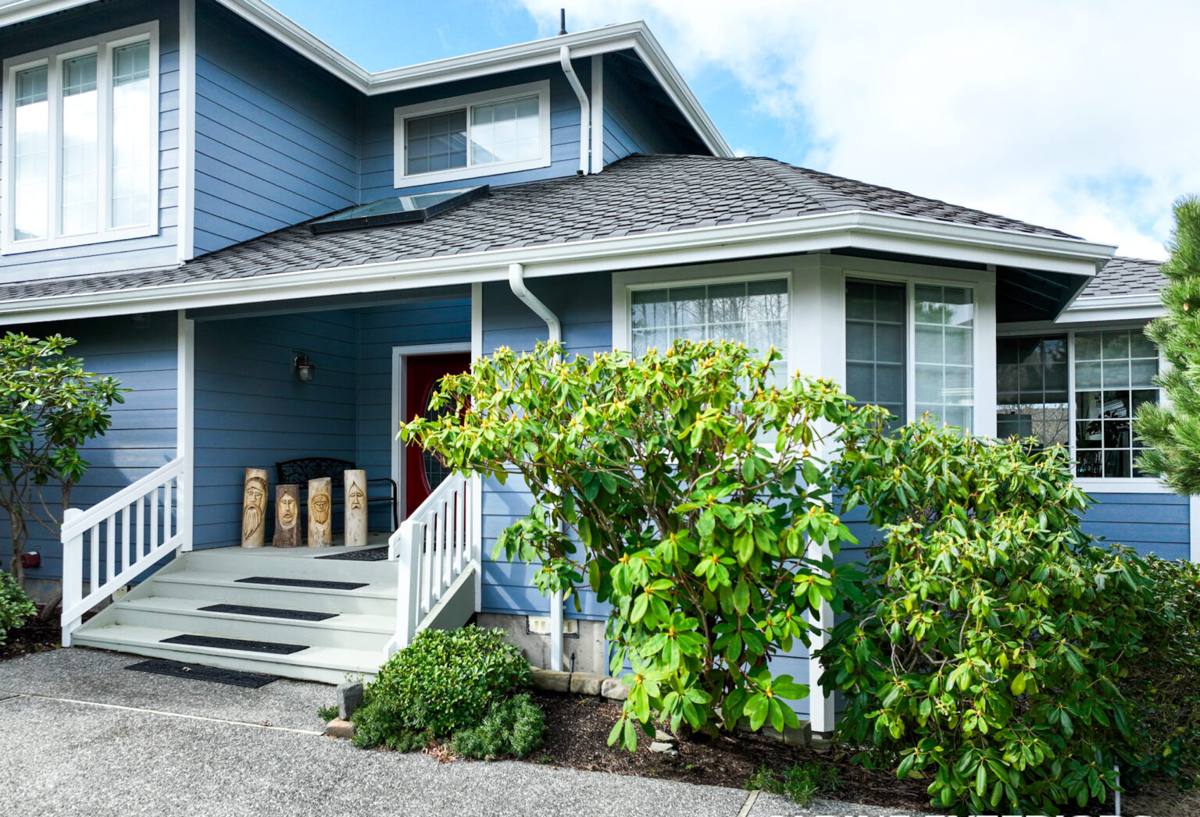
Why Salt Air and Driving Rain Matter More Than People Expect
Salt air accelerates corrosion on fasteners, flashing, and any exposed metal trim. It also breaks down lesser paint and coating systems faster than inland weathering would. Driving rain — rain pushed horizontally by wind rather than falling straight — finds every weak point in a siding system: unsealed butt joints, undersized flashing, missing kick-out flashing at roof-to-wall intersections, and gaps where trim meets siding. Water that gets behind the siding in a marine climate doesn't get a long dry spell to evaporate out. It sits, and that's when rot, mold, and structural damage start.
Moss adds a slower but equally damaging problem. Moss holds moisture directly against a surface for extended periods, and on the north- and shade-facing walls common in wooded or close-set Custer properties, it can establish itself within a year or two if the siding material and installation don't account for airflow and drainage.
What This Means for Material Choice
Materials that rely on an intact paint film for weather resistance — primed wood, some fiber cement alternatives — are only as good as that finish. Once the film is compromised by UV, salt exposure, or physical wear, the substrate underneath is exposed to exactly the kind of moisture this climate delivers year-round. James Hardie's ColorPlus finish is baked on at the factory under controlled conditions, which produces a more consistent, harder-wearing bond than field-applied paint — and it's backed by its own finish warranty separate from the substrate warranty.
What James Hardie Brings to a Custer Home
James Hardie fiber cement is a cement, sand, and cellulose fiber composite. It doesn't rot, it isn't attractive to insects, and it's non-combustible — a genuine advantage over wood-based and some polymer siding products, though wildfire exposure risk is a secondary concern here compared to the moisture and salt issues. For this climate, three things matter most:
- Dimensional stability — fiber cement doesn't swell and contract with moisture the way wood or wood-composite products do, which means joints and caulk lines stay tighter over time.
- HZ5 engineering — James Hardie manufactures climate-specific product lines, and HZ5 is formulated for regions with significant moisture exposure, which fits Whatcom County's marine weather pattern.
- Factory-applied finish — ColorPlus technology resists fading and moisture intrusion at the surface far better than field-applied paint, and doesn't need repainting on the same cycle wood siding does.
None of that replaces correct installation. Even the right product, hung wrong, will fail in this climate faster than a lesser product installed with real attention to water management.
What a Correct Installation Actually Involves Here
A lot of siding jobs look fine for the first year or two regardless of how they were installed. The problems this climate causes show up later — at year three, five, or eight — when water that was never supposed to get behind the siding finally does enough damage to be visible. Getting it right the first time means paying attention to details that don't show up in a driveway estimate walk-around.
Key installation points for a marine, high-rainfall climate
- Proper weather-resistant barrier (housewrap) installed and lapped correctly before any siding goes up
- Rainscreen or drainage gap where conditions call for it, so incidental moisture behind the siding can drain and dry instead of sitting against the wall sheathing
- Correct nail/fastener type and spacing per James Hardie's published fastening schedules — under- or over-driven fasteners are a common source of early failure
- Proper clearance between siding and grade, decks, patios, and roof lines to keep splash-back and standing water away from the bottom edge of the siding
- Flashing at every horizontal joint, window, door, and roof-to-wall intersection — this is where driving rain finds its way in if it's skipped or undersized
- Caulking only where James Hardie's install specs call for it, with a product rated for the exposure — over-caulking can trap moisture just as easily as under-caulking lets it in
This is also where hiring matters more than most homeowners expect going in. James Hardie siding installed off-spec doesn't fail because the product is bad — it fails because someone skipped a step that doesn't matter in a dry climate but matters enormously here.
Choosing the Right Hardie Product Line
James Hardie offers several product lines, and the right one for a given Custer home depends on the existing architecture, exposure, and the homeowner's maintenance preferences.
| Product Line | Look | Best Fit |
|---|---|---|
| HardiePlank Lap Siding | Traditional horizontal lap | Most homes; the standard choice for classic and craftsman-style exteriors |
| HardiePanel Vertical Siding | Vertical panel, often with battens | Modern builds, accent walls, gable ends |
| HardieShingle | Staggered or straight-edge shingle profile | Cottage or Craftsman-style homes wanting a shingle look without cedar's maintenance |
| HardieTrim | Trim boards, fascia, corner boards | Paired with any of the above for a finished, moisture-sealed edge detail |
For most Custer properties, HardiePlank in the HZ5 formulation is the practical default, with HardieTrim used around windows, doors, and corners to keep those transition points consistent and properly sealed.
What Drives Cost on a Job Like This
Every home is different, and we don't quote sight-unseen — but the factors that move a Custer siding job up or down in scope are consistent.
| Factor | Why It Matters |
|---|---|
| Existing siding removal | Full tear-off versus siding over an already-sound substrate changes labor significantly |
| Substrate condition | Rot or water damage found once old siding comes off needs repair before new siding goes on |
| Home size and wall complexity | More corners, dormers, and roof-to-wall intersections mean more flashing detail work |
| Product line and trim package | Plank versus panel versus shingle, plus trim scope, affects material cost |
| Color and finish selection | Factory ColorPlus finish versus field-painted affects both cost and long-term maintenance |
Our Process for a Custer Job
The steps don't change much home to home, but the details we're checking for at each one are shaped by what this climate does to a house over time.
- On-site assessment — we look at existing siding condition, wall exposure to prevailing wind and rain direction, moss and moisture staining patterns, and any signs of past water intrusion around windows, trim, or roof lines.
- Scope and product selection — we walk through product line, HZ5 versus standard formulation, trim package, and color with the homeowner based on what the house actually needs, not a one-size answer.
- Tear-off and substrate check — removing old siding tells us the real condition of the sheathing and framing underneath, which sometimes changes the scope before installation starts.
- Weather barrier and drainage plane — housewrap and, where called for, a rainscreen gap go in before a single piece of Hardie siding is hung.
- Flashing and installation to James Hardie spec — fastening schedule, clearances, and joint treatment follow manufacturer requirements for this exposure category.
- Final walkthrough — we go over the finished work with the homeowner, including basic care and what to watch for over the first year or two.
Keeping Siding Performing Once It's Installed
Correctly installed James Hardie siding is genuinely low-maintenance compared to wood or many composite products, but "low-maintenance" isn't "no-maintenance" in a climate that grows moss on driveways.
- Rinse siding periodically to remove salt residue and organic buildup, especially on shaded and north-facing walls
- Keep gutters clear so overflow doesn't run down the siding face repeatedly
- Trim back vegetation and tree cover that keeps a wall surface damp and shaded longer than necessary
- Watch for moss or algae starting at panel edges and joints, and address it early rather than letting it establish
- Have caulking and trim joints checked periodically — even good sealant has a service life
Why a Crew That Already Works Custer Matters
Installation quality on fiber cement siding isn't just about following a manual — it's about judgment calls made on-site: where a rainscreen gap is worth the extra step, how much clearance a particular grade condition needs, which walls on a given lot get the worst wind-driven rain. A crew that's worked other homes in Custer and around Ferndale has already seen how this specific stretch of Whatcom County treats siding, which means fewer surprises and fewer corners that get missed because they weren't obvious from a general install checklist.
If you're planning a siding project in Custer and want to talk through what your home specifically needs, we're happy to take a look and put together a free, no-pressure estimate.