 Ferndale Siding
 Roofing in Cordata Comes With Its Own Set of Problems
Cordata sits close enough to the water and low enough in the Whatcom County weather pattern that its roofs take a different kind of beating than roofs twenty miles inland. Homeowners here deal with salt-laden air off the Strait, long stretches of driving rain that comes in sideways more often than straight down, and a moss season that can run eight months out of the year if a roof isn't maintained. None of that is dramatic on its own. What it does is wear a roof down slowly, in ways that are easy to miss until a shingle system starts failing early instead of lasting its full service life.
An asphalt shingle roof installed correctly for this specific environment looks almost identical to one installed anywhere else in the country. The difference is underneath — the underlayment choices, the ventilation setup, the flashing detail, and the fastening pattern. Get those wrong and you get a roof that looks fine for three or four years and then starts showing granule loss, soft spots, and moss colonization well ahead of schedule. Get them right and a quality asphalt shingle roof will comfortably do its job for decades in this climate.
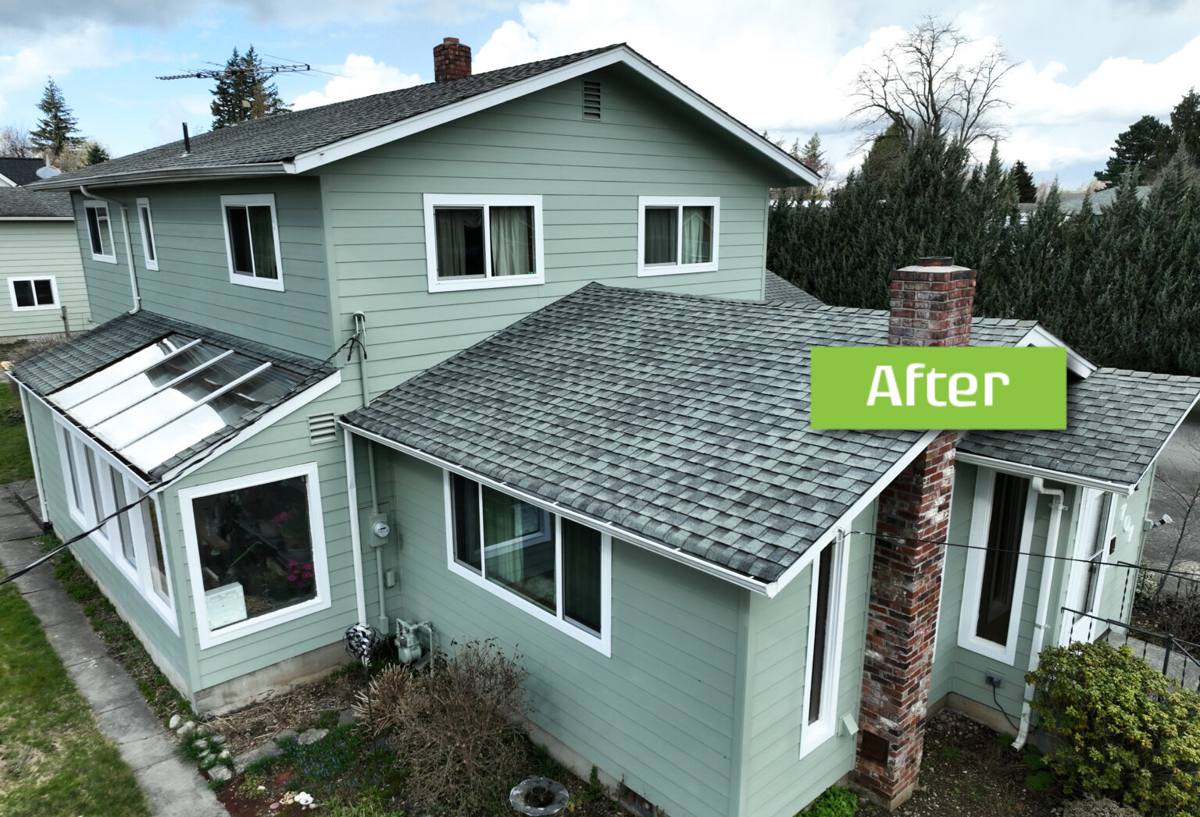
What Cordata's Climate Actually Does to a Shingle Roof
Salt Air and Metal Fatigue
Cordata isn't oceanfront, but it's close enough to Bellingham Bay and the Strait of Georgia that salt-bearing air reaches it, especially during winter storms with onshore wind. Salt air accelerates corrosion on exposed metal — flashing, drip edge, nail heads, and vent stacks. On a shingle roof, the metal components are doing more work than people realize: they're what keeps water out at every transition point (valleys, chimneys, sidewalls, penetrations). When that metal corrodes faster than expected, leaks start at those transitions long before the shingle field itself is worn out.
Driving Rain and Wind-Driven Water
Whatcom County storms frequently bring rain at an angle, not straight down. That matters because a roof designed only to shed water vertically can still leak under wind-driven rain if the underlayment, flashing laps, and shingle nailing pattern aren't built for it. Standard shingle installation assumes gravity does most of the work. In a driving-rain climate, water gets pushed uphill under tabs and sideways into laps, which is why underlayment quality and correct fastening are not optional upgrades here — they're the baseline.
Moss Season
Cordata's tree cover, shade patterns, and damp winters create long moss-growing conditions on north-facing and shaded roof slopes. Moss isn't just cosmetic. As it establishes, it lifts shingle edges, holds moisture against the roof deck, and works its way under tabs — all of which shortens the life of the shingle and increases the odds of a slow leak that doesn't show up inside the house until real damage has been done.
What a Correctly Built Asphalt Shingle Roof Includes Here
A roof built for Cordata's conditions isn't a different product line — it's the same asphalt shingle system installed with climate-appropriate detailing. The pieces that matter most:
- Ice and water shield at vulnerable zones — valleys, eaves, and around penetrations, not just where code minimums require it
- A full synthetic underlayment across the whole deck, not felt paper, for better wind-driven rain resistance and longer exposure tolerance during construction
- Corrosion-resistant flashing at all transitions, sized and lapped correctly for wind-driven rain, not just standard vertical drainage
- Balanced attic ventilation (intake at the eaves, exhaust at the ridge) so moisture from inside the home doesn't condense against the underside of the deck and accelerate rot or moss-friendly conditions
- Correct nailing pattern and shingle selection matched to local wind exposure, not just manufacturer minimums
- Algae-resistant shingle granules where the roof has heavy shade exposure, to slow moss and algae colonization
Our Process for a Cordata Roof Replacement
1. Roof and Attic Assessment
We start by looking at more than the shingles. We check the deck condition, existing ventilation, flashing points, and any signs of past moss or moisture damage. A shingle roof is only as good as what's underneath it, so this step determines what the rest of the job actually needs — not a generic package.
2. Tear-Off and Deck Inspection
Full tear-off lets us see the deck directly instead of guessing. Any soft, delaminated, or rotted sheathing gets identified and replaced before anything new goes down. Installing new shingles over a compromised deck just hides a problem that gets more expensive later.
3. Underlayment and Flashing
This is where the climate-specific work happens — ice and water shield in the vulnerable zones, full synthetic underlayment across the field, and new flashing at every transition point. We don't reuse old flashing on a full replacement; it's one of the most common points of early failure and it's not worth cutting a corner on.
4. Ventilation Check and Correction
If the attic ventilation is undersized or unbalanced, we address it as part of the job. Skipping this step is one of the more common reasons a shingle roof underperforms its warranty — trapped moisture works against the roof from the inside, no matter how good the shingles are.
5. Shingle Installation
Shingles go down to manufacturer spec with a nailing pattern matched to local wind exposure, not the bare minimum. Valleys, sidewalls, and penetrations get finished last so nothing is left exposed to weather during the job.
6. Final Walkthrough
We walk the completed roof, check gutters and downspouts for debris from the job, and go over the paperwork on warranty coverage so there's no confusion about what's covered and for how long.
Cost Factors for a Cordata Shingle Roof
Every roof is different, and we won't quote a number without seeing the job, but these are the factors that move the price up or down on a typical asphalt shingle replacement in this area:
| Factor | Why It Matters Here |
|---|---|
| Roof pitch and complexity | Steeper roofs and more valleys/dormers mean more labor and more flashing detail — critical in a driving-rain climate |
| Deck condition | Moss and moisture damage found during tear-off can require sheathing repair or replacement |
| Shingle tier | Algae-resistant and heavier architectural shingles cost more upfront but hold up better under Cordata's shade and moss conditions |
| Ventilation upgrades | Adding or correcting ridge and soffit ventilation adds cost but protects the investment long-term |
| Access and tree cover | Overhanging trees common in Cordata can add setup, protection, and cleanup time |
| Layer removal | Roofs with multiple existing layers take longer to tear off and dispose of than a single-layer roof |
Why Moss Prevention Should Be Built In, Not an Afterthought
A lot of moss problems on shingle roofs in this part of Whatcom County trace back to two things: shaded, north-facing slopes that never fully dry out, and a shingle product that wasn't chosen with algae resistance in mind. We treat moss prevention as part of the initial design decision, not a maintenance product sold after the fact. That means selecting algae-resistant shingles for shaded exposures and making sure valleys and low-slope transitions are detailed so water and debris don't pool and hold moisture against the roof surface.
Homeowners can extend this further with basic seasonal upkeep — keeping gutters clear so water doesn't back up under the eaves, and having moss growth addressed before it establishes rather than after it's visibly lifting shingles. A well-built roof reduces how much of this maintenance is needed, but it doesn't eliminate it entirely in a climate like this one.
Signs a Cordata Roof May Need Replacement Rather Than Repair
- Granule loss heavy enough to see bare fiberglass mat on multiple shingles, not just a few isolated spots
- Shingles that are curling, cupping, or cracking across large sections rather than one localized area
- Moss or algae established broadly across shaded slopes rather than just at the edges
- Daylight visible through the roof deck from inside the attic
- Recurring leaks at the same location despite prior repairs
- A roof approaching or past the upper end of its rated lifespan combined with any of the above
A roof with isolated damage — one storm-damaged section, one failed flashing point — is usually a repair candidate. Widespread wear across the whole roof, especially combined with an aging deck, is where replacement becomes the more cost-effective long-term choice.
Why It Matters That We Already Work in Cordata
There's a real difference between a crew that installs shingle roofs in general and a crew that already knows how Cordata's specific mix of shade, moisture, and coastal air behaves on a roof. We know which slopes in this neighborhood tend to hold moss longest, which exposures see the most wind-driven rain, and where standard underlayment and flashing specs fall short of what the local climate actually demands. That familiarity shows up in fewer callbacks and a roof that performs the way it's supposed to for its full rated life, not just its first few years.
We're a Ferndale-based crew working throughout Whatcom County, which means we're not driving in from out of the area to handle a job and then disappearing if a warranty question comes up later. If you're weighing a roof replacement or want a straight answer on whether a repair will hold, we're glad to take a look and give you a free, no-pressure estimate — just fill out the form below.