 Ferndale Siding
 Why Decks Fail Faster in Marietta Than Most Places Inland
Marietta sits close to the water, which is part of what makes it a good place to live and a hard place to keep a deck in shape. Between the salt-laden air blowing off Bellingham Bay, the driving rain that Whatcom County gets for months at a stretch, and a moss and algae season that can run from fall through spring, an outdoor deck here takes a beating that a deck in, say, eastern Washington never sees. Fasteners corrode faster near saltwater. Wood fibers stay damp longer because the air itself doesn't fully dry out between storms. And any horizontal surface that doesn't shed water and light equally ends up growing moss, which holds moisture against the boards and accelerates rot or surface breakdown underneath.
None of that means a deck can't last decades here — it means the material and the build details matter more than they would somewhere drier. That's the whole case for composite decking done right: it takes the moisture-absorption problem off the table and lets us focus on the structural and drainage details that actually determine how long the deck holds up.
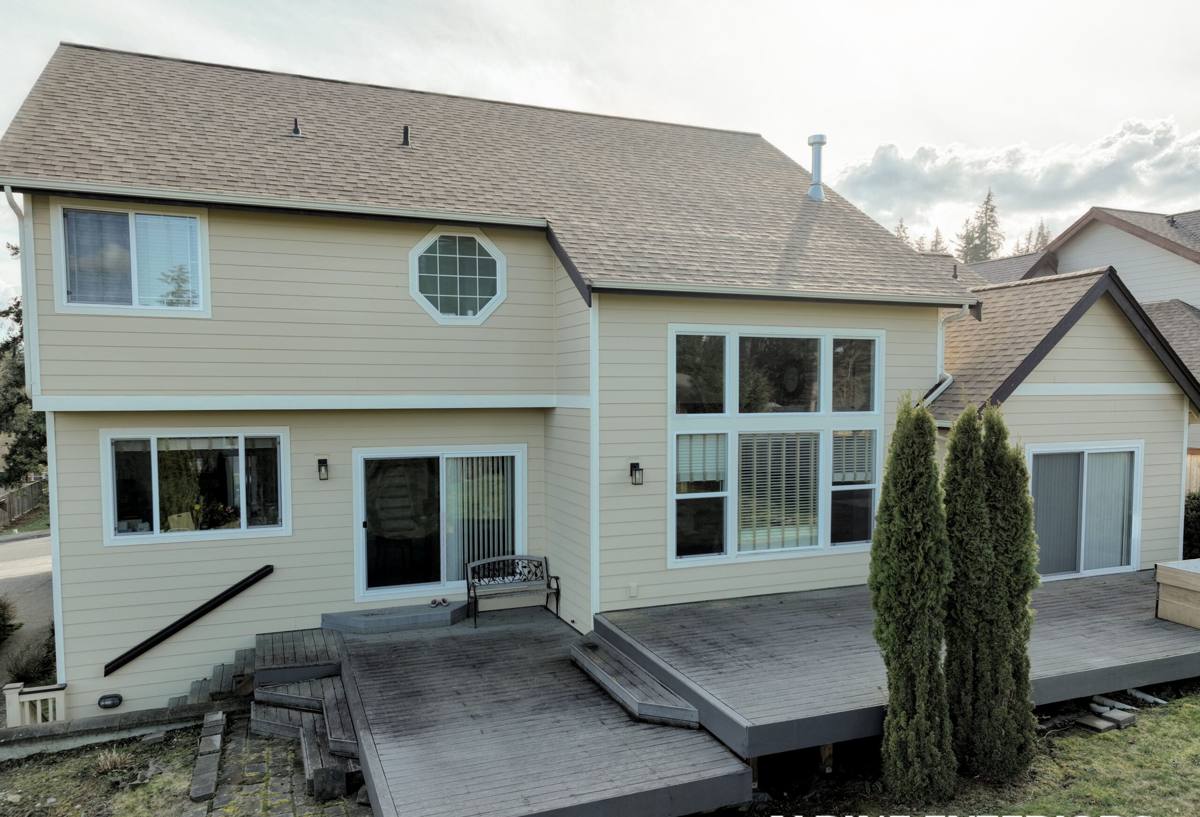
What Marietta Homes Actually Need From a Deck
We're not selling composite decking because it's trendy. We're recommending it for this specific area because of what the climate does to alternatives, and because of a few recurring conditions we see on decks around Ferndale and the surrounding waterside neighborhoods:
- Constant low-level moisture exposure — not just rain, but the ambient dampness and salt air that keeps surfaces from ever fully drying between weather systems.
- Moss and algae growth on any deck surface that stays shaded or doesn't drain well, which is common under covered patios and on the north or water-facing side of a house.
- Fastener and hardware corrosion from salt-air exposure, which is why hardware selection matters as much as the decking material itself.
- Freeze-thaw cycling in the colder stretches of winter, which is milder here than inland Whatcom County but still real, and still stresses any material that absorbs water.
A correct composite deck build addresses every one of those, not just the top surface.
Composite Decking Options: What We Install and Why
Capped composite, not the old-style boards
Early composite decking (the uncapped wood-plastic blends from years back) had a real problem in wet climates: the exposed composite surface could still absorb moisture and support mold growth, and it faded and stained more than manufacturers admitted. Modern capped composite boards — from brands like Trex, TimberTech, and Fiberon — wrap the board in a solid polymer shell on all four sides. That cap is what actually keeps water, salt air, and organic debris from getting into the board's core. When we quote a composite deck, we're specifying fully capped boards for that reason; it's a standard we hold regardless of brand, because a board that isn't capped on all sides just moves the moisture problem from "wood rot" to "composite core saturation," and either way you're re-decking sooner than you should be.
Why we don't push traditional wood decking in this location
Cedar and pressure-treated wood decks aren't a bad product everywhere, and we'll build one if that's genuinely what a homeowner wants. But in a marine climate like Marietta's, wood decking means annual or biannual sealing, more frequent board replacement as sections cup or split, and a maintenance schedule that's easy to fall behind on when the rain doesn't give you a long dry window to work in. Composite trades a higher upfront material cost for essentially eliminating that maintenance cycle — no sealing, no sanding, no yearly moss treatment on the boards themselves.
| Material | Moisture behavior in this climate | Maintenance | Typical lifespan here |
|---|---|---|---|
| Pressure-treated wood | Absorbs water, prone to cupping/splitting with constant damp exposure | Sealing every 1-2 years, regular moss removal | 10-15 years before major repair |
| Cedar | Naturally rot-resistant but still absorbs moisture over time | Sealing/staining, moss treatment | 12-18 years |
| Uncapped composite | Shell resists water better than wood but core can still take on moisture at cut ends and fastener holes | Low, but periodic cleaning needed | 15-20 years |
| Fully capped composite | Sealed on all sides; doesn't absorb water or support mold growth in the board itself | Occasional washing | 25-30+ years (per manufacturer warranty terms) |
What a Correct Composite Deck Build Involves
The decking boards get most of the attention, but the substructure and details underneath are what actually determine whether the deck performs well in a wet, salty climate. We treat these as non-negotiable on every composite deck we build near Marietta:
Ledger and flashing
Where the deck attaches to the house is the single most common point of hidden water damage. Correct flashing — properly lapped and sealed so water sheds away from the house rim joist rather than behind it — matters more here than in a dry climate, because there's simply more water hitting that joint over the course of a year.
Joist protection and spacing
Even under a composite deck surface, the framing underneath is usually still wood, and that framing needs its own protection: joist tape or a comparable moisture barrier on top of each joist, corrosion-resistant fasteners rated for the coastal environment, and joist spacing that matches the decking manufacturer's specification (composite boards typically need tighter joist spacing than wood, especially on angled or diagonal patterns).
Drainage and airflow underneath
A deck that sits low to the ground or over a patio needs a clear path for water to get away from the structure and for air to circulate underneath. Poor under-deck drainage is one of the biggest reasons we see moss and mildew building up on the underside of boards and along fascia, even when the top surface looks fine.
Fastening method
Hidden fastener systems (clips that hold boards from the side, invisible from above) give a cleaner look and, done correctly, reduce the number of penetration points where water and salt air can reach fasteners. Where face-screwing is necessary — stair treads, picture-frame borders — we use fasteners rated for coastal/corrosive exposure, not standard interior-grade hardware.
Our Process, Start to Finish
- On-site assessment — we look at the existing structure (if there is one), grading and drainage around the area, sun/shade exposure, and how the space is actually used.
- Design and material selection — board pattern, color, railing style, and any structural changes (height, stairs, multiple levels) get worked out before we quote a final number.
- Permit handling — most deck projects in Whatcom County require a building permit, especially above a certain height or attached to the house. We pull and manage this as part of the job so it's not left on the homeowner's plate.
- Demolition (if replacing an existing deck) — old decking, and often the substructure underneath, gets removed and hauled away. This is also when we find out what condition the ledger and framing are really in.
- Framing and flashing — the structural work described above, inspected before any decking goes down.
- Decking and railing installation — boards, fascia, stairs, and railing system installed to manufacturer spec.
- Final walkthrough and cleanup — site cleared, and we go over care and warranty registration with the homeowner.
Permits and Local Requirements
Deck projects in and around Ferndale generally go through Whatcom County or City of Ferndale permitting depending on exactly where the property sits, and the requirements can touch on setback distances from property lines, footing depth (frost depth requirements apply even in our relatively mild winters), and guard/railing height once a deck reaches a certain elevation above grade. We don't guess on this — we confirm the specific requirements for the property before finalizing a design, so the deck doesn't end up needing rework to pass inspection.
Living With Composite Decking Here: Realistic Maintenance
Composite decking is low-maintenance, not no-maintenance, especially in a moss-prone marine climate. What we tell every homeowner:
- Wash the deck surface a couple of times a year with a soft-bristle brush and mild soap-and-water solution or a composite-safe cleaner — a pressure washer on too high a setting or too close can damage the cap layer, so keep it on a wide, low-pressure setting.
- Keep gaps between boards clear of debris (needles, leaves, dirt) so water and airflow can do their job — clogged gaps are the most common cause of moss getting a foothold on composite.
- Trim back overhanging vegetation where possible; shaded, damp areas are where moss establishes first, on any material.
- Check railing hardware and fastener points annually for early signs of corrosion, particularly on decks with more direct salt-air exposure.
- Address standing water or poor drainage around the base of the deck promptly — that's a structural issue, not a cosmetic one.
What Drives the Cost
Composite decking costs more upfront than pressure-treated wood, but the honest comparison has to include the maintenance and replacement cycle over 15-20 years, not just the install price. Broadly, the variables that move a quote are:
| Factor | Why it matters |
|---|---|
| Deck size and shape | More square footage and more cuts/corners increase both material and labor |
| Height off grade | Taller decks need more substantial framing, stairs, and code-required railing |
| Substructure condition | Replacing rotted or undersized framing adds cost but is not optional if found |
| Board pattern | Diagonal or picture-frame patterns require tighter joist spacing and more labor |
| Railing system | Composite, aluminum, and cable railing all price differently and affect the coastal-hardware needs |
| Demolition/haul-away | Removing an existing deck and disposing of old material is a separate line item |
Why a Crew That Already Works in Marietta Makes a Difference
Anyone can install composite decking boards. What's harder to fake is knowing how the framing underneath needs to be handled for a house that sits in a salt-air, high-rainfall environment, and knowing the permitting process for this specific area well enough that it doesn't add weeks to the project. A crew that regularly works Ferndale and the surrounding Whatcom County waterside communities has already seen what happens to decks built without proper flashing, without coastal-rated fasteners, or without drainage planning — and builds around those failure points from the start instead of learning from a callback five years later.
A quick checklist before you hire anyone for this job
- Ask specifically whether the decking is capped on all four sides — not all composite is.
- Ask what fastener grade they use, and whether it's rated for coastal/corrosive exposure.
- Confirm who is pulling the permit and managing inspections.
- Ask how they handle ledger flashing and joist protection — a vague answer here is a red flag.
- Get the manufacturer warranty terms in writing, not just a verbal assurance.
If you're weighing composite decking for a home in Marietta or elsewhere around Ferndale, we're happy to take a look at your space and walk through honest options — no pressure, no hard sell. Fill out the form below for a free estimate.