 Ferndale Siding
 Blaine's Marine Climate Puts Extra Stress on Siding
Blaine sits about as close to saltwater and the Canadian border as a Whatcom County home can get, and that location comes with a specific set of exterior problems. Salt-laden air rolls in off the water almost daily, driving rain arrives sideways more often than straight down, and a long, damp shoulder season keeps north and shaded walls wet for weeks at a stretch. Add the moss and algae growth that comes with all that moisture and shade, and you have a climate that's genuinely harder on exterior materials than most inland parts of the county.
Siding in Blaine isn't just a cosmetic layer. It's the first and most tested line of defense between a home's framing and an environment that's actively working to find a way in. Homes here need a system chosen and installed with that reality in mind — not a product that happens to look fine on a showroom sample.
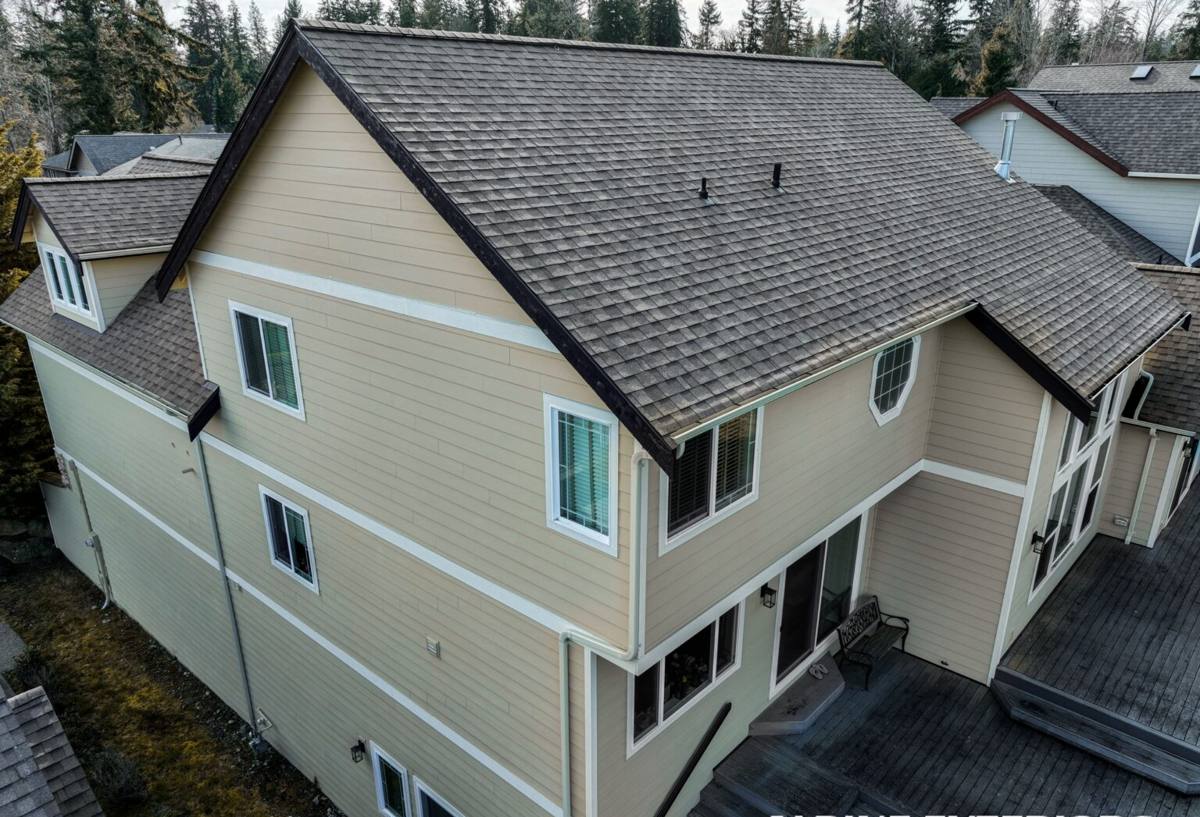
What Salt Air and Driving Rain Actually Do to Siding Over Time
Salt air is corrosive to metal fasteners and trim, and it accelerates the breakdown of finishes that aren't engineered to resist it. Combine that with wind-driven rain — which pushes water sideways into laps, seams, and butt joints instead of letting it run straight off — and you get moisture intrusion in places a calmer climate would never test.
Wood-based products (cedar, primed spruce, and engineered wood like LP SmartSide) are especially vulnerable in this combination. They rely on paint films and factory coatings to keep water out, and once those coatings are compromised by UV, moisture cycling, or a nick during installation, the underlying wood fiber is exposed to exactly the kind of sustained dampness Blaine specializes in. Moss and algae take hold fastest on shaded, damp surfaces, and once established they hold moisture against the siding face even longer, compounding the problem.
Vinyl siding has its own issues in this climate: it isn't fastened rigidly (by design, to allow for thermal movement), which means wind-driven rain can work its way behind panels at a coastal home's exposed corners and gable ends more easily than it would on a sheltered inland lot.
Fastener and Trim Corrosion
Salt air shortens the working life of standard fasteners and untreated trim. Corroded fasteners loosen siding over time, which opens gaps for water — a slow failure that's easy to miss until paint starts flaking or a panel starts to sag.
Moss and Algae in Shaded, Damp Zones
North-facing walls, areas under tree cover, and spots that don't get afternoon sun dry slowly here. That's exactly where moss gets a foothold, and once it does, it traps moisture against the siding surface year-round.
Why We Install Only James Hardie Fiber Cement Siding in Blaine
We standardized on James Hardie fiber cement siding for every home we side, including in Blaine, because it's the one product system that holds up to this specific combination of salt exposure, driving rain, and moss pressure without asking the homeowner to babysit it. Fiber cement doesn't rot, it isn't a food source for the organisms that cause moss and mildew staining, and it holds up to moisture cycling in a way wood-based products simply can't match.
James Hardie's ColorPlus factory-applied finish is baked on under controlled conditions and backed by its own finish warranty — a meaningfully different proposition than a field-applied paint job that has to perform against salt air and UV from day one. Hardie also produces climate-engineered HZ product lines specifically formulated for different moisture and temperature zones, which matters in a coastal Pacific Northwest climate like Blaine's.
We're not going to tell you competing products are worthless — plenty of them have a place somewhere. But we've made a professional decision not to install vinyl, LP SmartSide, Cemplank, Allura, primed spruce, or cedar on the homes we work on, because in a climate like this one, the long-term maintenance burden and moisture risk of those products isn't a trade-off we're willing to put our name behind. Fiber cement, installed correctly, is.
Material Comparison for a Coastal Whatcom County Climate
| Material | Salt Air Tolerance | Moisture/Moss Resistance | Ongoing Maintenance | Typical Finish Warranty |
|---|---|---|---|---|
| James Hardie Fiber Cement | Strong — non-combustible, dimensionally stable | Very strong — won't rot, resists moss staining better than wood | Low — periodic washing | Long-term, transferable (product + ColorPlus finish) |
| Vinyl Siding | Fair — can become brittle and discolor with UV/salt exposure | Panels can allow wind-driven water intrusion at seams | Low, but cracks/warps over time | Varies widely by manufacturer/grade |
| LP SmartSide / Engineered Wood | Moderate — coating-dependent | Vulnerable once coating is breached; sensitive to sustained moisture | Moderate to high — coating upkeep matters | Coating and substrate warranties are separate |
| Cedar / Primed Spruce | Weak without diligent upkeep | Prone to moss growth, rot, and paint failure in shaded/damp zones | High — repainting and spot repair cycle | No manufacturer product warranty (natural wood) |
What a Correct Installation Involves in Blaine
Fiber cement performs the way it's supposed to only when it's installed to manufacturer spec. In a climate like Blaine's, the details that get skipped on a rushed job are exactly the ones that determine whether a home stays dry for the next 30 years.
Water Management Comes First
Before a single piece of siding goes up, the wall needs a properly lapped water-resistive barrier, correctly flashed windows and doors, and drainage planes that let any moisture that does get behind the siding find its way back out instead of sitting against the sheathing. This is the step that matters most in a driving-rain climate, and it's invisible once the job is done — which is exactly why it has to be done right the first time.
Fastening and Clearances
James Hardie specifies fastener type, spacing, and penetration depth for a reason, and those specs get more important, not less, in salt air. We also hold proper clearance between siding and grade, decks, and roof lines so water has somewhere to go and the bottom edge of the siding isn't sitting in standing moisture.
Joints, Caulking, and Butt Seams
Butt joints and seams are where a lot of coastal siding failures start. Correct joint treatment and a quality sealant system matter more here than in a drier, calmer climate, because wind-driven rain actively probes for those gaps instead of just running past them.
Our Process for Blaine Siding Projects
- On-site assessment: we walk the exterior, check existing siding and sheathing condition, and note problem areas — shaded walls, wind-exposed corners, drainage issues.
- Plan and product selection: we recommend the Hardie product line and ColorPlus color suited to the home's exposure and your preferences.
- Tear-off and sheathing check: old siding comes off and we inspect the sheathing underneath for hidden moisture damage before covering it back up.
- Water-resistive barrier and flashing: house wrap, window/door flashing, and drainage details go in per manufacturer spec.
- Hardie installation: siding is fastened, jointed, and finished per James Hardie's installation requirements.
- Final walkthrough: we review the completed exterior with you before calling the job done.
Signs a Blaine Home May Need Siding Replacement
- Moss or dark streaking on north-facing or shaded walls that keeps coming back after cleaning
- Paint that's peeling, bubbling, or chalking faster than it should
- Soft spots, visible warping, or delamination in wood-based siding
- Fastener corrosion, staining, or loosening panels near exterior corners
- Visible gaps at butt joints, trim, or window edges
- Rising energy bills that suggest the wall assembly isn't sealing the way it used to
- Interior signs of moisture — musty smell, staining near exterior walls — with no obvious plumbing cause
Why Hiring a Crew That Already Works in Blaine Matters
A crew that mainly works drier, more sheltered neighborhoods can install siding perfectly well and still miss the details that matter specifically in a salt-air, high-rainfall environment like Blaine's. Knowing which walls take the worst weather, how much clearance to leave at grade on a lot with poor drainage, and where moss pressure tends to concentrate isn't generic siding knowledge — it's local knowledge, built from working this exact climate repeatedly.
That's the case for choosing a contractor who already does this work in Blaine and the surrounding Ferndale area, rather than a crew treating it as just another stop on a route through the county.
If you're planning a siding project in Blaine, we're happy to walk the exterior with you, look at what your home is actually dealing with, and talk through what James Hardie fiber cement would involve for your house — no pressure, no obligation. There's a short form below if you'd like to get a free estimate started.