 Ferndale Siding
 Why Siding Wears Differently Around Sudden Valley
Sudden Valley sits in a pocket of Whatcom County where tall fir and cedar canopy, close-set lots, and proximity to open water all combine to keep exterior surfaces wetter, longer, than homes out in open sun. Add in the driving rain that rolls off the marine air and the salt-tinged moisture that regional weather systems carry inland from the Bellingham Bay area, and you get a climate that is genuinely harder on siding than most manufacturers' generic install guides assume. Shaded north and west-facing walls stay damp for days after a storm. Gutters and downspouts run heavier and longer into the season. And moss, which needs almost nothing but consistent moisture and shade to establish itself, gets a long runway here — often eight or nine months of the year.
None of that is a reason to avoid siding a home in Sudden Valley. It's a reason to be specific about what product you use and how it goes on the wall. Products and installation details that work fine in a dry, sun-exposed subdivision can fail early here — not catastrophically, but in the slow, unglamorous way that shows up as swelling edges, peeling paint, soft trim, and streaked moss growth five to eight years in.
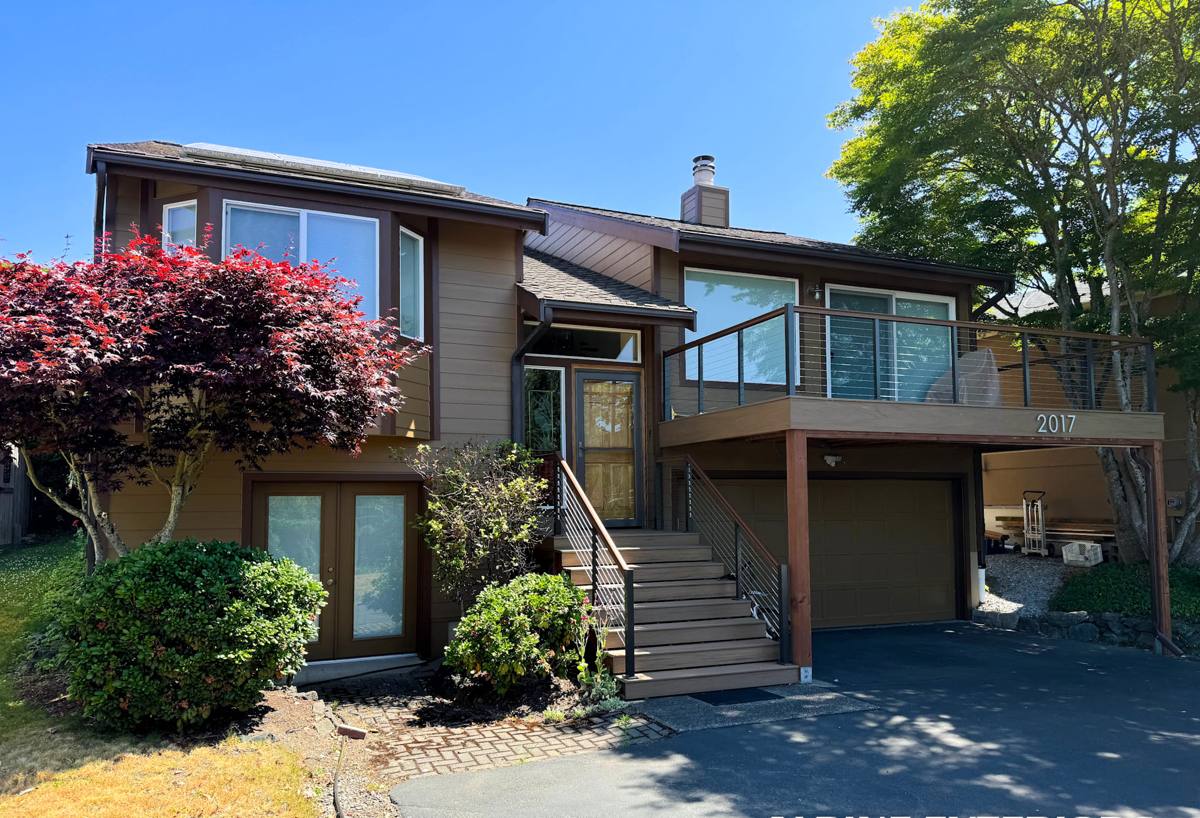
Why We Install James Hardie and Nothing Else
We standardized this company on James Hardie fiber cement siding, full stop. We don't install vinyl, LP SmartSide, cedar, primed spruce, or other fiber cement brands. That's a deliberate call, not a sales preference, and it matters most in exactly the conditions Sudden Valley deals with:
- It doesn't feed moss or rot. Fiber cement is cement, sand, and cellulose fiber — there's no wood sugar or organic surface for moss and algae to root into the way there is with cedar or wood-based composite siding.
- It's dimensionally stable in wet-dry cycling. Sudden Valley's shaded walls swing between saturated and dry more often than exposed walls. Hardie's engineered fiber cement doesn't swell and shrink the way wood-based products do, so joints and paint film stay intact longer.
- It's non-combustible. With tree cover this dense, wildfire exposure is a real consideration for Whatcom County homeowners, and fiber cement doesn't contribute fuel the way wood siding does.
- The factory finish (ColorPlus) is baked on, not brushed on. That finish is what actually resists the moss, mildew, and UV cycling this climate throws at a wall — a field-primed product depends entirely on how well the crew caulks and paints it.
We'll be straight about the trade-off: Hardie costs more up front than vinyl or LP, and it's heavier and slower to install correctly. We think that cost buys back years of maintenance you'd otherwise be doing yourself, which matters more on a shaded, moss-prone lot than it does on a dry one.
What a Correct Installation Actually Involves
James Hardie siding fails early almost exclusively because of installation mistakes, not product defects. In a climate like Sudden Valley's, the margin for error is smaller, because any gap in the water management gets exploited by moisture that simply doesn't dry out fast.
Drainage Plane and Flashing
Correct installation starts underneath the siding, not at it. That means a continuous weather-resistive barrier, properly lapped and taped seams, and flashing at every window, door, and horizontal transition that directs water back out rather than behind the cladding. On a shaded, high-moisture lot, a rain-screen gap (a drainage space between the WRB and the siding) is worth the extra step — it lets bulk water and trapped humidity escape instead of sitting against the back of the board.
Clearances and Fastening
James Hardie's own installation instructions specify minimum clearances from grade, roofing, decks, and other siding — typically 6 inches from grade and 1–2 inches from roof lines and horizontal surfaces, depending on the detail. Those clearances aren't cosmetic; they keep splashback and standing moisture off the bottom edge of the board, which is where fiber cement siding actually fails if it fails at all. Fasteners need to land in framing at the manufacturer's specified pattern and depth — overdriven nails crack the board's factory seal and start a slow moisture path right where you can't see it.
Caulking and Paint Touch-Up
Every field cut exposes raw fiber cement edge that needs to be sealed and painted to match, and every joint that calls for caulk needs a sealant rated for the movement and moisture cycling of this climate — not the cheapest tube on the shelf. Skipped or rushed caulk joints are one of the most common places we find early moisture intrusion on inspections of other contractors' work.
Attention to Detail
Getting this right in a wooded, wet neighborhood also means:
- Back-priming or factory-sealing all cut edges before they go on the wall, not after
- Flashing every penetration — hose bibs, light fixtures, vents — with the same care as a window
- Keeping fastener heads flush, not overdriven or underdriven
- Verifying rain-screen or drainage gap continuity at inside and outside corners, not just flat wall runs
- Matching J-channel and trim details so water sheds away from the wall assembly at every transition
Choosing the Right Hardie Line for a Shaded Lot
James Hardie makes several product lines, and the right pick for Sudden Valley isn't automatically the same as what we'd spec for an open, sun-exposed property elsewhere in Whatcom County.
HardiePlank lap siding in a smooth or cedar-textured finish is the most common choice and performs well on shaded walls because its horizontal laps naturally shed water when flashed correctly. HardieShingle panels give a traditional Pacific Northwest look that suits wooded lots, but shingle profiles have more butt joints and edges, which means more places that need careful caulking and drainage detailing — worth discussing before you commit if your lot stays damp most of the year. For homes closer to open water or exposed to more direct wind-driven rain, we'll usually talk through the HZ5 product line, which James Hardie engineers specifically for wetter, harsher climate zones like ours, rather than the standard HZ10 formulation built for milder regions.
On color, ColorPlus factory finishes in darker, richer tones can show water spotting and streaking less than flat whites on a shaded wall, but the deciding factor should still be what fits the home and neighborhood — we'll walk you through the actual finish options rather than pushing one color line.
Our Process, Start to Finish
- On-site walkthrough. We look at your specific exposure — how much shade, how much wind-driven rain your walls actually see, current moisture damage if any — before recommending a product line.
- Written estimate. Line-item scope: siding line and finish, trim work, flashing and drainage plane approach, and any rot repair we find during the walkthrough.
- Substrate check at tear-off. Once old siding comes off, we inspect sheathing and framing for hidden moisture damage — common on older homes in this area — and address it before anything new goes on.
- Weather barrier and flashing install. This is the step that actually determines how the siding performs for the next 30 years, and it's the one most easily rushed by crews unfamiliar with wet-climate installs.
- Siding installation to manufacturer spec. Correct clearances, fastening, and cut-edge treatment throughout.
- Trim, caulk, and touch-up. Final sealant pass and paint match on any field-cut edges.
- Walkthrough and warranty paperwork. We register the James Hardie product warranty and go over what maintenance, if any, is on you going forward.
Cost Factors for a Sudden Valley Siding Project
Every home is different, but these are the variables that actually move the number on a Hardie project in this area:
| Factor | Why It Matters Here | Effect on Cost |
|---|---|---|
| Amount of tear-off and hidden damage | Shaded, older siding often hides rot in sheathing or framing that isn't visible until removal | Can add meaningfully if repair work is needed |
| Product line (HZ5 vs. standard, plank vs. shingle) | Wetter, more exposed walls may call for the climate-engineered line or a more detail-intensive profile | Moderate increase for HZ5 or shingle profiles |
| Access and lot layout | Wooded, sloped, or tightly set lots common in this neighborhood affect staging and scaffolding | Can add labor time |
| Drainage plane / rain-screen detailing | Worth the extra step on shaded walls that stay damp; not always included in a basic bid | Small increase, large payoff in longevity |
| Trim and color complexity | More corners, transitions, and custom trim mean more cut edges to seal and finish | Increases labor and material |
We'll walk through which of these actually apply to your home before you see a number — broad ranges without seeing the house aren't useful to you, and we won't pretend otherwise.
Living With It: Maintenance in a Moss-Prone Environment
James Hardie siding, installed correctly, is genuinely low-maintenance — but "low" isn't "none," especially under tree cover. A simple annual routine keeps a Sudden Valley home ahead of moisture and moss issues rather than reacting to them:
- Rinse siding gently once or twice a year, focusing on shaded and north-facing walls where moss and mildew establish first
- Keep gutters clear so overflow doesn't run down the face of the siding — a common cause of localized staining and moss growth
- Trim back branches and shrubs so siding gets airflow and at least some direct sun exposure where possible
- Inspect caulk joints around windows, doors, and trim every year or two, and re-caulk before gaps open up
- Watch for any soft spots, especially near the bottom courses and around penetrations — catching it early is a caulk fix, catching it late is a repair
- Repaint on the cycle recommended for your ColorPlus finish, not sooner or later than needed
Why It Matters That We Already Work This Neighborhood
A crew that's worked in Sudden Valley before isn't guessing at how the microclimate behaves — they've already seen which walls stay wet the longest, how moss patterns show up on similar homes, and what level of drainage detailing actually earns its keep here versus what's overkill. Communities like this one often carry their own design expectations or review processes for exterior changes, and a contractor who's navigated that before saves you the back-and-forth of figuring it out mid-project. Local familiarity also means straight answers about realistic timelines around this area's wet stretches, rather than a generic schedule that doesn't account for how often work actually gets rained out here.
If you're weighing a siding project in Sudden Valley, we're glad to come take a look, tell you honestly what your home's exposure calls for, and put together a written estimate — no pressure, no pushy follow-up. Use the form below to get started.