 Ferndale Siding
 Why Cordata Homes Wear Out Siding Faster Than the Brochure Says
Cordata sits in the corridor between Ferndale and Bellingham, and homes here take a specific kind of beating that a lot of siding products simply weren't built to handle. It's not one dramatic event — no hurricanes, no hail the size of golf balls. It's the slow, patient combination of near-constant moisture, tree-shaded lots, and marine-influenced air moving in off Bellingham Bay and the Strait of Georgia. Over a decade or two, that combination finds every weak point in a siding system.
Moss, Algae, and the Never-Quite-Dry Season
Whatcom County doesn't get a true dry season the way inland regions do. Shaded lots and mature trees — common on Cordata's residential streets — keep north- and west-facing walls damp for days after a storm passes. That extended dampness is exactly what moss and algae need to take hold on siding, trim, and fascia. On some materials this is cosmetic. On others, especially wood-based products, it's a moisture pathway that leads to rot underneath the surface long before anything looks wrong from the curb.
Wind-Driven Rain and Hidden Moisture
Rain in this part of Whatcom County rarely falls straight down. Storms off the Sound push rain sideways into walls, working it behind laps, around window trim, and into any gap in the water-resistive barrier. Siding that isn't flashed and lapped correctly doesn't fail all at once — it fails quietly, over years, as water gets behind the cladding and the sheathing underneath starts to soften.
Salt-Tinged Air Off the Sound
Ferndale and the surrounding Whatcom County coastline sit close enough to saltwater that homes pick up a faint but real dose of salt-laden air, especially on breezier days. Salt accelerates corrosion on fasteners and metal flashing, and it speeds up the breakdown of paint films and lower-grade coatings. It's a slower factor than moss or rain, but it compounds with both.
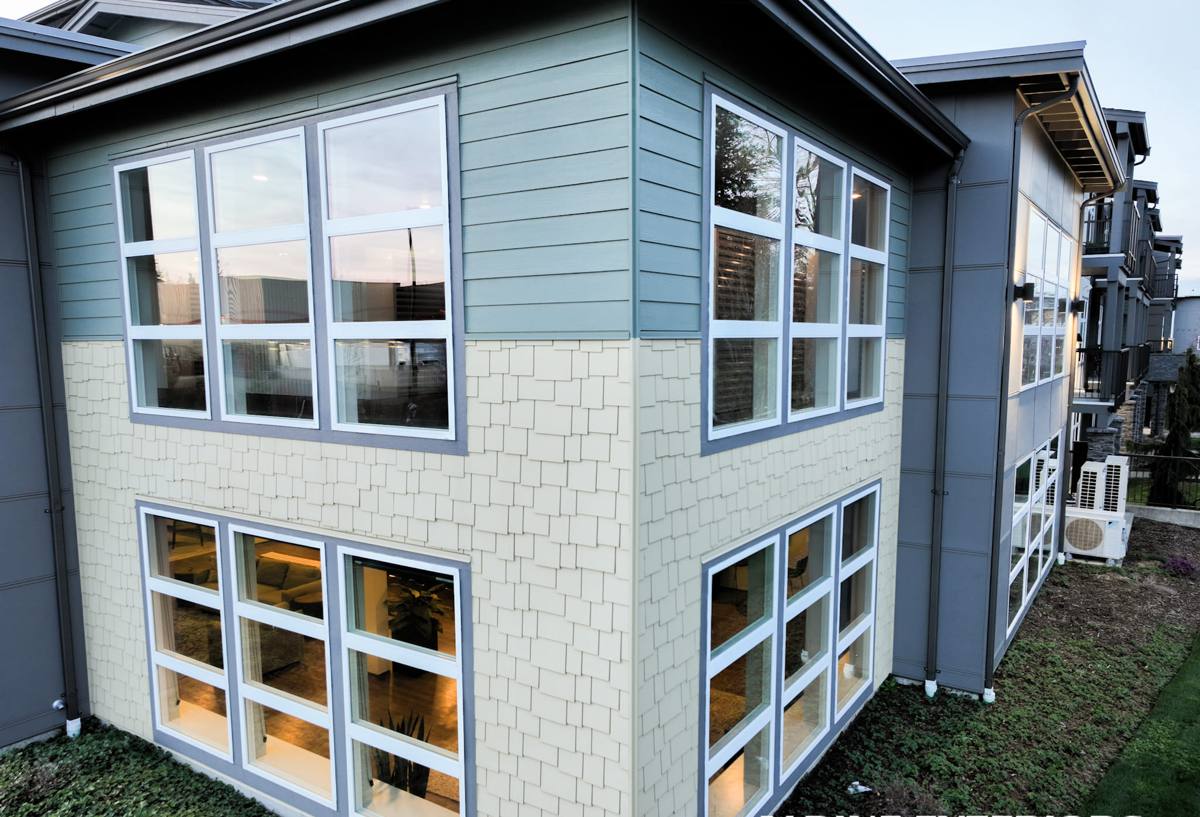
Signs Your Cordata Home's Siding Has Reached the End of Its Life
Most siding doesn't fail on a schedule — it fails when the material's protective layer gives out and moisture starts winning. Here's what we tell Cordata homeowners to watch for:
- Soft or spongy spots when you press on the siding, especially near the bottom courses and around windows
- Paint that's peeling, bubbling, or needs repainting more often than every 7-10 years
- Persistent moss or dark streaking that comes back within months of cleaning
- Visible warping, buckling, or panels pulling away from the wall
- Cracked or chipped boards, particularly at butt joints and corners
- Rising energy bills with no other obvious cause — a sign the wall assembly behind the siding may be compromised
- Interior drywall staining or a musty smell along exterior walls
Any one of these on its own might just mean a repair. Several together, especially on a home over 15-20 years old, usually means it's time to talk about full replacement rather than patching around the problem.
What a Correct Siding Replacement Actually Involves
The siding itself only gets part of the credit for how a home performs over the next 30 years. The work underneath it matters just as much, and it's where a lot of lower-bid jobs cut corners.
Full Tear-Off, Not a Recover
Installing new siding directly over old, failing siding — a "recover" — traps whatever moisture and rot is already present and hides it from view. On a genuine replacement, we strip the old material down to the sheathing so we can actually see the wall assembly, address any soft sheathing or framing damage we find, and start clean.
Water-Resistive Barrier and Flashing Details
With wind-driven rain a regular feature of Whatcom County weather, the house wrap and flashing details around windows, doors, and penetrations matter as much as the siding on top of them. Correct lapping (upper courses over lower, building paper over flashing, never the reverse) is what actually keeps water moving down and out instead of into the wall.
Fastening, Clearances, and Joint Treatment
Fiber cement siding has manufacturer-specified nailing patterns, fastener types, and minimum clearances from grade, decks, and roof lines — all of it there to keep the bottom edge of the siding from sitting in standing moisture. Skipping these details voids warranty coverage and shortens the real-world life of the job, even if it looks fine on installation day.
Why We Install Only James Hardie Fiber Cement
We don't install vinyl, LP SmartSide, Cemplank, Allura, or primed wood siding — not because those products don't have a place in the market, but because after years of doing this work in Whatcom County's climate, James Hardie is the only system we're willing to put our name behind for the long haul.
A Formulation Engineered for This Climate
Hardie manufactures its siding in different formulations tuned to different climate zones. The version specified for regions like ours — cold, wet winters and freeze-thaw cycles — is designed around resisting moisture absorption and the cracking that comes from repeated freeze-thaw stress, rather than the heat-and-humidity concerns of a Gulf Coast formulation. That distinction matters more here than most homeowners realize.
ColorPlus Factory Finish
Instead of a field-applied primer coat that needs painting soon after install, Hardie's ColorPlus finish is baked on at the factory in multiple coats, with a stronger bond to the fiber cement substrate than most site-applied paint. In a climate where moss and algae growth is constant, that matters practically: a factory finish holds its color and sheds mildew stains better, and it delays the repainting cycle that wood and primed siding demand.
Non-Combustible and Genuinely Durable
Fiber cement doesn't rot, and it isn't fuel for fire the way wood-based sidings are. Combined with correct installation, that's the difference between a siding job that needs attention again in 8-10 years and one that's still doing its job in 30.
A Warranty Worth Having
Hardie backs its products with a long, transferable non-prorated warranty on the substrate and a separate finish warranty on ColorPlus coatings. Because it's transferable, it's also a selling point if you list the home down the road — a real asset, not just a maintenance record.
Hardie vs. the Alternatives: A Straight Comparison
| Factor | James Hardie Fiber Cement | Vinyl | LP SmartSide / Wood-Based |
|---|---|---|---|
| Moisture behavior | Doesn't absorb water or rot; formulated for wet climates | Won't rot, but can warp/buckle and trap moisture behind it if installed loose | Engineered wood core is treated, but any breach in the coating exposes it to rot |
| Moss/algae resistance | Factory finish resists staining and cleans up without stripping paint | Surface can host algae, especially in shaded areas | Prone to surface mildew that must be addressed before it reaches the substrate |
| Fire performance | Non-combustible | Combustible (petroleum-based) | Combustible (wood-based) |
| Repainting cycle | ColorPlus finish typically lasts well beyond a decade before touch-up | Doesn't need painting but fades and can't be easily color-matched later | Needs recoating on a regular cycle to keep moisture out |
| Upfront cost | Mid-to-higher | Lowest | Mid |
| Long-term cost | Lower — fewer repaints, fewer repairs, long warranty | Low material cost but shorter realistic lifespan in this climate | Ongoing maintenance cost if coating isn't kept up |
None of this means the alternatives are junk — vinyl and engineered wood both have legitimate uses. It's why, for the specific demands of a Whatcom County exterior, we've standardized on one product we can install correctly and stand behind.
Our Siding Replacement Process, Start to Finish
- On-site assessment: We walk the exterior, check for soft spots, moisture damage, and the condition of trim, windows, and flashing — not just the siding surface.
- Written estimate: A clear scope covering material, tear-off, sheathing repair allowances, and finish — no vague line items.
- Tear-off and inspection: Old siding comes off, exposing the sheathing so any rot or damage can be addressed before anything new goes up.
- Water-resistive barrier and flashing: New house wrap and flashing installed and lapped correctly at every window, door, and penetration.
- Hardie installation: Fastened, spaced, and clearanced to manufacturer specification to keep the warranty intact.
- Trim, caulking, and cleanup: Final detailing and a full site cleanup before we walk the job with you.
Why a Crew That Already Works Cordata Matters
A siding contractor who works this specific stretch of Whatcom County already knows how the local weather patterns behave, which wall orientations take the worst of the wind-driven rain, and how much shade a typical Cordata lot's tree cover throws on the siding. That's not a substitute for doing the technical work correctly, but it does mean fewer surprises during the tear-off and a realistic read on what your home actually needs versus a generic scope written for a different climate. It also means we're a known quantity here — not a crew that shows up once and is gone if a warranty question comes up years later.
If your siding is showing its age, or you're planning ahead rather than reacting to a problem, we're happy to take a look and give you a straightforward, no-pressure estimate — use the form below to get started.