 Ferndale Siding
 Why Everson Roofs Age Differently Than You'd Expect
Everson sits inland along the Nooksack River valley, a short drive from Ferndale and Bellingham Bay, but "inland" doesn't mean dry. The same marine weather systems that push salt-laden air onto the coast at Ferndale still ride up the river valley into Everson, just with the salt mostly filtered out and the moisture left behind. What that means for a roof is long stretches of low-intensity rain and overcast skies rather than quick downpours that dry out fast. Shingles here rarely get a full drying cycle between storms, especially from late fall through spring.
Add in the mature tree cover common on Everson properties and you get the two conditions that shorten a roof's life faster than almost anything else: shade that keeps surfaces damp longer, and organic debris that feeds moss. A roof system built for a drier climate, or installed without attention to ventilation and drainage, will show its age in Everson years before it would somewhere with less rainfall and more sun exposure.
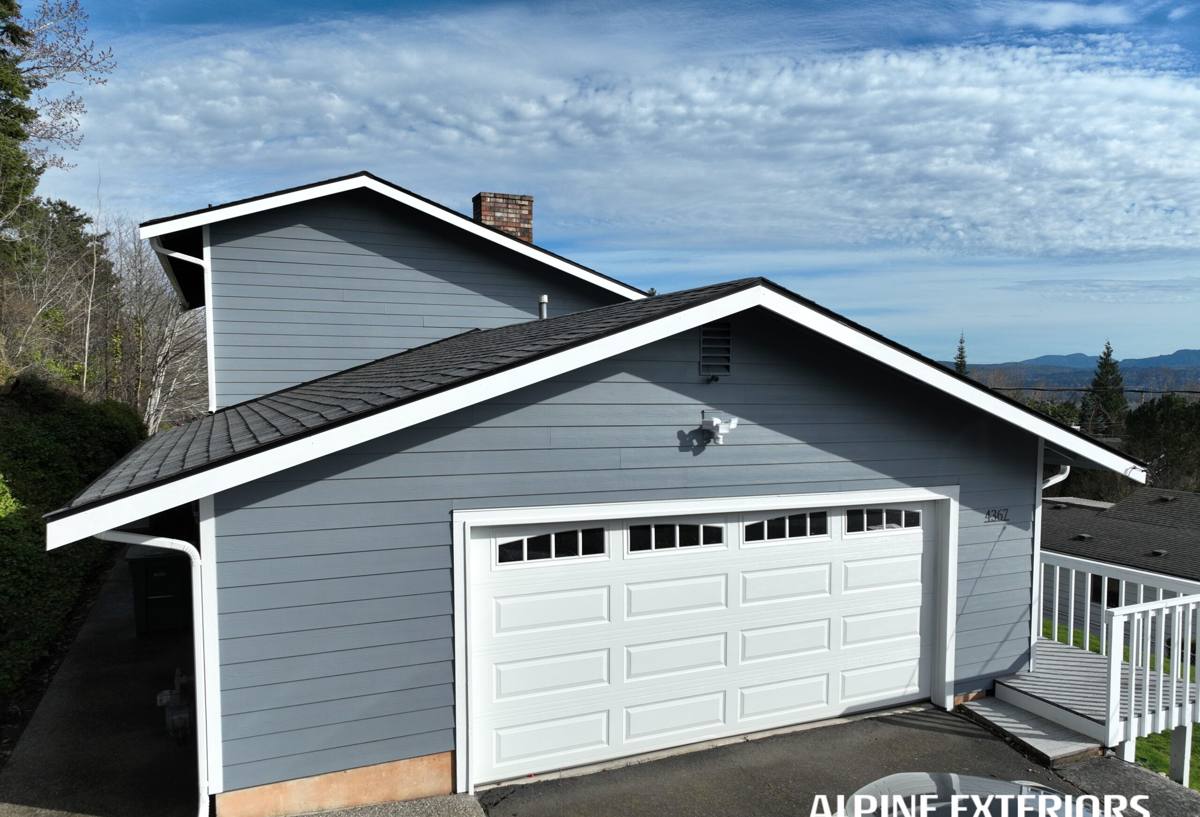
Signs an Everson Roof Needs Replacement, Not Another Patch
Not every roof problem calls for a full tear-off. But there's a point where patching becomes a way of throwing money at a roof that's already past its useful life. Homeowners in Everson should treat these as replacement signals rather than repair-and-wait signals:
- Moss established under shingle tabs, not just growing on the surface — once it's rooted under the shingle edge, it's lifting the roofing and letting water in
- Granule loss heavy enough that you can see bare, shiny patches of asphalt on multiple slopes
- Shingles that are cupping, curling, or cracking, especially on south- and west-facing slopes that see more temperature swing
- Soft or spongy decking felt underfoot during inspection, or daylight visible through the roof deck from inside the attic
- A roof that's already had one layer added over the original — Washington building code limits how many layers can be stacked, and a second overlay is rarely worth doing
- Age: most asphalt shingle roofs in this climate are honestly done by 20–25 years, sooner on shaded, moss-prone slopes
If a roof is showing two or more of these at once, repair costs start adding up toward what a full replacement would run anyway, without buying back any real lifespan.
What a Correct Roof Replacement Actually Involves
Tear-Off and Deck Inspection
A proper replacement starts with a full tear-off down to the deck, not a shingle-over. That's the only way to actually see what's underneath — soft plywood or plank decking, old flashing that's been leaking quietly for years, or ventilation gaps that were never cut in the first place. Any damaged decking gets replaced before anything new goes down, because no underlayment or shingle can compensate for a rotten deck.
Underlayment and Water Protection
In a climate that stays wet as long as Whatcom County's does, underlayment choice matters more than most homeowners realize. Self-adhered ice-and-water membrane at eaves, valleys, and around penetrations gives a second line of defense where water actually collects and pools, backed by synthetic underlayment across the rest of the field for tear resistance and water-shedding under the shingle.
Flashing Details
Most roof leaks trace back to flashing, not shingle failure — around chimneys, skylights, dormers, and where the roof meets a wall. New step flashing, counter-flashing, and valley metal get installed as part of the job, not reused from the old roof, since flashing is inexpensive compared to a callback for a leak.
Ventilation
Balanced intake at the eaves and exhaust at the ridge keeps the attic close to outdoor temperature and humidity. Without it, moisture from inside the house condenses on the underside of the deck, which rots sheathing from below and accelerates shingle failure from above — a problem that shows up faster in a damp, shaded climate like Everson's than almost anywhere else in the state.
Choosing a Roofing Material for a Moss-Prone Climate
Material choice on a roof replacement is really a set of trade-offs between upfront cost, how much attention the roof will need over time, and how well it sheds moisture and resists moss and algae growth. There's no single "right" answer for every home — a heavily shaded lot with mature trees calls for a different conversation than an open lot with more sun.
| Material | Typical Lifespan Locally | Moss/Algae Resistance | Relative Upfront Cost | Ongoing Maintenance |
|---|---|---|---|---|
| 3-Tab Asphalt Shingle | 15–20 years | Low — no algae-resistant granules | Lowest | Regular moss and debris removal needed |
| Architectural (Dimensional) Asphalt Shingle | 25–30 years | Moderate; better with algae-resistant option | Mid-range | Periodic moss treatment and gutter clearing |
| Algae-Resistant (AR) Architectural Shingle | 25–30 years | Higher resistance to algae streaking specifically | Mid-range, small premium | Still needs moss management on shaded slopes |
| Standing-Seam Metal | 40–50+ years | Highest — smooth surface sheds moisture and debris fast | Highest | Low; occasional debris clearing |
Our standard recommendation for most Everson homes is an architectural shingle with algae-resistant granules, matched to correct ventilation and flashing — it balances cost, appearance, and real-world performance in this climate well. Metal is worth the conversation on steeper, heavily shaded roofs where moss keeps coming back no matter what maintenance schedule an asphalt roof gets.
Our Process, From First Look to Final Walkthrough
- On-site inspection. We walk the roof and attic, check decking condition, flashing, ventilation, and current moss or moisture damage, and take measurements.
- Written estimate. A clear scope of work and price, broken down by material and labor, with no vague allowances hiding in the fine print.
- Scheduling around the weather. Tear-off exposes your home to the elements, so we schedule and sequence the job to keep dry-in time as short as possible given Whatcom County's rain patterns.
- Tear-off and deck repair. Old roofing comes off, decking is inspected and any damaged sections replaced before anything new goes down.
- Underlayment, flashing, and shingle installation. Installed to manufacturer specification, not shortcuts, since this is what the warranty depends on.
- Cleanup and magnetic sweep. Full site cleanup including a nail sweep of the yard and driveway.
- Final walkthrough. We go over the finished roof with you before calling the job done.
Why a Crew That Already Works Everson Matters
Roofing crews based out of Ferndale who already run jobs in Everson know the practical realities that don't show up in a generic estimate: which weeks tend to give a workable dry window for tear-off, how tree cover on a given street affects moss recurrence, and what local permitting through Whatcom County actually requires before work starts. That local familiarity shortens the guesswork on scheduling and material selection, and it means a shorter drive if a warranty question or storm-damage check comes up after the job is done.
It also matters for accountability. A crew that plans to keep working in the same small communities around Ferndale has every incentive to do the job right the first time — reputation in a tight-knit area like Everson travels fast, in both directions.
What to Ask Before You Hire a Roofing Contractor
- Are you a licensed, bonded, and insured contractor in Washington State, and can you provide proof?
- Will the job be a full tear-off, and what happens to the existing decking if it's found to be damaged?
- What underlayment and flashing materials are included, not just the shingle brand?
- How is ventilation being addressed — is intake and exhaust airflow actually being calculated, or just assumed?
- What does the workmanship warranty cover, separately from the manufacturer's material warranty?
- Is the estimate a fixed scope of work, or does it leave room for surprise change orders once the roof is opened up?
A contractor who answers these plainly, without dodging or upselling, is usually the safer bet regardless of price.
Protecting a New Roof After Installation
A correctly installed roof still benefits from basic upkeep in this climate. Keeping gutters clear of needles and leaves prevents water from backing up under the shingle edge. Trimming back overhanging branches reduces both shade and the steady drop of organic debris that feeds moss. A gentle moss treatment on shaded, north-facing slopes every year or two — never pressure washing, which strips granules and shortens shingle life — keeps growth from re-establishing under the tabs. None of this is complicated, but skipping it is the single biggest reason a well-installed roof underperforms its expected lifespan in a place like Everson.
If your roof is showing its age or you just want an honest read on where it stands, we're glad to come out from Ferndale and take a look. The estimate is free, there's no pressure attached to it, and you'll get a clear answer on whether you're looking at a repair or a replacement — use the form below to get started.