 Ferndale Siding
 Point Roberts Puts Extra Demands on Exterior Siding
Point Roberts sits on its own peninsula at the end of Boundary Bay, separated from the rest of Whatcom County by water and reachable by road only through Canada. That geography is part of what makes it a special place to live, but it also means homes there sit closer to open salt water, catch more wind off the Strait of Georgia, and stay damp longer than houses just a few miles inland in Ferndale or Blaine. Siding on a Point Roberts home is doing harder work than siding on an average Whatcom County house, and it needs to be installed with that in mind from the first course to the last piece of trim.
Salt Air and Direct Marine Exposure
Homes close to the water pick up airborne salt that settles on siding, trim, fasteners, and flashing. Over years, that salt exposure accelerates corrosion on anything metal and speeds up the breakdown of finishes that aren't built to handle it. It's one of the reasons fastener choice and flashing material matter as much as the siding product itself on a waterfront or near-waterfront lot.
Driving Rain and Wind-Driven Moisture
Point Roberts catches weather straight off the water with little to break the wind. Rain doesn't just fall here, it gets pushed sideways into wall assemblies, which means laps, seams, and penetrations have to be detailed to shed wind-driven rain, not just vertical rainfall. A siding job that would hold up fine on a sheltered inland lot can leak within a few seasons if it's installed with the same assumptions on an exposed Point Roberts elevation.
A Long Moss and Algae Season
The same marine, moisture-heavy climate that defines Whatcom County runs longer and damper on the water. Shaded walls, north-facing elevations, and anywhere tree cover blocks the sun stay wet for extended stretches, which gives moss, mildew, and algae more time each year to take hold on siding surfaces. Material that absorbs moisture or has a soft factory finish gives that growth something to grab onto; a hard, factory-cured finish gives it much less to work with.
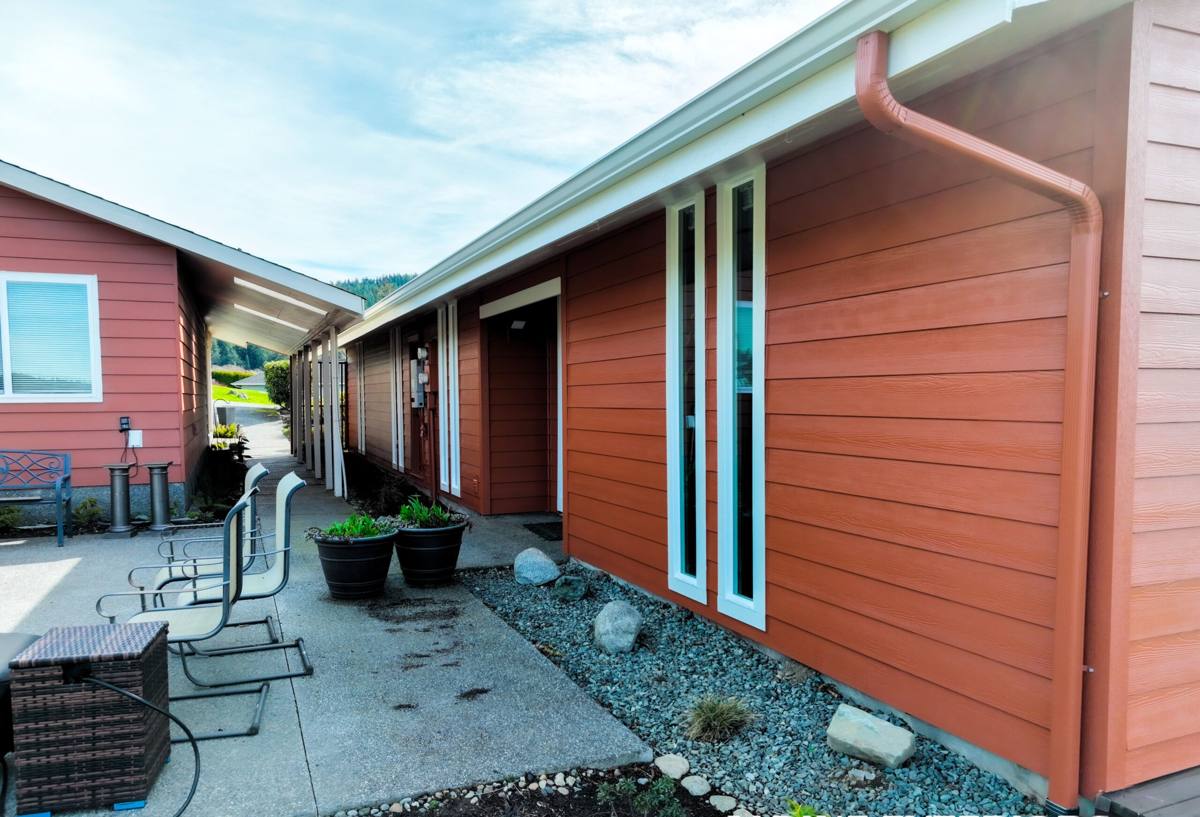
Why We Install Fiber Cement Here and Not Wood, Vinyl, or LP
We standardized on James Hardie fiber cement for every home we side, and Point Roberts is exactly the kind of site where that decision earns its keep. Fiber cement is non-combustible, dimensionally stable, and doesn't feed the moisture and pest problems that come with wood-based products. Vinyl softens and distorts under sustained direct wind exposure, and its seams and J-channels are only forgiving of wind-driven rain up to a point. Engineered wood products like LP SmartSide use a wood-strand core that, once its factory coating is compromised at a cut edge or fastener hole, can wick moisture the way any wood product can. In a climate that stays wet for months at a stretch, that's the wrong trade-off for a peninsula home.
Fiber cement doesn't eliminate the need for good installation, no siding product does, but it gives an installer a material that tolerates the local climate instead of fighting it.
What a Correct Fiber Cement Installation Requires in This Climate
Weather-Resistive Barrier and Flashing First
Siding is the last line of defense, not the only one. Behind every board there should be a continuous, properly lapped weather-resistive barrier, correctly flashed windows and doors, and drainage space for any water that gets past the surface to find its way back out. On a wind-driven-rain site like Point Roberts, skipping or shortcutting this layer is the single most common reason a siding job fails early, and it's invisible once the siding goes up, which is exactly why it has to be done right the first time.
Fastening, Clearances, and Cut Edges
James Hardie specifies fastener type, spacing, and placement for a reason, and near salt air that spec matters even more, corrosion-resistant fasteners aren't optional here. Ground clearance and clearance from roofing, decks, and grade keep the bottom edge of the siding from sitting in standing moisture. Every field cut needs to be sealed or primed per the manufacturer's instructions, because a raw cut edge is the one place fiber cement can take on water if it's left exposed.
Factory Finish Over Field Paint
ColorPlus factory-applied finish is baked on under controlled conditions and backed by its own finish warranty, it holds color and resists the kind of moisture and mildew that a field-applied paint job struggles with over time, especially in a climate where the siding rarely gets a long stretch to fully dry out. We detail joints and touch-up areas to keep that factory finish intact rather than relying on repeated field painting to protect the material.
James Hardie Product Lines for a Site Like This
James Hardie builds region-specific HZ5 formulations engineered for climates like the Pacific Northwest's, where humidity and moisture cycling are constant rather than seasonal. For a Point Roberts home we're typically working with:
- HardiePlank lap siding for the standard horizontal siding, available in several exposures and finish styles, covering the bulk of the wall area.
- HardieShingle siding for homes using a shingle or shake look on gables, accent areas, or full elevations, without the moisture uptake of real wood shingles.
- HardieTrim boards as matched trim so corners, fascia, and window surrounds age and finish consistently with the field siding.
- HardiePanel vertical siding for board-and-batten style sections or modern elevations.
Color and texture choices stay the same as anywhere else we work; what changes for Point Roberts is the attention paid to fastening, flashing, and edge sealing given the exposure.
What Drives Cost on a Point Roberts Siding Job
Every home is different, so we don't quote a price until we've walked the property, but the same factors move the number up or down on nearly every job we bid in this area:
| Cost Factor | Why It Matters Here |
|---|---|
| Tear-off vs. new construction | Removing old siding, checking the sheathing underneath, and repairing any hidden moisture damage from prior wind-driven rain intrusion adds labor before the new siding ever goes up. |
| Wall complexity | Cut-up elevations with multiple gables, dormers, or bump-outs mean more flashing details and more field cuts that need sealing. |
| Siding profile and accessories | Lap siding, shingle-style accents, and trim packages each carry different material and labor costs. |
| Exposure and elevation facing the water | Elevations that take the brunt of the wind and rain get extra attention to flashing and fastening, which affects labor time even though the material cost is the same. |
| Access and staging | Waterfront and peninsula lots can have tighter access or logistics that affect how quickly material and equipment get staged on site. |
Our Process for Point Roberts Jobs
Working Around the Border Logistics
Because Point Roberts is only reachable by road through Canada, scheduling and material delivery take a bit more planning than a job in Ferndale proper. We build that into the timeline up front, crew scheduling, material staging, and permitting are planned around it rather than treated as a surprise partway through the job. Homeowners don't have to manage any of that; it's on us to show up with what we need, when we said we would.
Weather Windows
Tear-off and open-wall time needs to happen during a dry stretch, and dry stretches on the water can be narrower than inland. We sequence the job, tear-off, barrier and flashing, then siding, to keep the wall assembly exposed for as little time as possible, and we watch the forecast closely rather than working around it after the fact.
Inspection Before We Close the Wall
Before any siding goes back on, we check the sheathing for damage from the old system and confirm the weather-resistive barrier and flashing are correctly lapped and sealed. This is the point in the job where problems are cheap to fix and easy to see, and the last point before they're covered up for the next few decades.
Maintenance and Longevity Once It's Installed
Fiber cement with a factory finish is genuinely low-maintenance, but low-maintenance isn't no-maintenance, especially this close to the water. A short annual routine keeps a Hardie installation performing the way it's designed to:
- Rinse siding once or twice a year to clear salt residue, especially on elevations facing the water directly.
- Keep gutters clear so overflow doesn't run down the face of the siding or pool at the bottom edge.
- Trim back vegetation and tree cover where it's keeping a wall shaded and damp longer than the rest of the house.
- Check caulking at trim joints and penetrations every year or two and have any gaps resealed before they let water in.
- Look at ground-level clearance after any landscaping or grading work to make sure soil or mulch hasn't crept up against the bottom edge.
Why It Matters to Hire a Crew That Already Works Point Roberts
A contractor who mostly works inland can still do a competent job, but a crew that regularly works Point Roberts already knows the border logistics, already accounts for the wind exposure in how it flashes a wall, and already treats the moss season as a design factor instead of an afterthought. That local experience shows up less in the sales pitch and more in the details you can't see once the siding is up, the flashing behind the trim, the fastener spacing, the sealed cut edges. Those are the details that decide whether a siding job is still doing its job in fifteen years.
If you're planning a siding replacement or new install in Point Roberts, we're happy to walk the property, look at what your home is dealing with, and put together a straightforward, no-pressure estimate for a James Hardie system built for this exact climate.