 Ferndale Siding
 Storm Damage Roofing in Lynden: A Different Set of Conditions
Lynden sits inland along the Nooksack River valley, in the farm country east of Ferndale near the Canadian border. It doesn't take the same salt-laden air that coastal Whatcom County homes deal with, but it takes plenty else. Pacific storm fronts roll off the Strait of Georgia and gain speed as they funnel through the lowlands, and in the colder months, gusty outflow winds pour down out of British Columbia's Fraser Valley and hit local roofs from the north, a direction a lot of roofing details simply weren't built to shed water from.
Add in the long, wet fall and winter stretch typical of Whatcom County, the shade and tree cover common on Lynden's larger residential lots, and the freeze-thaw swings that show up on clear winter nights, and you get a roof that's working harder than it looks. Moss and algae get a long runway to establish themselves, wind-driven rain finds any gap in flashing or shingle lap, and a single strong wind event can turn small, pre-existing weaknesses into an active leak overnight.
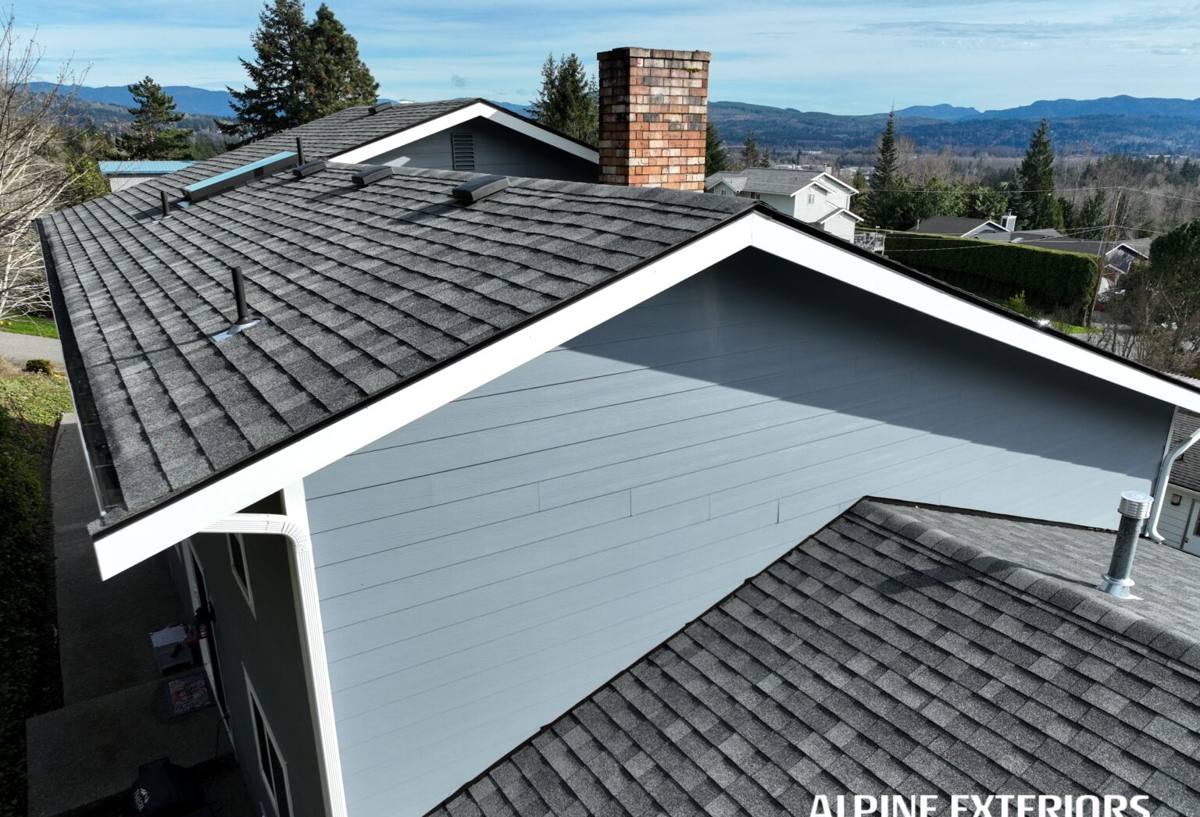
What Storm Damage Actually Looks Like on a Roof
Not all storm damage is obvious from the ground. Some of it announces itself right away; some of it sits quietly until it becomes a ceiling stain months later. On the repairs we see after wind and rain events in this area, the damage usually falls into a few categories:
- Lifted or torn shingles — wind gets under the tab, breaks the seal, and either tears the shingle or leaves it flapping and vulnerable to the next gust.
- Exposed or popped fasteners — nails backing out from repeated wind flex, leaving small but real entry points for water.
- Flashing damage — around chimneys, skylights, and roof-to-wall junctions, where a bent or separated flashing piece can leak long before anyone notices a missing shingle.
- Granule loss — wind-driven rain and debris strip the protective granule layer, which shortens the life of the shingle even if it doesn't leak immediately.
- Debris punctures — branches and wind-blown material can puncture or crack shingles, especially on roofs with overhanging trees.
- Ridge cap separation — the ridge takes the brunt of wind uplift and is often the first place to fail.
- Moss-related lifting — moss colonies that have grown under shingle edges hold moisture and physically lift the shingle tabs, which storm wind then finishes tearing loose.
Why "Just Patch It" Usually Isn't the Right Answer
A tarp over a hole stops water for a week. It isn't a repair. Real storm damage repair means finding out how the water actually got in, not just where it's dripping out, because those two points are frequently several feet apart on a sloped roof. A nail pop at the ridge can travel water down the underlayment and show up as a stain over a bedroom on the other side of the house.
A correct repair also means matching materials properly — shingle profile, exposure, and as close a color match as weathering allows — reinstalling flashing to manufacturer spec rather than just caulking over the gap, and confirming the underlayment and decking underneath weren't compromised before new shingles go back down. Skipping any of those steps is how a "repaired" roof ends up leaking again in the next storm.
Common Shortcuts to Watch For
- Caulk or roofing cement used in place of proper flashing repair
- New shingles nailed directly over damaged or soft decking
- Mismatched shingle exposure that leaves the repair visibly patched and prone to wind lift
- No inspection of the surrounding field, only the spot that's actively leaking
How We Handle a Storm Damage Repair Call
1. Stop Active Water Intrusion
If a roof is actively leaking or has an open hole, the first priority is a proper temporary tarp or cover, secured so it survives the next round of wind rather than tearing loose itself.
2. Full Roof Inspection, Not Just the Trouble Spot
We walk the whole roof, not just the area someone spotted from the yard. Storm damage rarely shows up in only one place; wind uplift and debris impact tend to leave more than one weak point, and we'd rather find the second one now than have you call us back in two months.
3. Written Findings and Photos
You get a clear, honest account of what's actually damaged, what's simply aged, and what's fine. That documentation also does double duty if you're filing an insurance claim.
4. A Straight Repair Plan and Estimate
We tell you what needs to be fixed, roughly what it involves, and what it's likely to cost, including whether a targeted repair is the right call or whether the damage is extensive enough that replacement makes more financial sense.
5. The Repair Itself
Matching shingles, correct flashing and underlayment work, proper fastening patterns, and a clean finish that doesn't look like a patch job from the street or from a ladder.
6. Follow-Up
We'd rather stand behind the work than disappear after the invoice. If something related to the repair doesn't hold up, we want to hear about it.
Repair or Replace? What Actually Drives That Call
Most storm-damaged roofs in this area don't need a full replacement, but some do — usually because the storm exposed a roof that was already near the end of its useful life. Here's a general guide to how we think through it:
| Factor | Repair Usually Makes Sense | Replacement Usually Makes Sense |
|---|---|---|
| Roof age | Under roughly 12-15 years, healthy field shingles elsewhere | Approaching or past the shingle's rated life, especially with widespread granule loss |
| Extent of damage | Isolated to one slope or a small area | Multiple slopes affected, or damage scattered across the whole roof |
| Decking condition | Solid, dry decking under the damaged area | Soft, delaminating, or water-stained decking found during inspection |
| Moss and algae history | Light, surface-level growth already being managed | Long-term moss colonization that's lifted shingles across large sections |
| Shingle matching | Discontinued or heavily weathered shingle only affects appearance | Can't get a safe functional match and repeated leaks are likely |
| Insurance scope | Adjuster and inspection agree on a targeted repair | Adjuster's scope and full inspection point to a full replacement |
We'll always tell you honestly which side of that line your roof falls on. There's no upside for us in talking a homeowner into a full replacement that a solid repair would have handled, and no upside in patching a roof that's going to be back on our schedule in a year.
Working With Insurance on a Storm Claim
Most storm damage claims follow a similar path: you report the damage, an adjuster comes out to assess it, and the insurer approves a scope of work and payment based on that assessment. Where a contractor helps is in the documentation — clear photos, an honest description of cause and extent, and a repair estimate that matches what actually needs to happen rather than what's easiest to sell.
We're glad to walk a roof with an adjuster and answer technical questions, and we'll give you our own findings whether or not they line up exactly with the insurance scope. If there's a gap between what the adjuster approved and what the roof actually needs, you deserve to know that before work starts, not after.
Keeping the Next Storm From Doing the Same Damage
A repaired roof is only as good as the maintenance that follows it. A few habits go a long way in this climate:
- Clear gutters and downspouts before the fall storm season so water isn't backing up under the roof edge
- Trim back branches that overhang the roofline, both for debris risk and because they shade the roof and feed moss growth
- Have moss and algae growth treated before it establishes under shingle edges, not after tabs are already lifting
- Check flashing around chimneys, vents, and skylights each year — these are the first places a leak usually starts
- Confirm attic ventilation is adequate, since poor airflow traps moisture that speeds up decking and shingle deterioration from underneath
- After any significant wind event, do a visual check from the ground for lifted shingles, debris, or obvious damage, and call for an inspection if anything looks off
Why It Matters That We Already Work in Lynden
A crew that works this part of Whatcom County regularly knows what a Fraser outflow wind event or a heavy fall storm typically does to roofs out here, because we've already seen it on the house down the road. That means faster, more accurate inspections, no guessing about what "normal wear" versus "storm damage" looks like on roofs that have been through the same weather, and a shorter response time when a storm comes through and a lot of homeowners are calling around at once.
It also means accountability. We're not a storm-chasing crew that shows up after a big weather event, signs a stack of contracts, and is gone by the time anyone needs a follow-up call. We live and work in this area, and the roofs we repair are on houses we drive past.
Get a Free, No-Pressure Estimate
If a recent storm left you with a leak, missing shingles, or just a nagging feeling that something up there isn't right, it's worth having it looked at before the next round of Whatcom County weather moves through. Fill out the form below for a free estimate — no pressure, just an honest look at what your roof actually needs.