 Ferndale Siding
 Why Roofs Near Lummi Nation Wear Differently
Homes on and around Lummi Nation sit close to the water, and that changes how a roof ages. Air coming off Bellingham Bay carries salt, and salt is hard on exposed metal — nail heads, drip edge, flashing, and vent stacks all corrode faster here than they do a few miles inland in Ferndale or the rest of Whatcom County. Add in driving rain that gets pushed sideways off the water during a storm, and you get water finding its way into laps and seams that would stay dry on a calmer site.
Then there's shade and moisture. A lot of lots in this area have mature trees and damp, low-light conditions for a good chunk of the year, which is exactly what moss and lichen need to take hold. Whatcom County's long, wet moss season means that once moss gets a foothold on a roof here, it keeps growing for months, not weeks. Between the salt exposure, the wind-driven rain, and the moss, a roof near Lummi Nation is doing more work than a roof in a drier, more sheltered part of the region — and it needs repair work that actually accounts for that, not a generic patch job.
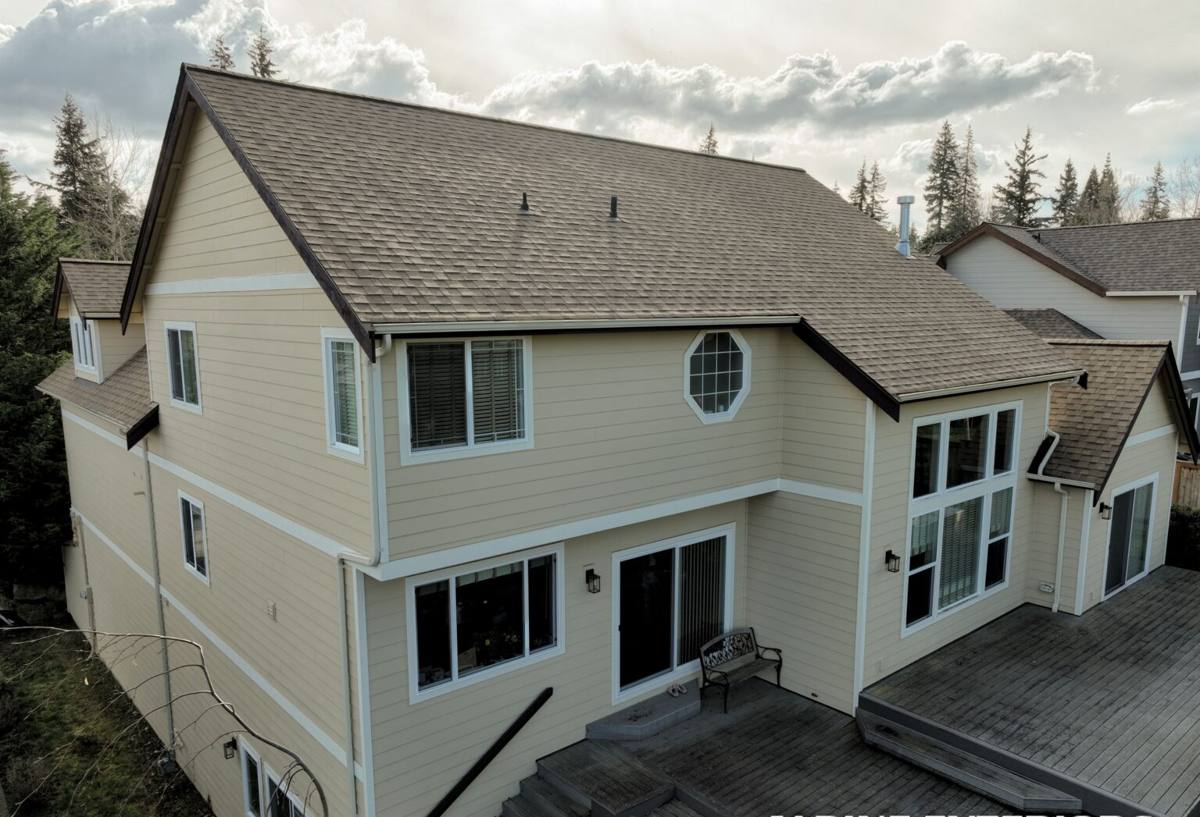
Signs a Roof Needs Repair, Not Just a Look
Most roof problems out here don't start as a dramatic leak — they start small and get ignored because nothing is dripping into a bucket yet. By the time you see a stain on the ceiling, water has usually been getting in for a while. Here's what we tell homeowners to watch for:
- Moss or dark streaking building up in the valleys or along the north side of the roof
- Granules collecting in gutters or at the base of downspouts
- Shingles that are curling, cupping, or lifting at the edges
- Rust streaks running down from flashing around chimneys, vents, or skylights
- Soft or spongy spots when walking the roof, or visible sagging from the ground
- Daylight visible through the roof deck from inside the attic
- Ceiling stains, especially ones that grow or reappear after a storm
None of these mean you automatically need a full replacement. Most of them are exactly what roof repair is for — catching the failure point before it turns into structural rot or interior damage.
What Actually Causes Roof Leaks Out Here
Flashing Failures
Flashing — the metal that seals roof penetrations and transitions — is usually the first thing to fail on a coastal roof, well before the shingles or panels around it wear out. Salt air accelerates corrosion at seams and fastener points, and once a pinhole opens up, water follows the path of least resistance straight into the decking. Chimneys, skylights, and roof-to-wall transitions are the usual suspects.
Moss and Lichen
Moss doesn't just look bad. Its roots hold moisture against the roofing material and lift shingle edges as it grows, which opens a path for wind-driven rain to get underneath. Left long enough, moss mats will hold water against the deck year-round, which is how a slow, invisible leak turns into rotted sheathing.
Wind-Driven Rain
On an open or water-facing lot, rain doesn't always fall straight down. When wind pushes it sideways or at an upward angle under an eave, standard lap coverage that would hold up inland can get overwhelmed. This is usually where we find water intrusion at low-slope transitions, eaves, and anywhere the original installation didn't allow extra margin for the wind exposure this area actually gets.
What a Correct Roof Repair Actually Involves
Diagnose Before You Patch
A repair that just covers the spot where water is showing up inside the house often misses the real entry point, since water travels along the decking before it drips through. A correct repair starts by tracing the leak back to its source — usually by getting on the roof and checking flashing, fastener lines, and moss-holding areas near the interior stain, not just patching the ceiling side.
Match the Existing System
Roofing is a layered system — underlayment, flashing, fasteners, and the finish material all work together. A repair that uses mismatched materials, wrong fastener metal, or the wrong underlayment type against the existing roof can create new failure points, sometimes faster than the original problem. We match what's there whenever possible and only recommend upgrading a component (like flashing metal) when the original is clearly undersized for a coastal exposure.
Check the Decking
If moisture has been getting into the deck for a while, the plywood or boards underneath can be soft, delaminating, or rotted. Covering rotted decking with new shingles just hides a structural problem. Any honest repair includes pulling back the affected area far enough to see solid wood, not just the section directly under the visible leak.
Detail the Flashing for This Climate
Given the salt exposure here, we lean toward flashing details and fastener metals that resist corrosion longer, and we make sure step flashing, counter-flashing, and kick-out flashing are actually doing their job — not just present, but lapped and sealed correctly. A lot of the leaks we get called out for started with flashing that was installed but installed wrong.
Repair or Replace? How We Help You Decide
Not every roof problem near Lummi Nation needs a full replacement, and we're not going to sell you one if a targeted repair will hold up. The honest answer depends on a few factors:
| Factor | Points Toward Repair | Points Toward Replacement |
|---|---|---|
| Roof age | Under 15–20 years, in line with material's expected life | At or past the material's expected service life |
| Extent of damage | Isolated to one section, flashing point, or valley | Multiple areas failing across different slopes |
| Decking condition | Solid wood found once damaged shingles are pulled back | Soft, rotted, or delaminating sheathing in multiple spots |
| Moss/algae staining | Surface growth, shingles still intact underneath | Granule loss and shingle degradation under the moss |
| Budget and timeline | Need a durable fix now, plan replacement later | Ready to solve the underlying issue once, long-term |
If a roof is generally sound and the problem is contained, repair is the honest recommendation — it's cheaper and it works. We'll tell you plainly if what we're looking at is closer to the replacement side of that table instead.
Our Process for Roof Repair Near Lummi Nation
- Inspection. We get on the roof (not just a ground-level look) and check flashing, fasteners, moss patterns, and the decking near any known leak.
- Written estimate. You get a clear scope of what's being repaired, what materials we're using, and why — no vague line items.
- Repair. We pull back damaged material to solid decking, address the actual cause (not just the symptom), and rebuild the flashing and finish layer correctly.
- Cleanup and check. Debris, old material, and moss buildup get cleared from the work area and gutters before we consider the job done.
- Follow-up. If a repair is masking a bigger issue we spotted along the way, we'll tell you before it becomes an emergency, not after.
Materials and Fasteners We Choose for a Marine Climate
Given the salt exposure this close to the water, we default to corrosion-resistant fasteners — stainless or hot-dip galvanized rather than standard electro-galvanized nails and screws, which can start rusting noticeably sooner in this environment. It costs a little more up front, but replacing fasteners is disruptive and expensive compared to installing the right ones the first time.
For flashing, we favor metals and detailing that hold up to sustained salt air rather than the minimum a manufacturer's spec sheet allows for inland installs. We're not knocking any particular brand here — most roofing materials perform fine when the installation accounts for the actual exposure. Where we draw the line is on shortcuts: reused old flashing, undersized fastener patterns, or underlayment that isn't rated for the extra moisture load this area gets. Those choices might not fail in year one, but they tend to fail early, and re-doing a repair costs more than doing it right the first time.
A Maintenance Checklist to Stretch the Life of Your Roof
A lot of the repair calls we get out here could have been smaller jobs — or avoided entirely — with some basic upkeep. Given how long the moss season runs in this part of Whatcom County, we recommend homeowners near Lummi Nation stay ahead of it rather than waiting for a stain to show up inside.
- Clear moss and debris from valleys and north-facing slopes at least once a year
- Keep gutters and downspouts clear so water isn't backing up under the lowest course of shingles
- Trim back branches that keep a section of roof shaded and damp
- Walk the attic after a hard windstorm and check for new light, moisture, or staining
- Have flashing around chimneys, skylights, and vents checked every couple of years, since it's usually the first thing to fail
- Address small leaks the season you notice them — decking rot spreads while you wait
Why Local Experience Near Lummi Nation Matters
A roof repair contractor who mostly works dry, inland neighborhoods is going to under-detail the flashing and under-spec the fasteners for a site this exposed, because that's what works where they usually build. A crew that's actually done repair work in and around Lummi Nation knows which flashing points fail first in this specific combination of salt air and wind-driven rain, and knows moss isn't just cosmetic here — it's a driver of real damage given how long it stays wet.
There's also a practical jurisdiction question worth asking up front: depending on exactly where a property sits, work may fall under tribal land-use rules rather than standard county permitting. A contractor who's worked in the area before should know to ask which applies before pulling a permit or starting work, rather than assuming Whatcom County's process covers every property in the area.
Timing matters too. Between the rain and the moss cycle, there's a real window each year when roof repair work goes smoothly and a window when it doesn't. A crew that works this area regularly plans repairs around that instead of scheduling around convenience.
If you've got a roof near Lummi Nation that's showing moss, a stain on the ceiling, or flashing that looks rough up close, we're happy to take a look and give you an honest read on what it needs. The estimate is free, there's no pressure to sign anything on the spot, and if a small repair is genuinely all it needs, that's what we'll tell you.