 Ferndale Siding
 Why Lummi Island Siding Wears Differently Than Mainland Homes
Lummi Island sits out in the water, and that changes how siding fails. Homes just a few miles inland in Ferndale or elsewhere in Whatcom County deal with plenty of rain, but island homes take on salt air, near-constant wind exposure, and moisture that lingers longer before it dries. If you've owned a home out here for more than a few years, you've probably already noticed your siding ages faster than a friend's place on the mainland.
Three things drive most of the repair calls we get on the island:
- Salt air — airborne salt settles on siding, trim, and fasteners. Over time it accelerates corrosion of nails and metal flashing, and it can leave a chalky residue that makes paint and caulk fail earlier than they would inland.
- Driving rain — wind off the water pushes rain sideways into walls that a typical eave overhang wouldn't have to handle on a more sheltered lot. Corners, butt joints, and anywhere caulk has cracked become entry points.
- A long moss season — Whatcom County's wet stretch runs long, and shaded, north-facing, or tree-covered walls on the island stay damp for weeks at a time. Moss and algae hold moisture against the siding surface, which is exactly the condition that lets rot start underneath paint that still looks okay from a distance.
None of this means island homes need exotic solutions. It means repairs have to account for causes that a mainland-only crew might not think to check.
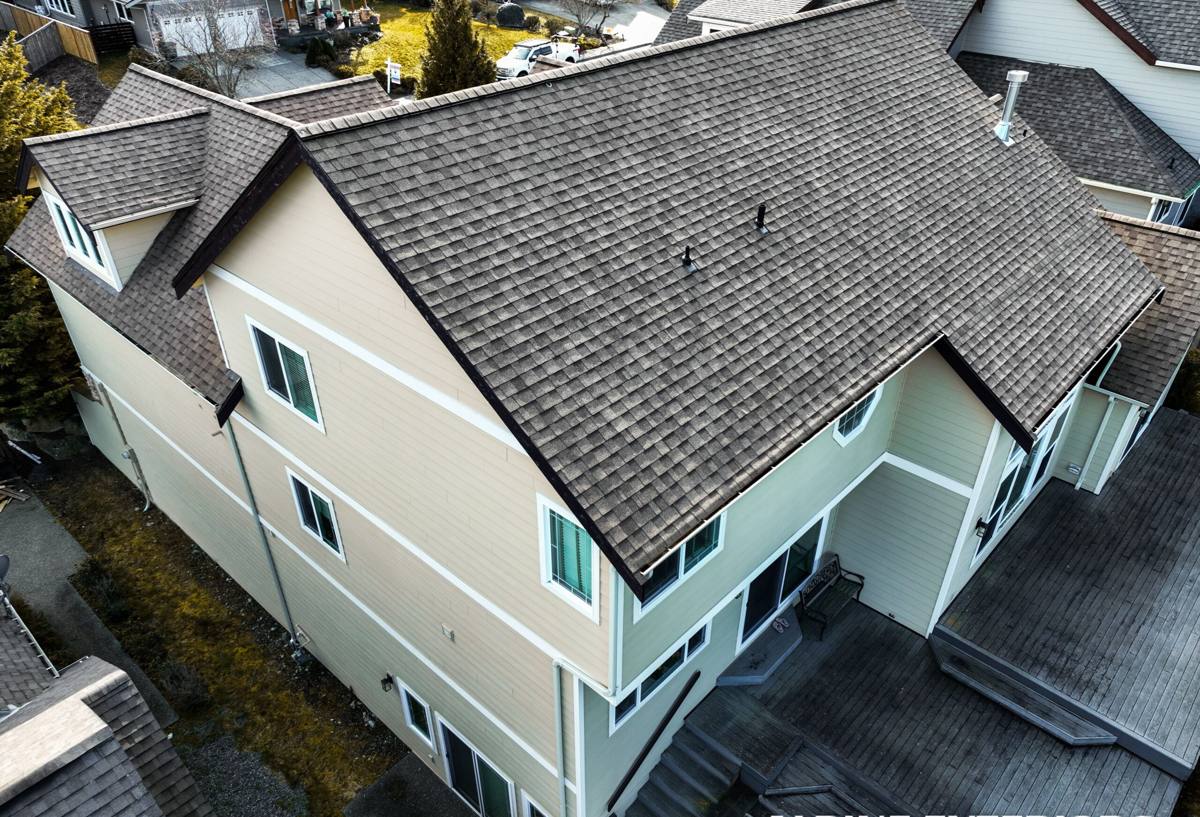
Signs Your Siding Needs Repair, Not Just a Wash
Pressure washing and repainting can make tired siding look better for a season without fixing what's actually wrong underneath. Before you spend money on cosmetic upkeep, look for these signs that point to an actual repair need:
- Soft, spongy, or bubbling spots when you press on the siding, especially near the bottom courses or below windows
- Cracked or missing caulk at corners, trim, and butt joints
- Dark streaking or persistent moss growth that comes back within weeks of cleaning
- Rust streaks bleeding from nail heads or metal flashing
- Gaps opening up between siding and trim, or boards that have visibly cupped or warped
- Paint that's failing in the same spots year after year, no matter how often it's redone
Any one of these on its own might be minor. Several together, especially on a wall that faces open water or sits in shade most of the day, usually means moisture has already gotten past the surface.
What a Correct Repair Actually Involves
Diagnosing the cause, not just patching the symptom
A repair that only replaces the visible damaged board without figuring out why that board failed tends to fail again in the same spot within a couple of years. On Lummi Island, that usually means checking the flashing above the damaged area, the condition of the water-resistive barrier behind the siding, and whether caulk joints nearby have already opened up. If the cause isn't addressed, the new board is just as exposed as the old one was.
Matching materials and finish
Patch repairs look wrong — and often perform worse — when the replacement material doesn't match the existing siding's profile, exposure, and finish. Field-painted repairs on factory-finished siding are also a common source of visible mismatch a year or two down the road, since factory finishes and hand-applied paint weather differently.
Flashing and water management details
Most of the repeat siding failures we see trace back to flashing, not the siding material itself — missing kick-out flashing at roof-to-wall intersections, reused old flashing that's already corroded from salt exposure, or caulk used in place of flashing where it doesn't belong. A correct repair fixes the water path, not just the cosmetic gap.
Repair or Replace? How We Help You Decide
Not every problem area means the whole wall needs to come off. But there's a point where patching costs more over time than addressing a full elevation at once. We walk through a few factors with every homeowner before recommending either path:
| Factor | Favors Repair | Favors Full Replacement |
|---|---|---|
| Extent of damage | Isolated to one or two boards or a small area | Spread across multiple walls or courses |
| Age of existing siding | Relatively recent, otherwise sound | Nearing or past its expected service life |
| Moisture behind the siding | Surface-level, caught early | Sheathing or framing already affected |
| Cause identified | Fixable flashing or caulk issue | Systemic issue (poor original installation, wrong material for exposure) |
| Appearance goals | Homeowner is fine with a well-matched patch | Homeowner wants a uniform, updated look |
We'll tell you honestly when a repair is the right call, even though a full re-side is a bigger job for us. A repair that's done right, on a wall where the underlying causes are manageable, can add years of service life for a fraction of replacement cost.
Our Process for a Lummi Island Repair Call
- Inspection — we look at the damaged area and the surrounding wall, including flashing, trim, and any signs of moisture that has traveled beyond the visible damage.
- Scope and quote — you get a clear explanation of what's actually wrong, what it will take to fix it correctly, and an honest range before any work starts.
- Scheduling around island access — getting crews, materials, and equipment to Lummi Island means factoring in ferry schedules, so we plan repair days to minimize back-and-forth trips and keep the job moving efficiently once we're on-site.
- The repair itself — removing affected material, correcting the underlying flashing or water management issue, and installing matched replacement siding.
- Cleanup and final check — site cleaned up, repair area reviewed with you before we leave.
Why We Repair and Rebuild Using James Hardie Fiber Cement
When a repair calls for replacement material — whether it's a few boards or a full wall — we use James Hardie fiber cement, and only James Hardie. That's a deliberate standard, not a default. We don't install vinyl, LP SmartSide, Cemplank, Allura, or primed wood siding, and on a site like Lummi Island the reasons matter more than usual:
- Non-combustible material — fiber cement doesn't feed a fire the way wood-based or vinyl products can, which matters on a rural island with longer emergency response times.
- Factory-applied ColorPlus finish — baked-on finish resists the fading and cracking that field-applied paint is prone to in salt air and constant UV/wind exposure, so a matched repair holds its color longer than a hand-painted patch would.
- Engineered for this climate — Hardie's HZ product line is formulated for wetter, moisture-prone regions like the Pacific Northwest, which is exactly the exposure profile of a west-facing wall on Lummi Island.
- Warranty that transfers — a strong, transferable manufacturer warranty matters more on a home you might sell someday than a lower-cost product with a thinner warranty structure.
We're not going to tell you every other siding product is worthless — vinyl and LP have their place and plenty of homes wear them fine in milder conditions. But for the salt air, wind-driven rain, and moss exposure that Lummi Island homes deal with, we've made fiber cement our standard, and we stand behind that on every repair and every full install.
What Affects the Cost of a Siding Repair Here
Every repair is different, so we won't quote a number without seeing the wall. But these are the factors that move the price up or down on most jobs we see on the island:
| Cost Factor | Why It Matters |
|---|---|
| Size of the affected area | A single board is a much smaller job than a full elevation |
| Hidden moisture or rot | Sheathing repair adds labor and material beyond the visible siding |
| Flashing correction needed | Fixing the actual water path costs more upfront but prevents repeat failure |
| Material matching | Matching an existing color and profile can require special ordering |
| Access and scheduling | Ferry logistics and site access can affect crew time on island jobs |
Small, isolated patch repairs are often a modest expense — commonly in the low four figures. Repairs involving rot remediation, larger sections, or flashing correction cost more, simply because more is being fixed. We'll always break down what you're paying for before we start.
Why Hire a Crew That Already Works Lummi Island
A contractor based on the mainland who's never worked the island can still do competent siding work — but there's a real advantage to hiring a crew that already understands the logistics and the exposure conditions specific to Lummi Island. We know to plan around ferry timing so a repair day isn't half-consumed by travel. We know which wall orientations on the island take the worst of the wind-driven rain and which spots stay damp long enough to grow moss most of the year. And because we service Ferndale and the surrounding Whatcom County coastline regularly, follow-up visits and warranty work aren't a special trip — they're part of the normal route.
If your siding is showing soft spots, recurring moss, failing caulk, or paint that won't hold, don't wait for it to spread. We'd be glad to take a look and give you a straightforward, no-pressure estimate on what it would take to fix it right — use the form below to get started.