 Ferndale Siding
 Roof Repair Built for Lummi Island's Climate
Lummi Island sits out in the salt air off the Whatcom County coast, and that changes what a roof has to put up with compared to a house a few miles inland in Ferndale. The combination of salt-laden air, driving rain off the water, and a long moss season that can run most of the year works on a roof from three directions at once: it corrodes metal, it finds every gap in flashing and underlayment, and it feeds growth that lifts and breaks down shingles from underneath. A repair that ignores any one of those three forces tends to fail again within a year or two. A repair that accounts for all three tends to actually last.
We work on roofs across Ferndale and the surrounding Whatcom County shoreline, including Lummi Island homes, and the repair approach we use out there is not identical to what we'd do on a dry, inland roof. This page covers what that difference actually looks like.
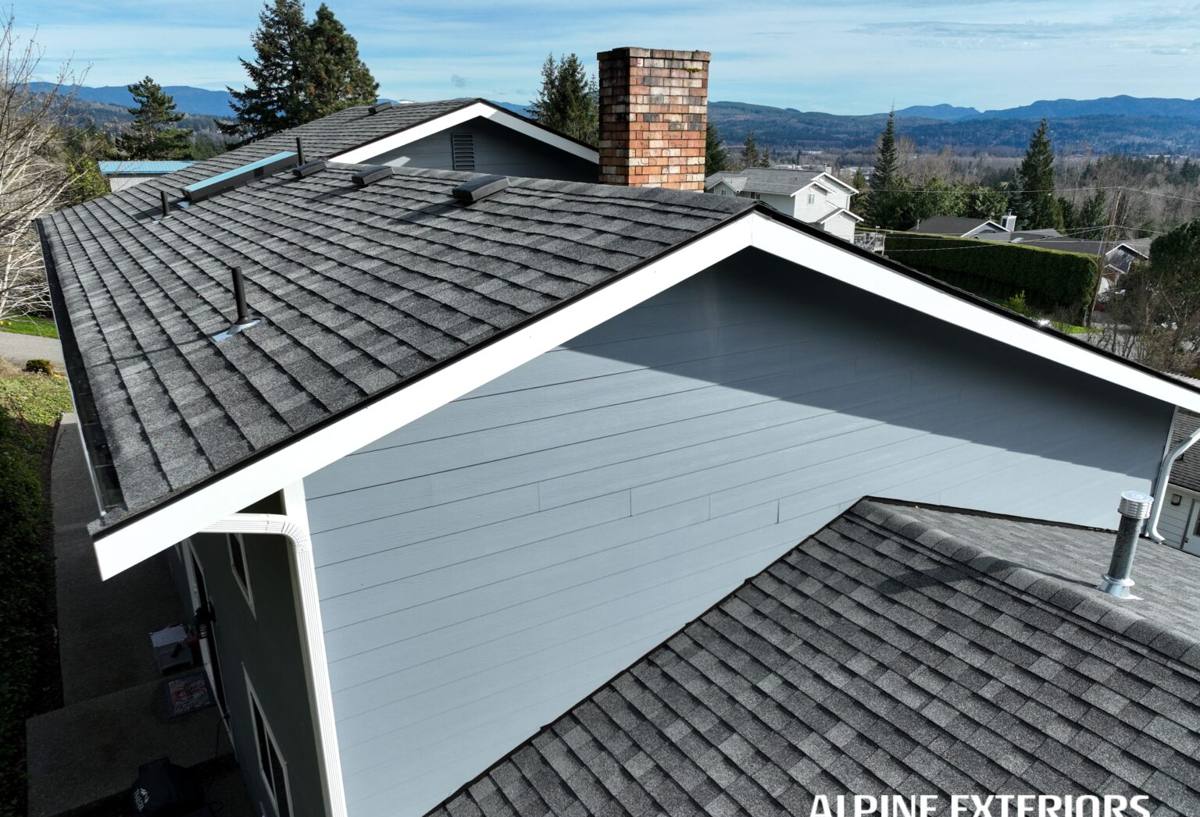
What Salt Air, Rain, and Moss Actually Do to a Roof
Salt Air and Corrosion
Airborne salt settles on every exposed metal surface on a roof — nail heads, flashing, vent caps, gutter hangers, even the fasteners holding shingles down. Over years, that salt accelerates rust and corrosion far faster than it would happen inland. A nail that's corroded loses its grip on the decking, which is one of the most common reasons we find shingles that have lifted or blown off in an otherwise "healthy-looking" roof section. Flashing around chimneys, skylights, and roof-to-wall joints corrodes from the same exposure, and once flashing thins out or rusts through, water finds its way underneath it.
Driving Rain and Wind-Driven Water
Rain that comes in sideways off open water behaves differently than rain falling straight down. It can push up under shingle edges, work its way sideways at valleys and step flashing, and get past underlayment that would hold up fine in a calmer, more sheltered spot. This is why the leaks we find on exposed island and shoreline roofs are so often at transitions — valleys, wall intersections, chimney saddles, and low-slope sections — rather than out in the open field of the roof where wind and water don't concentrate.
A Long Moss Season
Whatcom County's damp, mild climate keeps conditions right for moss growth for a large part of the year, and Lummi Island's exposure and tree cover in places make it worse, not better. Moss doesn't just look bad — it holds moisture against the shingle surface, works its way under shingle tabs and lifts them, and clogs the granule surface that's supposed to shed water. A roof that's carrying a heavy moss mat is almost always losing years of service life underneath it, even before any leak shows up inside the house.
Signs a Lummi Island Roof Needs Repair
Most roof failures out here don't start as a dramatic leak — they start small and get ignored because there's no obvious drip yet. Here's what we tell homeowners to watch for between inspections:
- Granules collecting in gutters or at the base of downspouts (a sign shingles are wearing thin)
- Moss or dark algae staining concentrated on the shaded or north-facing slopes
- Rust streaking below metal flashing, vent stacks, or gutter hangers
- Shingle tabs that look curled, cupped, or lifted at the edges, especially after a windy stretch
- Soft spots or slight sag when walking the roof deck, particularly near valleys
- Water stains or a faint musty smell in the attic near chimneys, skylights, or exterior walls
- Daylight visible through the roof deck from inside the attic
Any one of these on its own might be minor. Two or three together, especially near a valley or wall transition, usually means active water intrusion that hasn't reached the ceiling yet.
What a Correct Repair Involves Out Here
A roof repair on a salt-exposed, rain-driven, moss-prone roof needs to do more than patch the visible symptom. Here's what we consider non-negotiable for the work to actually hold:
Matching Materials, Not Just Patching Them
Shingles fade and wear unevenly with age and sun exposure, so a patch using new material next to old will always look and perform a little differently. We match as closely as the existing roof allows and are upfront when an exact match isn't possible — that's a maintenance-burden and appearance trade-off worth knowing about before work starts, not after.
Corrosion-Resistant Fasteners and Flashing
Given how much salt air accelerates corrosion here, we use fasteners and flashing rated for coastal exposure rather than standard-grade material, even on a small repair. It costs a little more upfront and avoids the same failure showing back up in a few years.
Underlayment at the Vulnerable Points
Valleys, eaves, and roof-to-wall transitions are where driving rain does the most damage, so those are the spots that get self-adhering, water-resistant underlayment during a repair — not just a shingle swap. Skipping this step is the single biggest reason we see "repaired" leaks come right back after the next big storm.
Moss Removal Done the Right Way
Moss has to come off without stripping granules or damaging the shingle mat underneath, which rules out aggressive pressure-washing. We remove it by hand or with low-pressure methods, then treat the surface to slow regrowth, since simply scraping moss off and walking away just resets the clock a few months.
Ventilation Check
A roof that's trapping moisture from underneath — from poor attic ventilation — will grow moss and wear out faster no matter how good the shingles are. Any real repair should include a quick check of attic airflow, because fixing the surface while ignoring the ventilation is a half-measure.
Repair or Replace? What Actually Decides It
Homeowners often assume any leak means a full new roof, and just as often assume a small leak means a five-minute fix. Neither is usually true. Here's how we actually weigh it:
| Factor | Leans Toward Repair | Leans Toward Replacement |
|---|---|---|
| Roof age | Under roughly 15 years, or a newer roof with isolated damage | Near or past its expected service life for the material |
| Extent of damage | Localized to one section, valley, or penetration | Spread across multiple slopes or recurring in several spots |
| Decking condition | Solid, no soft spots found during inspection | Soft, rotted, or delaminated decking discovered underneath |
| Moss/algae staining | Surface-level, treatable and removable | Long-term staining with granule loss underneath |
| Cost outlook | Typically a few hundred to a couple thousand dollars depending on scope | Repair costs start approaching a meaningful fraction of replacement cost |
We'll tell you honestly which side of that table your roof falls on. If a repair is genuinely the right call, we don't upsell a replacement — and if a repair would just be a stopgap on a roof that's already past its useful life, we'll say that too.
Our Repair Process
- Inspection. We walk the roof (weather permitting) and check the attic from inside, looking specifically at valleys, flashing, penetrations, and any moss-affected areas.
- Diagnosis and honest options. We explain what's actually failing, why, and whether repair or replacement makes sense — in plain terms, not sales language.
- Written scope and quote. You know what's being done and roughly what it costs before anything starts.
- The repair itself. Old damaged material comes out, decking gets checked and replaced where needed, new underlayment goes in at the vulnerable points, and matching shingles and corrosion-resistant flashing go back in.
- Cleanup and check. Job site and gutters get cleared of debris, and we walk you through what was done.
Why It Matters That the Crew Already Works Lummi Island
Getting a crew and materials to an island job takes more planning than a repair a few blocks off Main Street in Ferndale — timing has to account for the ferry schedule, and that's simply part of the logistics of working out there. A crew that already does this regularly builds it into scheduling instead of treating it as a surprise that delays your repair.
More importantly, a crew that's worked multiple Lummi Island roofs already knows which slopes on that kind of exposure tend to hold moss longest, which flashing details tend to fail first under driving rain off the water, and which fastener and underlayment choices actually hold up to years of salt air rather than just looking fine on installation day. That's not something you get from a crew that occasionally takes an island job — it comes from doing the work here repeatedly and seeing what comes back and what doesn't.
Keeping a Repaired Roof in Good Shape
A correct repair buys you years, but a few habits stretch that further given the local climate:
- Clear gutters and valleys of needles and debris at least twice a year — clogged valleys are where driving rain does the most damage
- Have moss growth treated before it becomes a thick mat, not after
- Trim back overhanging branches where practical to cut down on shade and debris that feed moss
- Have the roof looked at after any unusually severe windstorm, not just on a routine schedule
- Keep an eye on attic ventilation — musty smells or visible condensation are worth a call before they become a bigger issue
None of this requires much time or money, but skipping it is how a good repair turns into a repeat service call two or three years down the road.
Get a Straight Answer on Your Roof
If you're dealing with a leak, moss buildup, or storm damage on a Lummi Island roof, we're happy to come take a look, tell you honestly what we find, and lay out your options with no pressure either way. Use the form below to request a free estimate.