 Ferndale Siding
 Composite Decking in Kendall: A Different Set of Problems Than Most Areas
Kendall sits back from the coast, tucked into the tree line east of Ferndale, and that changes what a deck has to deal with. You get less direct salt exposure than homes right along Bellingham Bay, but you make up for it with heavier tree cover, more shade, and slower-drying ground. Add in the driving rain that moves through Whatcom County most of the year and the long moss season that follows it, and you've got a climate that's genuinely hard on any outdoor structure — wood or composite. The difference is what happens next: wood decking starts losing the fight against moisture almost immediately, while a properly installed composite deck is built to shrug it off for decades.
We work on siding and decking across this whole area, and composite decking has become the default recommendation for Kendall properties specifically because of how the site conditions behave — shaded yards, tree litter, and moisture that lingers longer than it does on an open, sun-exposed lot closer to town.
What Kendall's Terrain and Weather Actually Do to a Deck
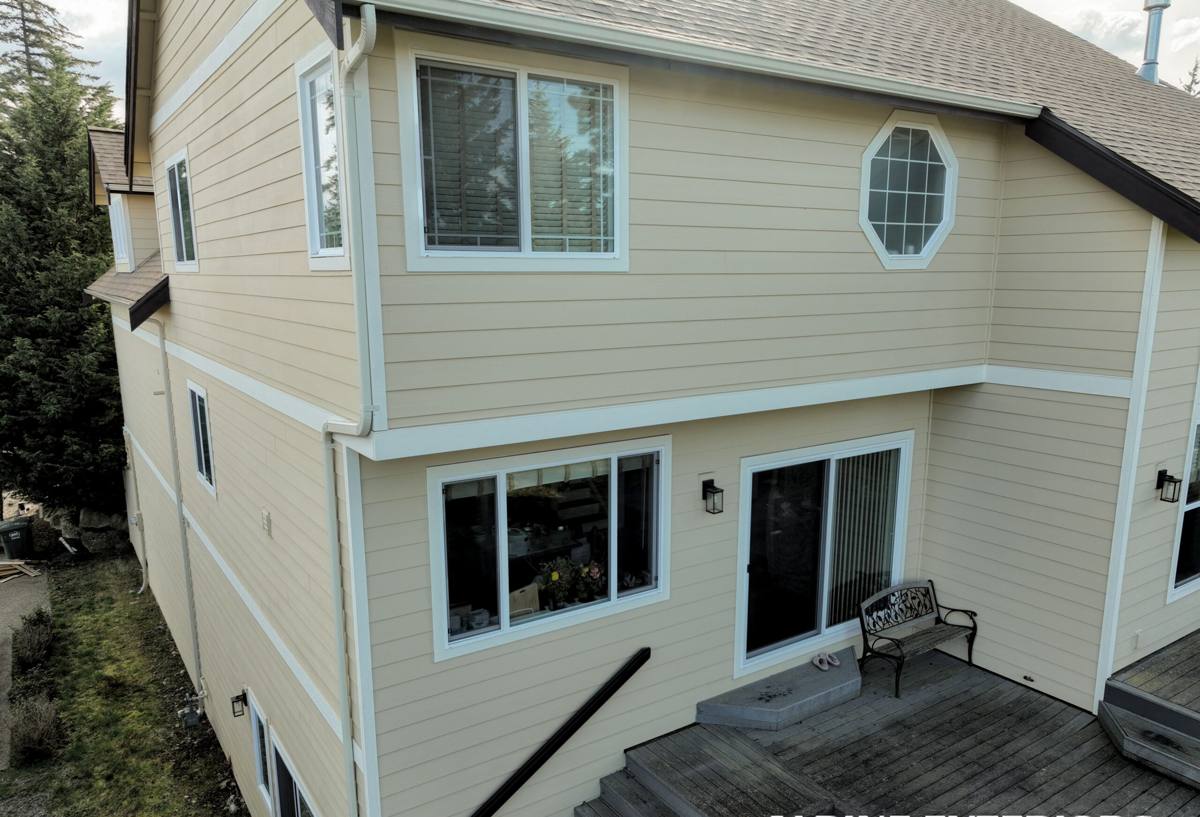
A deck built in an open, sunny yard dries out between rain events. A deck built under fir or cedar cover — which describes a lot of Kendall lots — doesn't get that break. Needles and leaf litter collect between boards, moisture sits in the gaps, and low airflow underneath keeps the substructure damp longer than it should be. That combination is exactly what accelerates rot in untreated wood decking and what feeds moss and algae growth on any deck surface that isn't engineered to resist it.
Over a few seasons, the pattern is predictable:
- Wood boards start to cup, splinter, or gray unevenly where shade and moisture linger longest.
- Moss and algae take hold first on the north-facing or heavily shaded sections of the deck.
- Fasteners in wood decking work loose as the boards swell and shrink through repeated wet-dry cycles.
- Ledger boards and framing near the house absorb splashback and standing water if flashing was never installed correctly.
None of this is unique to Kendall, but the tree cover and slower drying times make it show up faster and more visibly than it would on a more exposed lot elsewhere in Whatcom County.
Why Composite Decking Holds Up Better Here
Composite decking doesn't have wood grain for moisture to travel through, and it doesn't need to be sealed or stained on a yearly schedule to keep water out. That matters a lot on a shaded, damp lot where a wood deck's maintenance window keeps closing before you get to it. Modern capped composite boards resist moisture absorption at the surface, which slows — though doesn't eliminate — the buildup of the algae and moss film that forms on any exterior surface sitting in shade and standing moisture for months at a time.
It's also more dimensionally stable than wood. Composite boards don't cup, split, or splinter the way wood does when it goes through repeated wet-to-dry cycles, which is the exact stress pattern Whatcom County's weather puts on outdoor structures. That stability is why we don't push wood decking as the default in areas like Kendall — not because wood decking is inherently bad, but because it demands a maintenance commitment (annual cleaning, sealing, and inspection) that most homeowners underestimate until the deck already shows damage.
Where Composite Still Needs Real Attention
Composite isn't maintenance-free, and we don't sell it that way. It still needs to be kept clear of debris, cleaned periodically to prevent surface film buildup, and — critically — installed with the airflow and drainage details that keep moisture from getting trapped underneath. A composite deck installed without those details will still develop moisture and organic growth problems; the board material alone doesn't solve a bad substructure.
What a Correctly Installed Composite Deck Involves
Substructure and Framing
The framing underneath a composite deck matters as much as the boards on top. We check joist spacing against the manufacturer's span requirements for the specific board profile — composite boards generally need tighter joist spacing than wood, and getting this wrong shows up later as bounce or sag. On shaded, moisture-prone lots, we also look hard at the condition of any existing substructure before deciding whether it can be reused or needs to be rebuilt.
Fasteners, Gapping, and Board Direction
Composite boards expand and contract with temperature more than most homeowners expect. Hidden fastener clip systems are our default because they allow that movement without creating the split-and-crack pattern you get from face-screwing boards that were never gapped correctly. Gapping between boards and at butt joints is set to the manufacturer's spec, not eyeballed — too tight and the boards buckle in warm weather, too loose and debris packs into the gaps and holds moisture against the board edges.
Flashing Where the Deck Meets the House
This is the detail that gets skipped most often on lower-quality deck jobs, and it's the one that causes the most expensive damage. The ledger board where a deck attaches to the house needs proper flashing tied into the wall's water management, not just lag bolts and caulk. Since we work on siding as much as decking, we treat the ledger connection as part of the building envelope — it has to shed water the same way the wall siding above it does, or you end up with hidden rot behind the siding at the exact point where the deck attaches.
Drainage and Airflow Underneath
On a shaded Kendall lot, what happens under the deck matters as much as what happens on top of it. Grading away from the foundation, keeping the underside ventilated, and avoiding low spots where water pools are all part of a correct install. Skip this and you get the same moss-and-moisture problems under a composite deck that you'd get with wood — just delayed.
Composite Board Options: What We Install and Why
Not all composite decking is built the same way, and the differences matter more in a wet, shaded climate than they would somewhere dry. Here's how the main categories compare for a Kendall property:
| Board Type | Moisture Resistance | Maintenance | Best Fit For |
|---|---|---|---|
| Capped composite (full wrap) | Highest — surface fully protected from moisture and staining | Occasional cleaning, no sealing or staining | Shaded, moss-prone lots like most of Kendall |
| Capped composite (three-side) | Good on exposed faces; cut ends need attention at install | Low, with proper end-cap treatment at cuts | Standard decks with fewer field cuts |
| Uncapped composite | Lower — surface absorbs more moisture over time | Higher; may need periodic cleaning and treatment | Budget-conscious projects with good sun exposure |
| Traditional wood | Depends entirely on upkeep | Annual sealing/staining, regular inspection | Homeowners committed to ongoing maintenance |
For most Kendall properties, we recommend fully capped composite specifically because of the shade and moisture combination — it's the option that best matches what the site conditions demand, not just a default upsell.
Our Process for a Composite Decking Project
- Site visit and assessment. We look at sun and shade exposure, existing substructure condition, drainage patterns, and how the deck ties into the house's siding and water management.
- Board and layout consultation. We walk through composite options based on your budget, the shade exposure of the specific area, and how the deck will be used.
- Substructure evaluation or rebuild. If you're replacing an existing deck, we determine what framing can be reused and what needs to be rebuilt to meet current span and moisture-management standards.
- Flashing and ledger tie-in. Since we handle siding as well, we make sure the ledger connection is integrated correctly with the wall assembly rather than treated as a separate system.
- Installation. Framing, fastening, and board layout are done to manufacturer spec — proper gapping, joist spacing, and fastener systems throughout.
- Final walkthrough. We go over basic care, what to expect in year one as the boards settle in, and answer any questions before we consider the job done.
What Composite Decking Still Needs From You
A composite deck cuts maintenance dramatically compared to wood, but "low-maintenance" isn't "no-maintenance" — especially under tree cover. A short seasonal checklist keeps a composite deck performing the way it's supposed to:
- Sweep off needles, leaves, and debris regularly, especially in fall and through the wet months.
- Clean the surface a couple of times a year with a soft brush and mild soap to prevent algae or moss film from taking hold in shaded areas.
- Keep gutters and downspouts near the deck clear so runoff isn't dumping extra water onto the deck surface or the ledger connection.
- Check underneath periodically for debris buildup that can block airflow and trap moisture against the framing.
- Watch for any movement, gaps, or loose fasteners at the ledger connection and have it inspected if you notice changes.
Why Hire a Crew That Already Works in Kendall
Composite decking done wrong looks fine for the first year or two — the problems show up later, in the framing, the ledger connection, or the drainage underneath, and by then they're expensive to fix. A crew that already works Kendall's shaded, moisture-heavy lots knows to plan for that from the start: tighter joist spacing where composite spans demand it, ledger flashing that's actually tied into the house's water management, and layout decisions that account for how little sun some parts of a lot get through the year.
We're a Ferndale-based crew that works across Whatcom County, and composite decking is something we install alongside the siding work we're known for — which means we're already thinking about how the deck ties into the rest of the exterior, not treating it as a standalone add-on. Local familiarity also means straightforward answers about permitting, realistic timelines around the wetter months, and being reachable afterward if something needs a look.
Get an Estimate for Your Kendall Deck
If you're planning a new composite deck or replacing one that's showing its age, we're happy to take a look and give you a straight, no-pressure estimate — no invented urgency, just an honest read on what your property needs. Use the form below to get started.