 Ferndale Siding
 Why Decks in Point Roberts Wear Faster Than They Should
Point Roberts sits on its own peninsula, exposed to open water on three sides, which means homes here take a steadier beating from salt-laden air and wind-driven rain than most of Whatcom County. Add the long, low-sun winters that keep shaded decking damp for weeks at a time, and you get a climate that's hard on any outdoor surface — but especially hard on wood decking that wasn't built or maintained with that exposure in mind. We see the same failure patterns over and over: fasteners bleeding rust through the boards, moss taking hold in the shaded corners by late fall, and moisture working its way into joints and end grain long before the boards look obviously bad on top.
Composite decking, installed correctly for this environment, sidesteps most of that. But "installed correctly for this environment" is doing a lot of work in that sentence — a composite deck built the way it would be built inland doesn't automatically hold up out here. The material choice matters, but so does the substructure underneath it, the fasteners holding it down, and how the whole assembly sheds water.
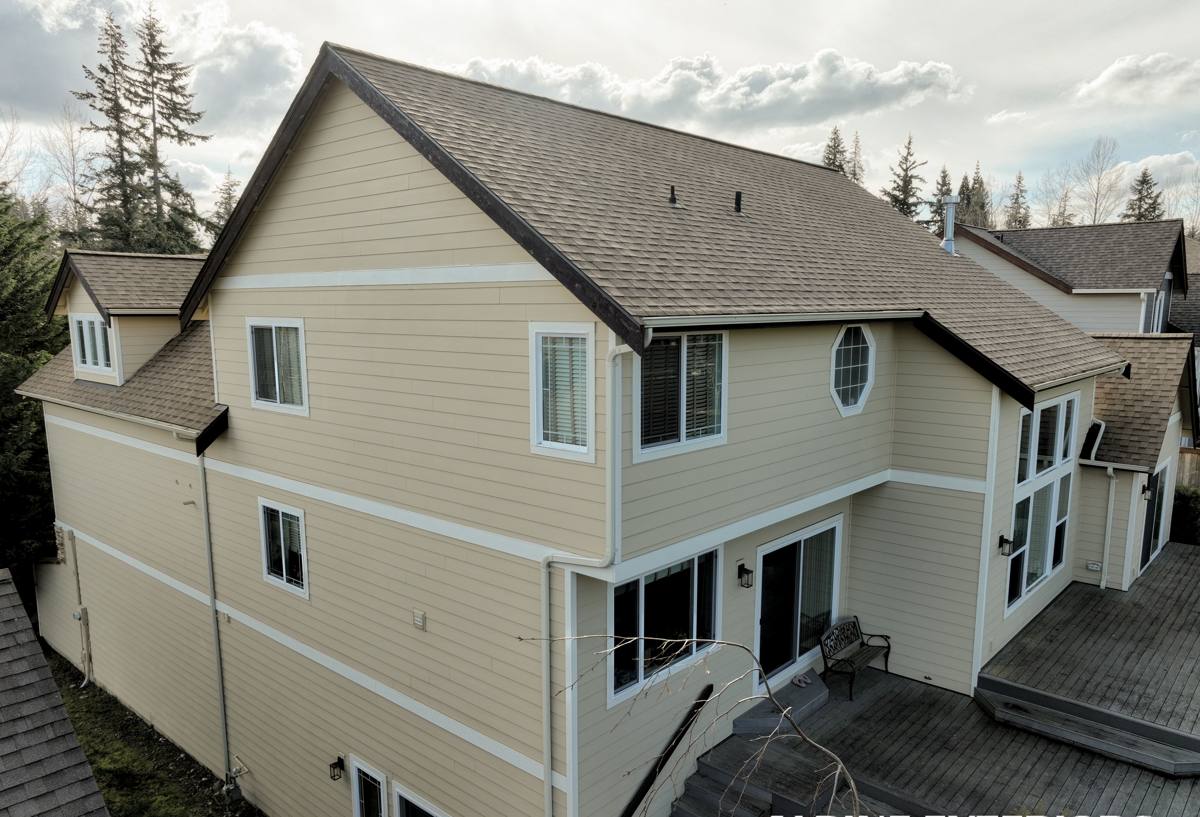
What Salt Air, Rain, and Moss Actually Do to a Deck
Salt Air and Metal Hardware
Airborne salt accelerates corrosion on anything less than fully marine-rated hardware. Standard galvanized screws and joist hangers that would last decades further inland can start showing rust streaks and pitting in a few seasons this close to the water. Once a fastener corrodes, it loses grip strength long before it fails outright, which is how you end up with squeaky, slightly loose boards that seem fine but aren't.
Driving Rain and Water Intrusion
Rain here doesn't just fall — wind pushes it sideways into ledger boards, board ends, and any gap where water can collect instead of drain. On an older or poorly built deck, that water finds its way behind fascia boards and into the ledger connection at the house, which is exactly where a deck problem becomes a siding and structural problem.
Moss, Mildew, and Extended Shade Season
Point Roberts gets a long stretch of the year where decks — especially north-facing or tree-shaded ones — simply don't dry out between rains. That's ideal conditions for moss and mildew to establish themselves in seams, fastener heads, and any texture that holds moisture. On wood, that growth accelerates rot underneath it. On composite, it's mostly a surface and slip-hazard issue, but only if the boards were installed with enough drainage gap to let air move underneath.
Why Composite Decking Fits This Climate
Composite decking won't rot, splinter, or need refinishing, which removes the maintenance burden that wood decking demands in a wet marine climate. The boards themselves don't absorb water the way wood does, so they aren't feeding the moss and mildew problem the same way. That said, composite isn't maintenance-free — it needs periodic washing to keep organic growth from building up on the surface, and cheaper, uncapped composite products can still absorb moisture at cut ends if they aren't sealed or capped properly.
Capped vs. Uncapped Composite
This is the distinction that matters most for a property like this. Fully capped composite boards have a polymer shell wrapped around the wood-fiber core on all sides, which keeps moisture out of the core even at cut ends and board faces. Uncapped or partially capped composite can still wick water into the fiber core over time, especially in a climate that stays wet as long as this one does. We install fully capped composite specifically because it holds up to sustained damp conditions without the slow moisture absorption that shortens the life of lower-tier products.
Color and Heat Considerations
Because Point Roberts doesn't get the sustained summer heat that inland areas do, dark composite colors that would be a problem for foot comfort elsewhere aren't as much of a concern here. That gives homeowners more flexibility on color without the tradeoffs that come up in hotter climates.
What a Correct Composite Deck Build Involves
The composite boards are the visible part, but most of what determines whether a deck lasts 10 years or 30 happens underneath them.
- Joist and ledger inspection: Any existing rot, corrosion, or soft framing gets found and repaired before new decking goes down — covering up a compromised substructure with new boards just hides the problem.
- Ledger flashing: Where the deck attaches to the house, proper flashing keeps water from working its way behind the siding and into the wall assembly. This is the single most common point of failure we find on older decks in wet climates.
- Joist protection tape: A self-adhering waterproof tape over the top of each joist keeps rain from soaking into the framing through screw penetrations, extending the life of the substructure significantly.
- Stainless or coated marine-grade fasteners: Standard hardware corrodes too fast this close to the water; we spec fasteners rated for the exposure.
- Hidden fastener systems: Clip-based fastening leaves no exposed screw heads on the board face, which removes a common point where water pools and stains form.
- Proper board spacing: Gaps sized for drainage and airflow keep moisture from sitting between boards, which matters more here than almost anywhere given how long things stay damp.
Composite Decking Options: What Changes With Price
| Factor | Entry-Level Composite | Fully Capped / Premium Composite |
|---|---|---|
| Moisture resistance | Partial capping; cut ends can absorb water over time | Fully sealed shell on all sides, including grooved edges |
| Fade and stain resistance | Moderate; may show mildew staining sooner in shaded areas | Better resistance to organic staining and fading |
| Warranty structure | Shorter, often prorated warranties | Longer warranties with less proration, reflecting the material's durability |
| Upfront cost | Lower material cost per square foot | Higher material cost, offset by lower long-term maintenance |
| Fit for this climate | Workable for covered or low-exposure areas | Better suited to full sun/rain exposure and shaded, damp areas alike |
We'll walk you through where your project actually needs the premium tier and where it doesn't — a fully covered deck under an existing roofline doesn't face the same exposure as an open deck catching wind off the water, and the right spec should reflect that instead of defaulting to the most expensive option across the board.
Our Process
- On-site assessment: We look at the existing deck or build site, check drainage, sun/shade exposure, and wind exposure to figure out what spec actually fits the location.
- Substructure evaluation: For replacements, we inspect joists, ledger connection, and posts before quoting — this determines whether it's a resurface or a full rebuild.
- Written estimate: A clear scope of work and material spec, with straightforward pricing — no vague allowances you find out about later.
- Permitting: We handle the permit application through the appropriate Whatcom County process for the project scope.
- Build: Framing repairs or new substructure first, then flashing, joist tape, and decking installation with hidden fasteners.
- Final walkthrough: We check spacing, fastening, and drainage details with you before calling the job done.
Permits and Code Considerations
Point Roberts falls under unincorporated Whatcom County, and most deck replacements — especially anything attached to the house, elevated, or requiring new footings — need a building permit through Whatcom County's permitting process. Guardrail height, baluster spacing, and stair requirements are also governed by code, not personal preference, and they get checked at inspection. We factor permitting and code compliance into the project from the estimate stage rather than treating it as an afterthought, so there are no surprises mid-project.
Why a Crew That Already Works Point Roberts Matters
Point Roberts is a bit of a logistical outlier compared to the rest of Whatcom County: it's only reachable by land through Canada, which means material deliveries and crew scheduling have to account for border crossings rather than a simple drive down the road. A contractor who hasn't planned around that can end up with delayed material, delayed crews, or a project that stalls out mid-build. We already factor that into scheduling and material staging because we've done the work out here before — it's not something we're figuring out on your job.
There's also a familiarity factor that matters more than people expect. A crew that's replaced decks and siding on this peninsula knows which exposures take the worst weather, which framing details tend to be hiding moisture damage on homes of a certain age, and what actually holds up here versus what looks fine on paper. That's the difference between a deck that's built to spec and a deck that's built for where it actually sits.
Keeping a Composite Deck Looking Right in This Climate
- Rinse or sweep debris off the deck regularly, especially in fall when leaves and organic matter build up fastest.
- Wash the surface a couple of times a year with a deck cleaner or mild soap and water to keep moss and mildew from establishing themselves in the board texture.
- Check that furniture, planters, and rugs aren't trapping moisture against the boards for extended periods — airflow matters even with composite.
- Keep gutters and downspouts near the deck clear so runoff isn't dumping extra water onto the surface or the ledger connection.
- Have the substructure checked periodically, especially on older decks being resurfaced — composite boards can outlast a substructure that isn't holding up its end.
Get a Straight Answer on What Your Deck Needs
Every property out here handles exposure a little differently depending on orientation, shade, and how the existing structure has held up. If you're weighing a deck replacement or a new build in Point Roberts, we're happy to come take a look, walk you through what we're seeing, and put together a straightforward, no-pressure estimate — just fill out the form below to get started.