 Ferndale Siding
 Decks Near Nooksack Wear Differently Than Decks Inland
If you're in the Nooksack area outside Ferndale, you already know your deck doesn't age like a deck in Spokane or Yakima. Whatcom County sits right up against Bellingham Bay and the Strait of Georgia, and that means salt-tinged air moving through year-round, long stretches of driving rain off the water, and a moss season that can run from October clear into April in a wet year. None of that is dramatic on its own. What it does is add up — quietly, board by board — until a deck that looked fine two summers ago is soft underfoot, dark with mildew stains, or worse, hiding rot in the framing where you can't see it.
We're not writing this to scare anyone into a replacement they don't need. Plenty of decks out here can be repaired — a few boards swapped, a ledger re-flashed, some hardware upgraded. But when the structure itself has been compromised, patching it is a short-term fix on a long-term problem. This page is about knowing the difference, and about what a proper deck replacement should actually involve if it's going to hold up to another decade of Whatcom County weather.
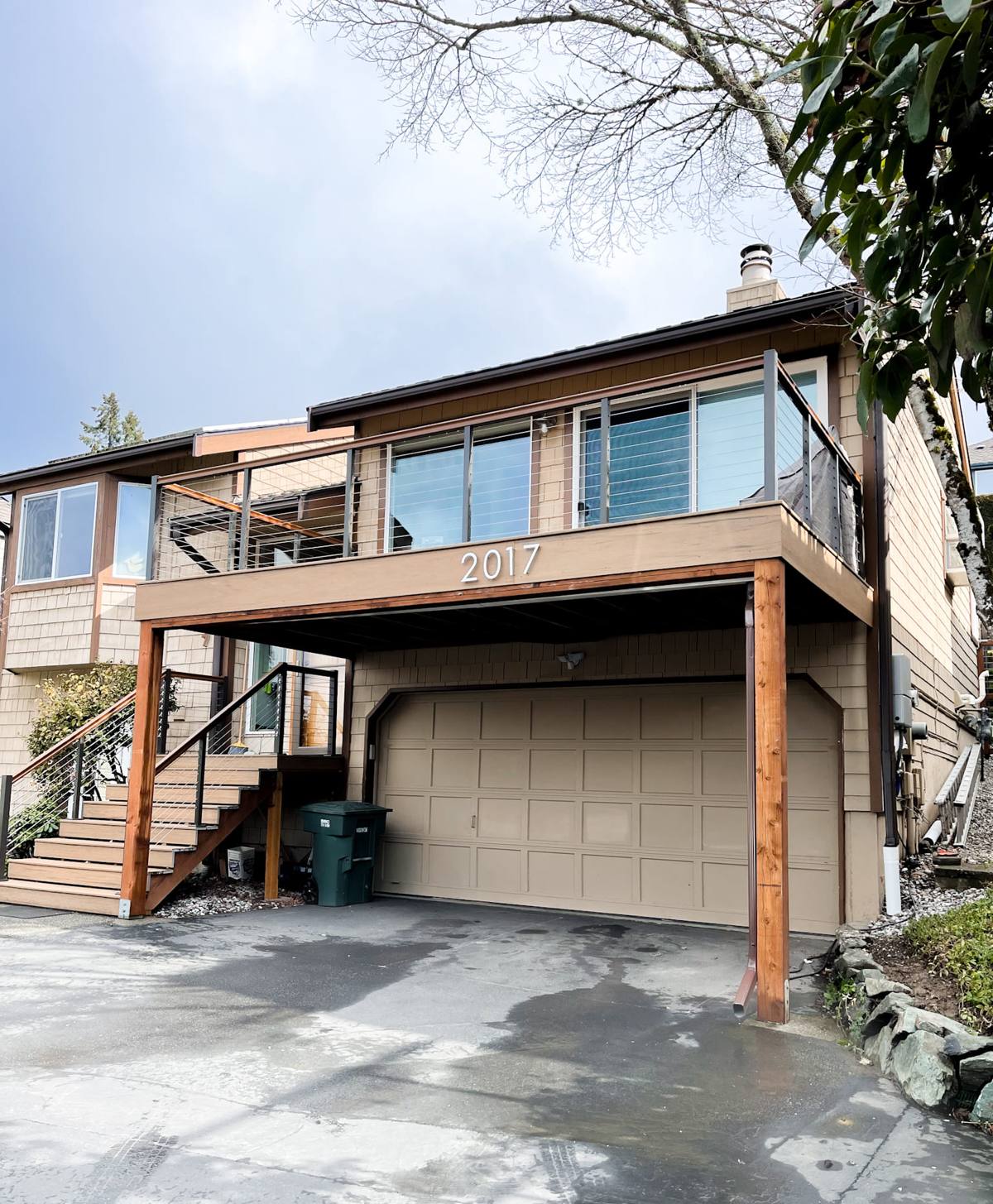
What the Climate Actually Does to a Deck
Moisture That Never Fully Leaves
Driving rain doesn't just fall on a deck — wind pushes it sideways, into joints, under railings, and against the house where the ledger board attaches. Combined with the region's humidity, wood surfaces rarely get a long enough dry stretch to fully release moisture between storms. That's the environment where rot gets a foothold, especially in framing lumber that isn't properly flashed or ventilated underneath.
Moss and Algae, Not Just Cosmetic
A long moss season does more than make a deck look neglected. Moss holds water against the decking surface, which accelerates decay in wood and can degrade the wear layer on lower-grade composite boards over time. On stairs and low-traffic corners — the spots that don't get walked on or swept — moss buildup also becomes a slip hazard, which matters more on a deck than almost anywhere else on a house.
Salt Air and Hardware
Being near the water means airborne salt reaches fasteners, brackets, and any exposed metal hardware. Standard coated screws and joist hangers can start corroding well before the wood around them shows any wear, which is exactly the kind of hidden failure point that turns into a structural problem down the road.
Signs a Deck Needs Replacement, Not Just Repair
Homeowners in Nooksack and around Ferndale ask us this constantly: is this a repair or a rebuild? A few boards can usually be fixed. The framing and ledger connection are a different story. Here's what tells us a full replacement is the honest recommendation:
- Joists or beams that feel spongy, flex noticeably, or show a screwdriver sinking in easily when probed
- A ledger board attachment to the house that's improperly flashed or shows staining/rot at the rim joist behind it
- Rust streaking from fasteners or joist hangers, or hardware that's visibly corroded
- Railings or posts that wobble under normal pressure — a safety issue, not a cosmetic one
- Widespread moss and algae staining that keeps returning within weeks of cleaning
- Multiple deck boards cupping, splitting, or delaminating (common on older or lower-grade composite)
- The deck predates current code for guardrail height, baluster spacing, or footing depth
If it's just one or two of these on an otherwise sound structure, repair is usually the right call and we'll say so. When several show up together, it almost always means the structure has been compromised long enough that patching individual symptoms won't fix the underlying problem.
What a Correct Deck Replacement Involves
Structural Framing and Footings
The framing is where most of the long-term performance of a deck actually gets decided, even though it's the part nobody sees once the decking goes down. That means footings sized and set to current frost and load requirements, joists spaced correctly for the decking material being used, and a ledger board — if the deck attaches to the house — properly flashed so water sheds away from the rim joist instead of running behind it. This is the single most common failure point we find on older decks in this area, and it's worth getting right the first time rather than covering it up again.
Fasteners and Hardware
Given the salt air and moisture exposure here, we don't cut corners on hardware. That means corrosion-resistant structural screws, joist hangers, and post bases rated for exterior and coastal-adjacent use — not the cheapest bin of deck screws at the hardware store. It costs a little more up front and it's the difference between hardware that's still solid in fifteen years and hardware that's rusting through in five.
Decking Material
Material choice matters more here than in a dry inland climate, because whatever you put down has to deal with sustained moisture and moss exposure for months at a stretch every year.
| Material | Upfront Cost | Moss/Moisture Behavior | Maintenance | Typical Lifespan |
|---|---|---|---|---|
| Pressure-treated lumber | Lowest | Absorbs moisture; needs sealing to resist moss staining | Annual cleaning, periodic re-staining/sealing | 10–15 years |
| Cedar | Moderate | Naturally rot-resistant but still needs sealing in this climate | Regular cleaning and refinishing | 15–20 years with upkeep |
| Capped composite | Higher | Sheds moisture well; wear layer resists moss staining | Occasional washing, no sealing/staining | 25–30 years |
| PVC decking | Highest | No wood fiber to absorb moisture; best moss/mildew resistance | Lowest — soap and water | 25–30+ years |
We install all of these when that's what a homeowner wants, but we're upfront about trade-offs. Uncapped or budget composite boards from years past had real problems with moisture wicking into cut ends and staining that wouldn't clean off — later generations of capped composite and PVC largely solved that, but it's why we're careful about which products we put our name behind and how cut ends and fastener penetrations get sealed during install.
Our Process, Start to Finish
1. On-Site Evaluation
We look at the existing structure in person — framing condition, ledger attachment, footing depth if accessible, and how the deck drains water and sheds moss buildup currently. This tells us honestly whether you need a repair or a full replacement, and we'll say so either way.
2. Design and Material Selection
We walk through decking material, railing style, and layout options based on your budget and how you actually use the space, then put together a clear, itemized estimate — no vague allowances.
3. Permitting
Most deck replacements involving structural changes require a permit locally. We handle that step as part of the job rather than leaving it on the homeowner's plate.
4. Demolition and Structural Rebuild
Old decking, railings, and any compromised framing come out. Footings, ledger flashing, and framing get rebuilt to current code before a single new board goes down.
5. Decking, Railings, and Finish Work
Decking, railing systems, stairs, and any lighting or fascia get installed with fastener and flashing details suited to this climate — not a generic install method that ignores the moisture load our weather puts on it.
6. Final Walkthrough
We walk the finished deck with you, cover basic care specific to the material installed, and make sure everything's solid before we call it done.
Why a Crew That Already Works This Area Matters
A deck replacement in Nooksack isn't the same job as one done thirty miles inland, even though the materials list might look identical on paper. A crew that already works this part of Whatcom County knows to over-build flashing details around ledger boards because they've seen what happens when that step gets shortcut in a wet climate. They know which hardware actually holds up to salt air exposure over years, not just on paper. And they're not learning that on your project — they've already learned it on the last one down the road.
There's also a practical side to hiring local: scheduling around our own weather windows, understanding how site drainage typically behaves on properties in this area, and being reachable afterward if a question comes up — not a crew that did one job in the area and then moved on.
Maintenance After Replacement
Even a well-built deck needs some seasonal attention here, and what it needs depends on the material:
- Sweep debris and standing moss off the surface regularly through fall and winter — don't let it sit for months
- Check and clear gaps between boards so water and debris keep draining rather than pooling
- For wood decking, plan on re-sealing or staining on a regular cycle — skipping a cycle in this climate shows up fast
- For composite or PVC, an occasional wash with mild soap and water handles most moss and mildew buildup
- Inspect railings and stair connections once a year for looseness, especially after a hard winter
None of this is complicated, but skipping it is exactly how a well-built deck ends up needing early repairs — the climate here doesn't forgive neglect the way a drier region might.
Get a Straight Answer on Your Deck
If you're not sure whether your deck needs a repair or a full replacement, we'll tell you honestly after taking a look — no pressure either way. Use the form below to request a free estimate for your Nooksack-area property, and we'll walk you through what we find and what it would take to fix it right.