 Ferndale Siding
 Roofing in Custer: A Different Climate Than Most Roofers Admit
Custer sits in the stretch of Whatcom County between Ferndale and the Canadian border, close enough to the water that salt-laden air is part of daily life and far enough into farm and timber country that shade, moisture, and organic debris are constant companions on a roof. Homes here take a different kind of beating than roofs 50 miles inland. It's not one big storm that wrecks a roof in this part of Washington — it's years of steady, low-grade exposure: marine air working on fasteners and flashing, months of driving rain finding every weak seam, and a moss season that runs longer here than almost anywhere else in the state.
A roof replacement done right in Custer has to account for all three of those things at once. A crew that mainly works drier, inland climates can install a technically correct roof that still underperforms here, because the details that matter — ventilation, underlayment choice, flashing at valleys and penetrations, and how the roof sheds moss and needle debris — are exactly the details that a coastal Whatcom County climate punishes first.
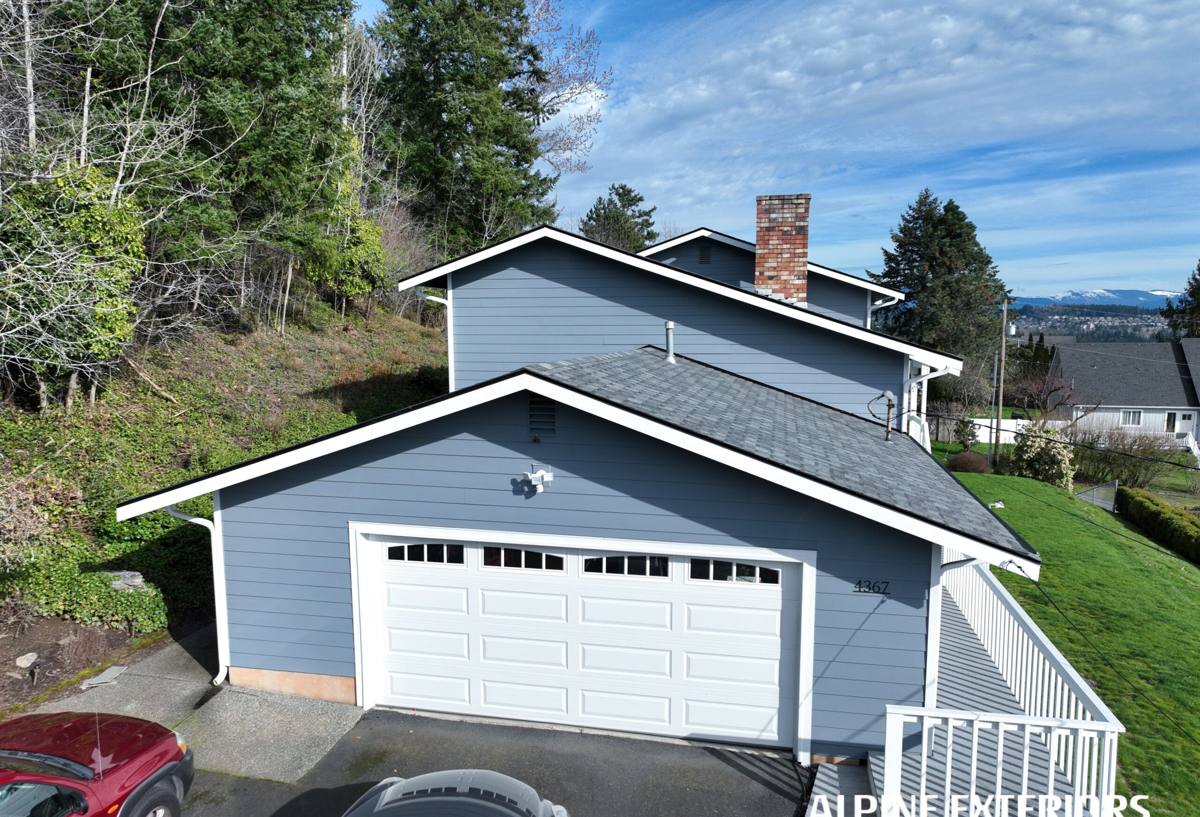
Why Roofs Around Custer Wear Out Faster Than the Warranty Assumes
Salt Air and Metal Fatigue
Roofing warranties are written assuming a generic climate. Custer's proximity to the water means airborne salt settles on roofing metal — flashing, nail heads, gutter systems, and any exposed fasteners — and accelerates corrosion compared to the same materials installed further inland. Left unaddressed, this shows up first as rust streaking below flashing points and eventually as failed seals around penetrations, long before the shingles themselves are worn out.
Driving Rain and Wind-Driven Water
Western Washington's rain doesn't just fall straight down. Storms off the Strait of Georgia and the broader Puget Sound region regularly push rain sideways, which means water gets tested against every lap, seam, and fastener on a roof, not just the open field of shingles. A roof that would perform fine in a calmer climate can leak here if the underlayment, flashing laps, and starter courses weren't installed with wind-driven rain specifically in mind.
The Long Moss Season
Whatcom County's combination of shade from mature conifers, cool temperatures, and near-constant moisture gives moss an unusually long growing window — often nine months of the year or more on north-facing and shaded slopes. Moss isn't just cosmetic. It holds moisture directly against the roofing surface, works its way under shingle tabs as it grows, and lifts material over time, which shortens the usable life of a roof faster than sun exposure ever would in this climate.
Signs a Custer Home Needs Replacement, Not Another Repair
Not every roof problem calls for a full tear-off, and a straight contractor should tell you that. But there's a point where patching individual leaks becomes more expensive and less reliable than replacing the roof outright. Signs it's time to stop repairing include:
- Granule loss heavy enough that you can see bare asphalt mat on multiple slopes, not just one spot
- Shingles that are cupping, curling, or cracking across large sections rather than isolated tabs
- Moss growth that returns within a season or two of cleaning, especially on north-facing slopes
- Soft or spongy decking felt underfoot during any roof access, which signals moisture has reached the sheathing
- Daylight visible through the attic at roof boards, or consistent staining on interior ceilings
- A roof already past 20-25 years for asphalt products, especially one that's never had proper ventilation upgrades
- Flashing around chimneys, skylights, or valleys that's been re-caulked repeatedly instead of properly re-flashed
If you're only seeing one or two of these, a repair may genuinely be the right call. If you're seeing several at once, a replacement is usually the more honest recommendation, and a contractor who tells you that upfront is doing you a favor over one who strings out repairs on a roof that's already failing structurally.
What a Correct Roof Replacement Involves in This Climate
A roof replacement is more than swapping old shingles for new ones. In a climate like Custer's, the components underneath the visible surface are what determine whether the roof performs for its full expected lifespan or starts failing early. A properly done replacement includes:
Full Tear-Off, Not Overlay
Installing new shingles over an existing layer traps moisture, hides the condition of the decking, and voids most manufacturer warranties. In a wet climate, decking condition matters too much to leave hidden. A full tear-off lets us inspect and repair the sheathing, which is where hidden rot from years of moss and slow leaks usually shows up first.
Ice and Water Shield at Vulnerable Points
Valleys, eaves, and penetrations get a self-adhering waterproof membrane underneath the primary underlayment. This is the layer that keeps wind-driven rain and ice-dam backup from reaching the decking at the spots most likely to fail.
Synthetic Underlayment Across the Field
Synthetic underlayment holds up better than traditional felt in a climate with this much sustained moisture exposure — it resists tearing, doesn't wrinkle the way felt can when it absorbs water during a multi-day install, and gives the roof a second line of defense if wind or debris ever compromises the shingle layer above it.
Proper Flashing at Every Transition
Chimneys, skylights, sidewalls, and valleys are where the large majority of roof leaks actually originate — not in the open field of shingles. Correct step flashing, counter-flashing, and valley metal, installed rather than caulked over old flashing, is non-negotiable in a driving-rain climate.
Balanced Ventilation
Intake at the eaves and exhaust at the ridge need to work together to keep the attic space at outdoor temperature and humidity. Without it, moisture from inside the home condenses against the underside of the decking, which rots sheathing from below regardless of how well the roof surface is installed above it.
Roofing Materials That Actually Hold Up Near the Water
Every roofing material has trade-offs, and the right choice depends on the home, the budget, and how much long-term maintenance an owner wants to take on. Here's how the common options compare for a coastal Whatcom County property like those around Custer:
| Material | Moss & Moisture Behavior | Maintenance | Typical Lifespan Here |
|---|---|---|---|
| Architectural asphalt shingle | Good with proper ventilation and periodic moss treatment; algae-resistant granules help | Low to moderate; benefits from a moss check every 1-2 years | 20-30 years |
| Standing seam metal | Sheds moisture fast, moss struggles to establish on smooth panels | Very low once installed correctly | 40-60 years |
| Cedar shake | Naturally moisture-tolerant but demands more upkeep in a climate this wet | High; needs regular treatment and moss management | 20-30 years with diligent upkeep |
| Synthetic composite shingle | Resists moisture absorption well; performance varies by manufacturer | Low | 30-50 years depending on product |
We install a mix of architectural asphalt and standing seam metal on most Custer-area jobs, because both give homeowners a strong balance of upfront cost and realistic long-term performance in this climate. Cedar can look excellent, but we're honest with homeowners that it asks for more attention here than in a drier region, given how long moss season runs. That's a maintenance conversation, not a knock on the material itself.
Our Roof Replacement Process, Start to Finish
- On-site inspection. We walk the roof, check the attic for ventilation and moisture issues, and look at decking condition from below where accessible, before ever quoting a number.
- Written estimate. You get a clear scope: tear-off, decking repair allowance, underlayment type, flashing plan, ventilation changes, and material choice, spelled out rather than bundled into a vague total.
- Material order and scheduling. We time the job around the weather window as best we can — in this climate, that means watching multi-day forecasts closely rather than just the day of install.
- Tear-off and decking inspection. Old roofing comes off down to the deck, any soft or rotted sheathing gets identified and replaced, and you're told about it before it's covered back up, not after.
- Underlayment, flashing, and ventilation installed. This is the stage that determines how the roof performs in year 10 and year 20, not just how it looks the day we finish.
- Final roofing material installed to manufacturer spec, with attention to nailing pattern and exposure, both of which affect wind resistance in a climate that sees its share of winter storms.
- Site cleanup and magnetic sweep for stray fasteners, and a final walkthrough where we point out what was done and why.
Ventilation and Moss Prevention: The Step Most Re-Roofs Skip
A lot of roof replacements in this region focus entirely on the surface material and treat ventilation as an afterthought, if it's addressed at all. That's a mistake in a climate where moisture pressure comes from both directions — driving rain from outside and humid indoor air pushing up into the attic from inside. Balanced ventilation, done correctly at both intake and exhaust, is one of the cheapest parts of a roof replacement relative to how much it protects the investment.
On the moss side, no roofing material is entirely moss-proof under Whatcom County's shade and moisture conditions, but design choices make a real difference. Slope, overhanging tree cover, and material texture all affect how fast moss re-establishes after a roof is cleaned or replaced. We'll talk through realistic expectations for your specific property — including whether trimming overhanging branches would meaningfully extend the interval between moss treatments, since that's often a bigger factor than the roofing material itself.
What Actually Drives the Cost of a Custer Roof Replacement
We don't publish flat prices because roof replacement cost genuinely varies by property, and quoting a number without seeing the roof does homeowners a disservice. What we can do is walk through the factors that move the price up or down, so an estimate makes sense once you have it in hand:
| Factor | Why It Matters |
|---|---|
| Roof size and number of stories | More square footage and steeper access both add labor time and material |
| Roof pitch | Steep slopes require more safety equipment and slow down installation |
| Number of layers to remove | Tearing off two layers of old roofing costs more than one |
| Decking condition | Rotted sheathing found during tear-off requires replacement before new roofing goes on |
| Material choice | Standing seam metal and cedar shake cost more upfront than architectural asphalt |
| Roof complexity | Valleys, dormers, skylights, and chimneys all add flashing work |
| Ventilation upgrades needed | Adding proper intake and exhaust venting where none existed adds scope |
Two roofs of the same square footage on paper can land at very different prices once pitch, decking condition, and complexity are factored in. That's why we walk the roof before quoting, rather than pricing off a satellite photo or a phone call.
Why It Matters That We Already Work in Custer
Roofing crews that primarily work other parts of the state, or even other parts of Whatcom County further from the water, don't always account for how differently a coastal-adjacent property behaves. A crew that already works Custer and the surrounding Ferndale area knows which slopes tend to hold moss the longest, understands how local permitting works for this jurisdiction, and has a track record of scheduling around the realistic rain windows this area gets rather than the drier patterns assumed by generic install guides. That local pattern recognition doesn't replace good workmanship, but it does mean fewer surprises during the job and a roof that's specified correctly for where it actually sits, not for an average climate that doesn't match Custer's.
Before you commit to a roof replacement, it's worth having a straightforward, no-pressure conversation about what your specific roof needs. We're glad to walk the roof, answer questions honestly — including if a repair still makes more sense than a full replacement — and put together a written estimate with no obligation attached. Use the form below to request a free estimate for your Custer or Ferndale property.