 Ferndale Siding
 Why Blaine Decks Wear Out Faster Than the Rest of Whatcom County
Blaine sits about as close to saltwater and the Canadian border as a Whatcom County home can get, and that location comes with a specific set of problems for anything built outdoors. Salt-laden air off the Strait of Georgia corrodes fasteners and hardware faster than it does even a few miles inland. Driving rain off the water finds every gap in flashing and decking that a calmer climate would never expose. And the long, damp shoulder seasons here mean moss and algae have months to establish themselves on any deck surface that doesn't drain and dry quickly. A deck built to a generic national spec, without those three factors in mind, will show its age in Blaine years before it would in a drier part of the state.
We work on homes throughout Ferndale and up into Blaine regularly, and the pattern is consistent: decks fail first at the connections, not the decking boards themselves. Corroded ledger bolts, rusted joist hangers, and fasteners that were never rated for coastal exposure are usually the real story behind a deck that "just got old." A proper replacement addresses that root cause, not just the visible surface.
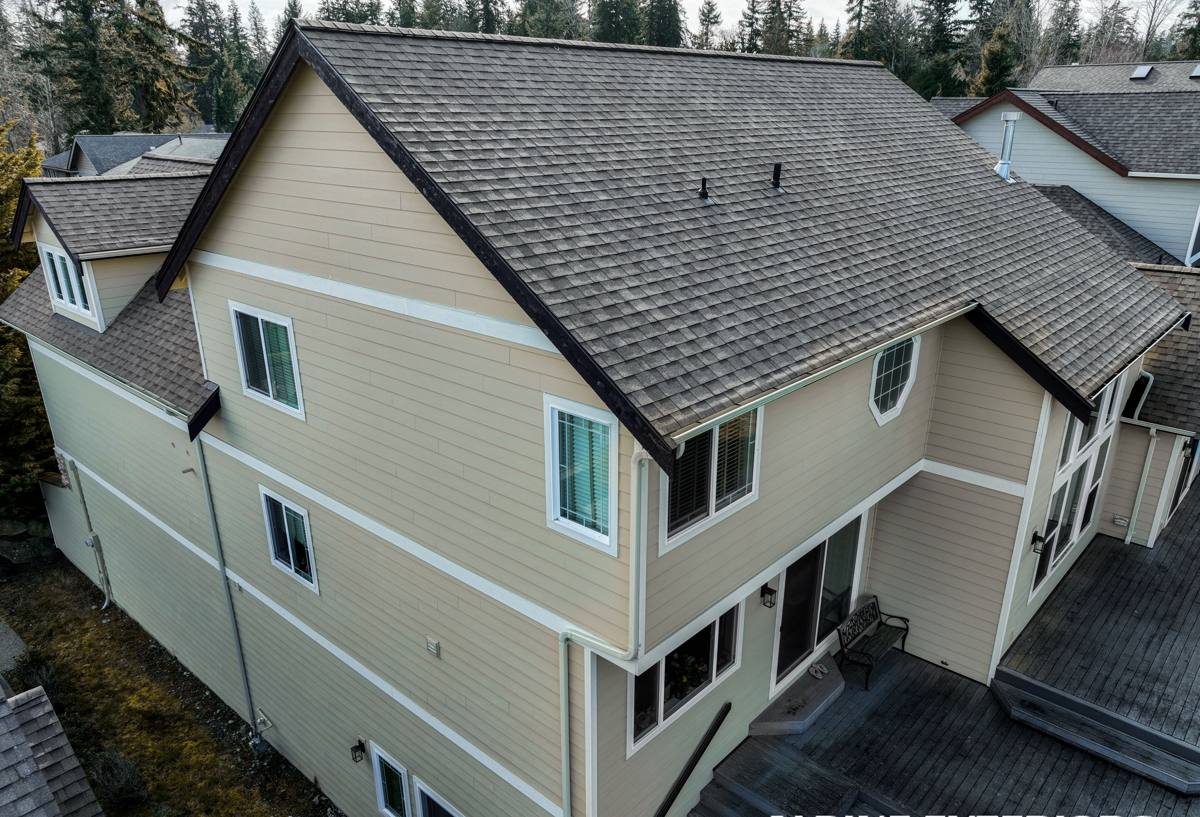
Signs a Blaine Deck Needs Replacement, Not Another Repair
Homeowners often ask us to patch a board or two, and sometimes that's genuinely all that's needed. But there's a point where repair stops making sense and replacement becomes the honest recommendation. Here's what we look for during an inspection:
- Soft or spongy spots in decking boards, especially near the house or at board ends
- Rust staining running down from screws, bolts, or joist hangers
- Visible gap or movement where the deck ledger meets the house
- Persistent moss or black-green staining that returns within weeks of cleaning
- Wobble or give in the railing posts when pushed by hand
- Structural framing (joists, beams, posts) that's soft, cracked, or has visible rot rather than just surface weathering
One or two of these on their own might point to a repair. Several at once, or any sign of framing failure, usually means the deck's structure has been compromised and a full replacement is the safer and, over time, cheaper path.
Why "Just Refinishing It" Doesn't Fix the Underlying Problem
Sanding and re-staining a deck can buy a season or two of better looks, but it doesn't touch what's happening underneath the boards. If the ledger flashing was installed wrong, or the joist hangers were never upgraded to a coastal-rated coating, refinishing the surface leaves the actual failure point untouched. We'll tell you plainly if a deck is a good refinishing candidate versus one where the structure underneath has already given up.
What a Correct Deck Replacement Involves
A deck replacement is more than pulling old boards and nailing down new ones. Done right, it touches every layer of the structure:
- Ledger board and flashing — the connection where the deck meets the house is the single most common failure point on rain-exposed homes. This needs proper flashing that sheds water away from the house framing, not just caulk.
- Footings and posts — checked for frost depth and soil contact, since a deck is only as stable as what's holding it off the ground.
- Framing and joists — sized and spaced for the actual decking material and expected load, with hardware rated for coastal, high-moisture exposure.
- Decking surface — material chosen for how it handles standing water, moss growth, and UV/salt exposure over the long run.
- Railings and stairs — code-compliant height, baluster spacing, and graspable handrail where required.
- Drainage and airflow underneath — space and grading so the area under the deck can dry out between rains instead of staying damp all winter.
Skipping any one of these is how a deck ends up needing full replacement again in ten years instead of twenty-five or thirty.
Choosing the Right Decking Material for a Coastal Climate
There's no single "best" decking material for every home — it depends on budget, maintenance appetite, and how close the deck sits to salt spray. Here's how the common options actually perform in a Blaine-type climate:
| Material | Moisture & Salt Behavior | Moss Resistance | Maintenance |
|---|---|---|---|
| Pressure-treated wood | Handles moisture if sealed regularly; fasteners must be coastal-rated to avoid corrosion | Needs regular cleaning to stay ahead of moss | Annual cleaning and re-sealing recommended |
| Cedar | Naturally rot-resistant but still needs sealing near salt air | Better natural resistance, still needs cleaning | Periodic sealing to hold color and resist checking |
| Composite decking | Doesn't rot or absorb water like wood; performs well in salt air | Surface texture matters — some composites hold moss more than others | Low — occasional washing |
| PVC/capped polymer | Fully sealed surface, excellent in wet, salty conditions | Sheds moisture fastest, generally the most moss-resistant | Lowest — soap and water as needed |
We install all of these and won't push you toward the most expensive option if it's not the right fit for your home or budget. What we will do is walk you through the honest trade-offs — wood costs less up front but demands ongoing upkeep to hold up here; composite and PVC cost more initially but shift that cost from yearly maintenance into the upfront price.
Fasteners and Hardware Matter as Much as the Decking
This is the part homeowners rarely think to ask about, and it's where a lot of "budget" deck jobs quietly cut corners. In a salt-air environment, standard galvanized fasteners can corrode within a handful of years. We use fasteners and structural hardware rated for coastal exposure — the added cost is small relative to the whole project, but it's the difference between a deck that holds together for decades and one where hidden rust starts undermining the frame while the surface still looks fine.
Our Deck Replacement Process
We keep the process straightforward and give you real information at each step rather than surprises:
- On-site inspection — we assess the existing deck's framing, footings, and ledger connection, not just the surface boards.
- Honest scope discussion — we tell you what actually needs replacing versus what can be reused, and walk through material options for your budget.
- Permitting — most deck replacements in Whatcom County require a permit, especially when framing, footings, or structural elements change. We handle that coordination.
- Demolition — old decking, and any compromised framing or footings, removed and disposed of properly.
- Structural rebuild — footings, posts, ledger flashing, and framing brought up to current code with coastal-rated hardware.
- Decking, railing, and stairs installed — to the material and layout you chose.
- Final walkthrough — we go over the finished deck with you and explain what maintenance, if any, it needs going forward.
Permits and Local Building Considerations
Deck work in Blaine falls under Whatcom County building requirements, and depending on the deck's height, size, and whether it's attached to the house, that typically means a permit and inspection are required before and after the work. This isn't a step worth skipping — an unpermitted deck can complicate a future home sale and, more importantly, skipping inspection removes the one outside check that the structural work was actually done correctly. We factor permitting into our timeline and handle the paperwork so it's one less thing on your plate.
Keeping a New Blaine Deck Looking Right Through the Wet Season
Even the best-built deck benefits from a little seasonal attention in this climate. Here's what we recommend to homeowners after installation:
- Sweep debris off the deck regularly in fall so wet leaves don't sit and trap moisture against the surface
- Rinse off salt residue and grime a few times a year, especially after storms with wind off the water
- Check that gaps between boards stay clear so water can drain through instead of pooling
- Trim back nearby vegetation so sunlight and airflow can reach the deck surface and discourage moss
- For wood decks, plan on re-sealing on the schedule your material calls for — don't wait until it visibly needs it
- Have railings and stair connections checked periodically, since these take the most day-to-day stress
None of this is complicated, but skipping it is exactly how a well-built deck starts showing problems ahead of schedule.
Why a Crew That Already Works Blaine Makes a Difference
Deck construction principles are the same everywhere, but the details that keep a deck performing long-term change with the climate. A crew that installs decks mainly in drier inland regions may not think twice about fastener grade, flashing detail at the ledger, or how much airflow a deck needs underneath to dry out between rains — because in their normal work, it doesn't matter as much. Here, it's the difference between a deck that's still solid in twenty years and one that needs structural attention in eight.
We're a Ferndale-based crew that already does this work throughout Whatcom County, including Blaine, so we're not guessing at what the local conditions demand — it's built into how we spec and build every deck from the start. That local familiarity also means we know what Whatcom County permitting and inspection actually involves, rather than learning it project by project.
Get a Straight Answer on Your Blaine Deck
If your deck is showing rust stains, soft spots, persistent moss, or just feels less solid than it used to, it's worth having someone look at the framing underneath before deciding between repair and replacement. We offer free, no-pressure estimates for Blaine homeowners — come take a look, get an honest assessment, and use the form below to get started.