 Ferndale Siding
 Why Birch Bay's Climate Is Rougher on Siding Than People Expect
Birch Bay sits right on the water, and that changes what a house needs from its exterior. Homes a mile inland in Ferndale deal with plenty of rain, but Birch Bay properties also take on salt-laden air coming off the bay, near-constant wind-driven moisture, and a moss and algae season that runs longer than most homeowners realize. None of that is dramatic on its own. What it does is compound — salt air accelerates corrosion on fasteners and trim, driving rain finds every gap in a poorly flashed wall, and shade plus dampness lets moss and mildew colonize a north- or west-facing wall for most of the year. Siding that isn't specifically suited to that combination doesn't fail overnight. It fails slowly, in ways that are hard to see until the damage is already behind the wall.
This is the reason we treat Birch Bay as its own job, not a copy-paste of a siding install anywhere else in Whatcom County. The product, the flashing details, and the fastening all get chosen with the bay's conditions in mind.
What James Hardie Actually Brings to a Home Like This
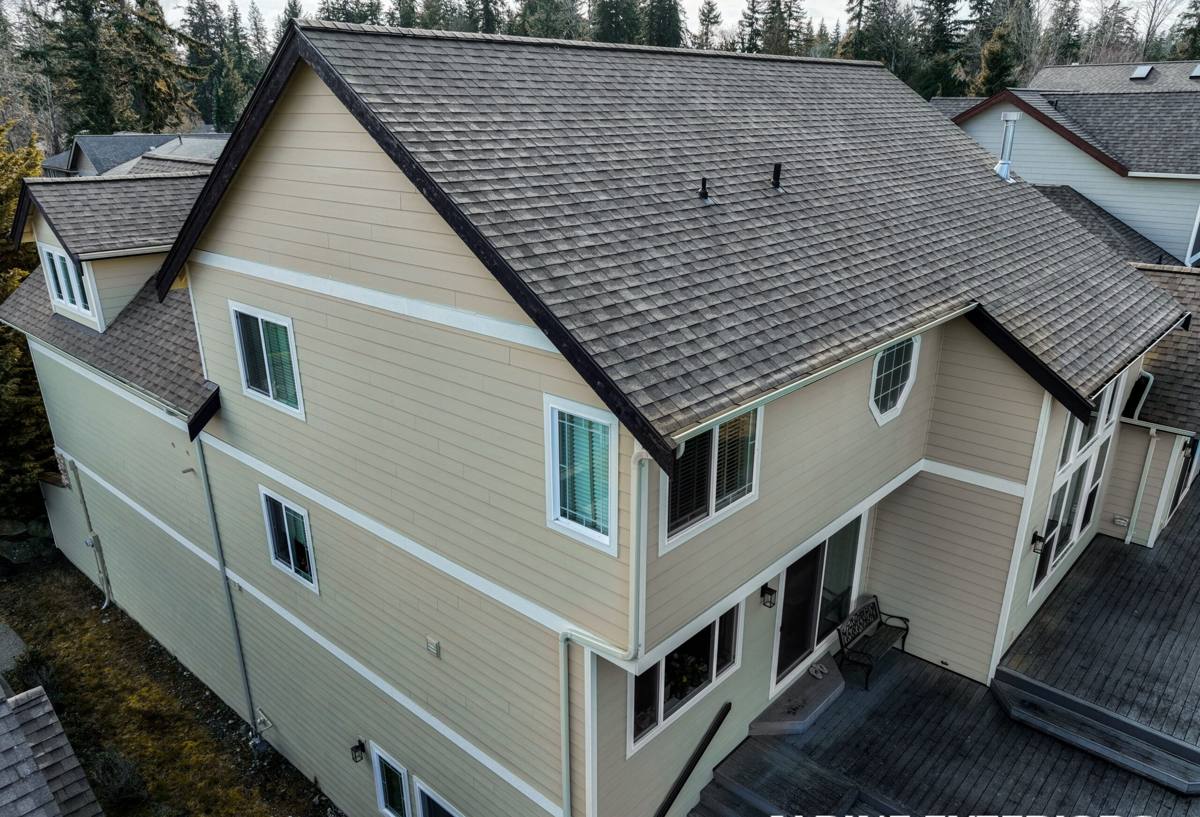
We install James Hardie fiber cement exclusively, and in a coastal, high-moisture area like Birch Bay the reasons are practical, not brand loyalty. Fiber cement is dimensionally stable — it doesn't swell, cup, or delaminate the way wood-based or engineered-wood products can when they take on repeated moisture cycles. It's also non-combustible, which matters given how dry Whatcom County summers have trended in recent years even though winters stay wet. And it doesn't rust, which is a real advantage over some metal trim and fastener systems in a salt-air environment.
HZ5 Engineering
James Hardie's siding is manufactured in climate-specific formulations, and the Pacific Northwest falls under Hardie's HZ5 (Hardiezone 5) engineering — the version built for a wet, freeze-thaw-capable climate rather than the hotter, drier formulations sold in the Southwest or Southeast. That distinction matters more than most homeowners are told. HZ5 siding is formulated and tested for exactly the moisture exposure Birch Bay gets.
ColorPlus Factory Finish
Most of what we install carries Hardie's ColorPlus finish — a baked-on, multi-coat finish applied at the factory rather than in the field. It resists fading and holds up to UV and salt air far better than a job-site paint job, and it comes with its own finish warranty separate from the substrate warranty. In a location where a fresh coat of field-applied paint can start looking tired within a few years, that factory finish is worth the difference in appearance alone.
The Installation Details That Actually Determine Whether Siding Holds Up Here
Fiber cement siding is only as good as the installation behind it. In a place like Birch Bay, the details that get skipped on a rushed job are exactly the ones that matter most.
Flashing and Water Management
Every window, door, and horizontal trim transition needs proper flashing and a drainage plane behind the siding — not caulk alone. Caulk is a backup, not a water management system. We install house wrap or a rainscreen drainage layer, flash penetrations correctly, and make sure water that does get behind the cladding has somewhere to go rather than sitting against the sheathing.
Clearance From Grade and Hard Surfaces
Hardie's own installation instructions call for a minimum clearance from grade, roof lines, and paved surfaces, and that clearance matters even more on bay-adjacent lots where soil can stay damp longer and splash-back carries salt residue. We check this on every job rather than assuming the old siding line was correct — a lot of older installs in this area were not.
Fastener Choice
Fasteners get corroded by salt air faster than almost anything else on a house. We use fasteners rated for the exposure and follow Hardie's fastening pattern and embedment specs exactly — over-driven or under-driven nails are one of the most common causes of premature siding failure, and it's an easy thing for a crew in a hurry to get wrong.
Caulking and Joint Treatment
Joints, butt seams, and trim transitions get the manufacturer-specified sealant, not whatever's left in the truck. In a driving-rain environment, a joint that's caulked wrong is a slow leak waiting to happen.
Moss, Algae, and the Long Wet Season
Whatcom County's wet season runs long, and Birch Bay's tree cover and marine air keep humidity elevated even between storms. That's ideal growing conditions for moss and algae on north- and west-facing walls, especially anywhere shaded by trees or a neighboring structure. Correctly installed Hardie siding doesn't stop organic growth from ever landing on a wall — nothing fully does — but it does two things a lot of alternatives don't: it doesn't absorb and hold moisture the way wood-based siding can, so growth stays on the surface where it can be washed off, and the factory finish resists staining better than field-applied paint. We also make sure gutters, downspouts, and any roof-to-wall transitions near shaded sections are detailed correctly during install, since poor water management is usually what turns a mild moss problem into a persistent one.
Our Process for a Birch Bay Job
- Walkthrough and assessment — we look at existing siding condition, water damage risk points, trim, and any areas with heavy shade or wind exposure specific to the property.
- Product and color selection — HZ5 Hardie panel, lap, or shingle-style siding in the ColorPlus color and profile that fits the home.
- Tear-off and sheathing check — we don't just cover over old siding; we check the sheathing underneath for rot or moisture damage before closing the wall back up.
- Water management layer — house wrap or rainscreen, flashing at every penetration and horizontal transition.
- Installation to Hardie spec — correct clearances, fastening pattern, and joint treatment throughout.
- Final walkthrough — trim, caulking, and touch-up review with the homeowner before we call the job done.
Cost Factors on a Birch Bay Project
Every home is different, but the same handful of factors move the price on most Birch Bay siding jobs:
| Factor | Why It Matters Here |
|---|---|
| Home size and wall complexity | More corners, gables, and trim transitions mean more flashing detail and labor time |
| Existing siding condition | Rot or moisture damage found under old siding needs repair before new siding goes on |
| Siding profile (lap, shingle, panel) | Shingle-style and specialty profiles run more than standard lap siding |
| Color and finish | ColorPlus factory colors vs. field-applied paint affects both cost and long-term maintenance |
| Access and site conditions | Waterfront lots, slopes, and limited staging area can add setup time |
| Trim and accessory work | Fascia, soffit, and window trim replacement alongside siding adds scope but reduces future problem points |
Why a Crew That Already Works Birch Bay Matters
Siding installation isn't identical everywhere, and a crew that mainly works drier inland areas can make assumptions that don't hold up on the water. We work in Ferndale and the surrounding Whatcom County coastline regularly, which means we're used to scheduling around the wetter stretches of the year, know to check for salt-air corrosion on existing fasteners and flashing before we ever quote a job, and don't need to relearn local permitting and inspection expectations on every project. That familiarity shows up in fewer surprises mid-job and a finished install that's actually built for the conditions the house will sit in for the next several decades.
Signs Your Current Siding May Not Be Holding Up
- Persistent moss or algae staining that returns quickly after cleaning
- Soft spots, bubbling, or visible warping, especially on north- or water-facing walls
- Paint that's peeling or chalking faster than it should between repaints
- Visible rust streaking from fasteners or metal trim
- Gaps opening up at seams, corners, or around window and door trim
- Higher heating bills that suggest air or moisture infiltration behind the siding
Questions Worth Asking Any Siding Contractor
Before hiring anyone for a Birch Bay siding job, it's worth asking directly what product line they're quoting (HZ5 or a generic formulation), whether they're following manufacturer fastening and clearance specs or just their own habits, what water management layer goes behind the siding, and what warranty coverage — both material and labor — actually applies to your job. A contractor who can't answer those clearly is worth a second look before you sign anything.
If you're weighing a siding replacement on a Birch Bay property, we're happy to walk the exterior with you, point out what we're seeing, and put together a straightforward, no-pressure estimate — just fill out the form below to get started.